
Cigarettes to get expensive from Feb 1! How much more will you have to pay? Check list

[ad_1]

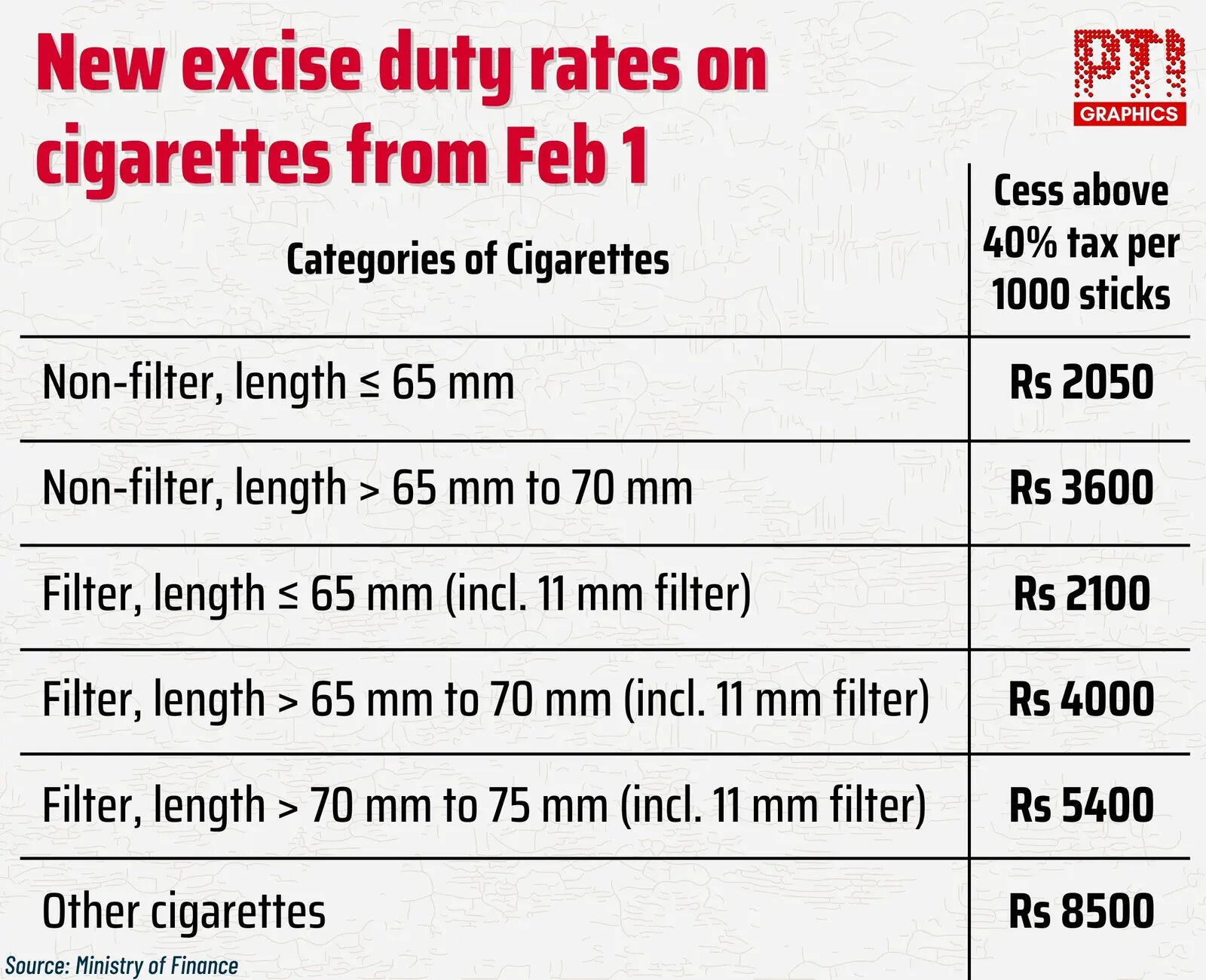
Cigarettes are set to cost more from next month! The jump in cigarette prices comes after government’s decision to impose an additional excise duty under a revised tax structure, pushing up the tax burden across all categories. The finance ministry notified amendments to the Central Excise Act, introducing an additional excise duty ranging from Rs 2,050 to Rs 8,500 per 1,000 sticks, depending on cigarette length. This increase will come on top of the 40% GST that will be levied on tobacco products from February 1, making each cigarette noticeably costlier at the counter. In per-stick terms, the increase translates into a clear jump in retail prices, particularly for medium and long cigarettes. The additional excise duty across categories is outlined below:
How much cigarette prices will go up from February 1?
| Cigarette category | Length | Additional excise duty |
|---|---|---|
| Short non-filter cigarettes | Up to 65 mm | ~Rs 2.05 per stick |
| Short filter cigarettes | Up to 65 mm | ~Rs 2.10 per stick |
| Medium-length cigarettes | 65–70 mm | ~Rs 3.6–4 per stick |
| Long / premium cigarettes | 70–75 mm | ~Rs 5.4 per stick |
| “Other” non-standard designs | Varies | Rs 8.5 per stick |
This higher slab for “other” category applies only to unusual or non-standard cigarette designs. Most popular cigarette brands do not fall under this category.
What about other products?
From February 1, all tobacco products, including cigarettes and pan masala, will attract 40% GST, while biris will be taxed at 18%. Chewing tobacco and jarda scented tobacco will face an excise duty of 82%, and gutkha will attract an excise duty of 91%. The total tax incidence on pan masala, after factoring in GST, will remain unchanged at 88%. The revised tax structure replaces the existing regime of 28% GST along with a compensation cess on tobacco and related products. The levy of excise duty on cigarettes and a cess on pan masala was approved by Parliament last month, following a GST Council decision in September on taxing these products over and above GST after the compensation cess framework ends.
What has changed?
Currently, tobacco products attract 28% GST along with a varied compensation cess. From February 1, this will shift to 40% GST, along with excise duty and compensation cess. The GST Council had earlier decided that the compensation cess would cease after the repayment of loans taken to compensate states for GST revenue losses during the Covid-19 pandemic. The Rs 2.69 lakh crore loan is scheduled to be fully repaid by January 31, 2026. Giving reasons for the hike in excise duty on cigarettes, sources said it will ensure that cigarettes carry a tax burden proportionate to their severe public health impact, and also maintain a tax incidence closer to international best practices. Taxes on cigarettes in India have remained unchanged for the past seven years since the introduction of GST in July 2017. According to World Bank estimates, India’s total tax incidence on cigarettes is around 53% of the retail price, substantially lower than the World Health Organization’s recommended benchmark of 75% or more. In comparison, countries such as the United Kingdom and Australia tax cigarettes at over 80–85% of the retail price, while France, New Zealand and several EU member states maintain tax levels exceeding 75–80%.New rules also mandate manufacturers of chewing tobacco, jarda scented tobacco and gutkha to install functional CCTV systems covering all packing machines and preserve footage for at least 24 months. Manufacturers will have to disclose the number and capacity of machines to excise authorities and can claim abatement in excise duty if a machine remains non-functional for a minimum of 15 consecutive days.
[ad_2]
Source link