
‘Red line’: Why Saudi Arabia attacked Yemen, gave stark warning to UAE – explained

Saudi Arabia’s airstrikes on Yemen’s southern port city of Mukalla this week have exposed a sharp and public rupture inside what was once a unified Gulf-backed coalition. What began as a complex war against the Iran-aligned Houthi movement has now evolved into an open confrontation between partners who once fought on the same side.The strikes followed the arrival of two vessels from the UAE port of Fujairah, which Saudi Arabia says unloaded weapons and armoured vehicles destined for the UAE-backed Southern Transitional Council (STC), a separatist force seeking self-rule in southern Yemen. Riyadh described the shipments as an “imminent threat” to its national security and warned that Emirati actions were “extremely dangerous”, language that underscored the seriousness of the fallout.At the heart of the dispute lies Saudi Arabia’s fear that instability in Yemen’s eastern provinces, particularly Hadramout and al-Mahra, could spill directly onto its borders.
What happened in Mukalla
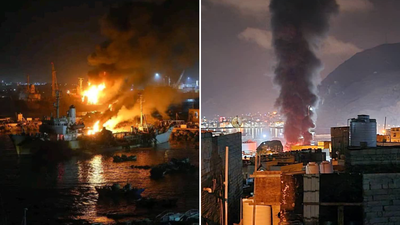
Saudi warplanes struck targets in Mukalla after the Saudi-led coalition accused two ships of arriving without authorisation, disabling their tracking systems and unloading “a large amount of weapons and combat vehicles” to support the STC. Riyadh said the operation was limited, conducted overnight, and aimed at preventing collateral damage.“The crews had the disabled tracking devices aboard the vessels and unloaded a large amount of weapons and combat vehicles in support of Southern Transitional Council’s forces,” the coalition said. “Considering that the aforementioned weapons constitute an imminent threat, and an escalation that threatens peace and stability, the Coalition Air Force has conducted this morning a limited airstrike.”Footage aired by Yemeni state media showed black smoke rising from the port and burned vehicles near the docks. Saudi state media said there were no casualties, though local residents reported damage to nearby homes.
What is the STC?
The Southern Transitional Council (STC) is a separatist movement in southern Yemen that seeks autonomy or independence for the region. It was formed in May 2017 following mass protests in the southern port city of Aden over the dismissal of its leader, Aidarus al-Zoubaidi, who now heads the council.The STC’s stated goal is to “reinstate the Southern State”, referring to the independent country that existed in South Yemen between 1967 and unification with the north in 1990. Support for southern secession has long existed, but gained momentum after Yemen’s civil war erupted in 2014.Backed by the United Arab Emirates, the STC controls key territory in the south, including Aden, and commands armed forces known as the Southern Armed Forces. While it has at times shared power with Yemen’s internationally recognised government, its core demand for southern self-rule remains unchanged.The STC now faces a critical test. It is part of the Presidential Leadership Council, yet its forces have seized swathes of territory from Saudi-backed units. Its leadership insists the UAE remains a “main partner” in the fight against the Houthis and has rejected Al-Alimi’s orders, saying they lack consensus.While the STC has framed its advance as consolidating southern control, defying Riyadh carries risks. Saudi Arabia controls Yemen’s airspace and has made clear it will act to prevent any shift that threatens its security interests.
A ‘red line’ between Saudi and UAE
Saudi Arabia and the UAE were once the twin pillars of the coalition formed in 2015 to restore Yemen’s internationally recognised government after the Houthis seized the capital, Sanaa. While both opposed the Houthis, their long-term goals increasingly diverged.Riyadh has remained committed to a unified Yemen under the internationally recognised government. Abu Dhabi, by contrast, has backed the STC, which seeks to revive the formerly independent state of South Yemen. That divergence has now erupted into open confrontation.Saudi Arabia accused the UAE of pressuring the STC to carry out military operations near its borders, calling such actions a “threat to the kingdom’s national security”. “The Kingdom stresses that any threat to its national security is a red line,” the Saudi foreign ministry said, adding that it would not hesitate to act.The UAE rejected the accusations, saying the shipment “did not contain any weapons” and that the vehicles were intended for Emirati forces operating in Yemen. It condemned any attempt to implicate it in operations threatening Saudi security and called for restraint and coordination.
What the UAE said
The UAE said it was surprised by the Saudi airstrike and rejected allegations that it directed STC military operations.“The UAE categorically rejects any attempt to implicate it in the tensions between Yemeni parties,” its foreign ministry said, calling for restraint and coordination.Abu Dhabi said its presence in Yemen was at the invitation of the internationally recognised government and within the Saudi-led coalition framework. It urged that recent developments be handled “responsibly and in a way that prevents escalation”.Later in the day, the UAE announced that it would withdraw its remaining forces from Yemen.“The Ministry of Defence announces the termination of the remaining counterterrorism teams in Yemen,” a statement from the ministry said, as cited by news agency AFP.
Why the east matters to Riyadh
The focus on Hadramout and al-Mahra is no coincidence. Hadramout borders Saudi Arabia and has deep economic and historical ties with the kingdom. Al-Mahra sits astride key land routes linking Yemen to Oman and Saudi Arabia and controls vital ports and crossings.For Riyadh, large-scale instability in the east is not a distant Yemeni problem but a direct border security issue. Saudi officials fear that unchecked STC expansion could redraw control over resource-rich areas and trade routes, creating long-term insecurity along the kingdom’s southern frontier.This explains why Saudi Arabia warned the STC against advancing into Hadramout and demanded a withdrawal, a call the separatists dismissed.
Yemen’s leadership steps in
The escalation was framed politically through Yemen’s internationally recognised leadership. Rashad al-Alimi, head of the Presidential Leadership Council, cancelled a defence pact with the UAE and ordered Emirati forces to leave Yemen within 24 hours. In a televised speech, he accused Abu Dhabi of fuelling strife by backing the STC.“Unfortunately, it has been definitively confirmed that the United Arab Emirates pressured and directed the STC to undermine and rebel against the authority of the state through military escalation,” he said.Al-Alimi also imposed a temporary no-fly zone and a sea and ground blockade on ports and crossings, except for coalition-approved exemptions, signalling the seriousness of the moment.
Why this matters for Yemen
The escalation risks opening a new front in Yemen’s decade-long war, with anti-Houthi forces turning on each other while the Houthis remain entrenched in the north, including in Sanaa.More than ten years of conflict have already killed over 150,000 people and created one of the world’s worst humanitarian crises. Strategic southern regions now at the centre of the dispute hold key ports and most of Yemen’s oil reserves.(With inputs from agencies)