TOI’s Indian Sportsperson of the Year: The women’s World Cup winning team | Cricket News
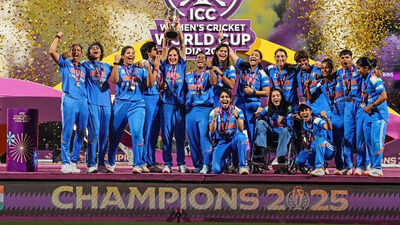
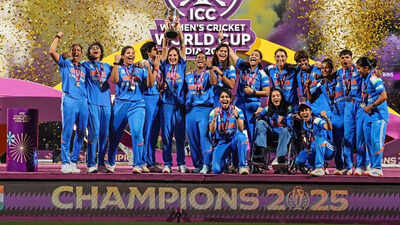
In a year that was awash with sporting achievement, if there was one that captured resilience, redemption and resolve in equal measure, look no further than the Indian women’s cricket team’s ICC World Cup triumph.Go Beyond The Boundary with our YouTube channel. SUBSCRIBE NOW!Harmanpreet Kaur‘s girls did not begin the year as favourites, nor did they enter the World Cup at home with the aura of inevitability that often surrounds champions like Australia.A sputtering start — three consecutive defeats in the league stage, against biggies South Africa, Australia and England — only reinforced old doubts about consistency, composure and whether this group really had it in them to finally cross the line.
Yet, by the time Harmanpreet lifted the trophy in Navi Mumbai on Nov 2, those doubts felt like relics from another time. And in one fell swoop, it changed the narrative that has surrounded Indian women’s cricket for the past so many years — that of the nearly women who always tend to stumble at the last. What a story it was!The league phase, to make the eventual title win sweeter, exposed India at their most vulnerable.Dropped catches, missed stumpings, sloppy overthrows and erratic fielding threatened to derail the campaign early. At the top of the order, stability was fleeting.But beneath the visible flaws lay a quieter, sturdier undercurrent — a belief that this episode unfolding before a fervently expectant home crowd was still theirs to shape.

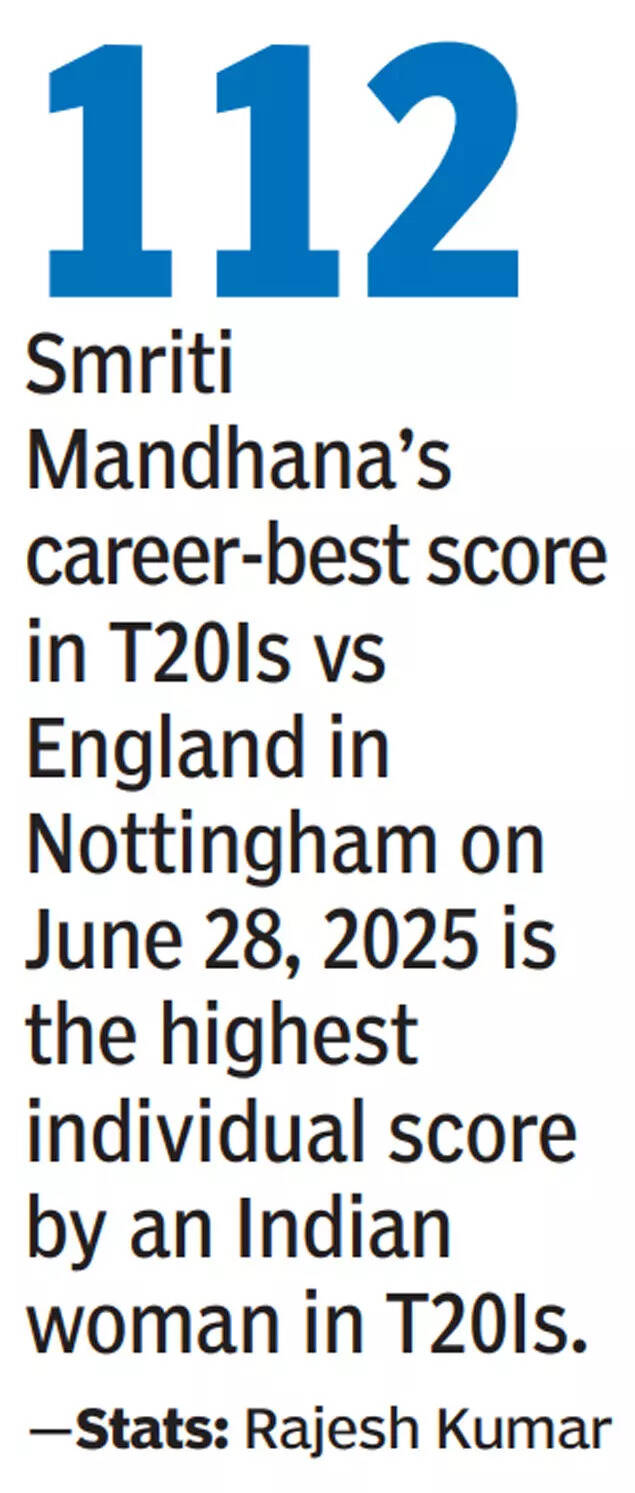
The turnaround started on Oct 23 at the DY Patil Stadium. Against New Zealand, with elimination looming, Pratika Rawal and Smriti Mandhana stitched together a monumental 212-run opening stand. Rawal’s 122 and Mandhana’s 109 powered India to a 53-run win but more importantly, reignited a campaign that had seemed on the brink. Twelve days later, at the same venue, Harmanpreet would lift the World Cup.From that point, India played with freedom and ferocity, a newly-forged belief. Contributions flowed from across the XI and beyond. The fielding unit, once hesitant, transformed into a side willing to dive, chase and scrap. Even adversity, in the form of Pratika Rawal’s injury, became an opportunity. Shafali Verma, short on confidence and coming off a stint on the sidelines, returned to the squad.Her semifinal numbers against Australia were a poor 10, but her presence reflected a team backing belief over fear, which yielded results in the final in the form of a defining 87 and two crucial wickets from the 21-year-old.
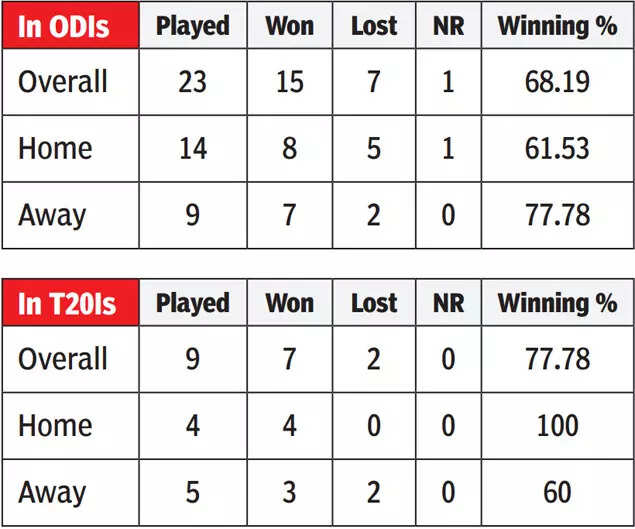
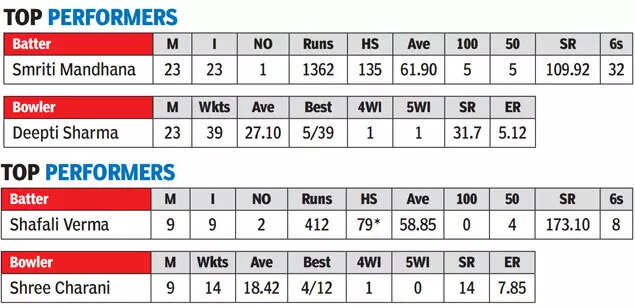
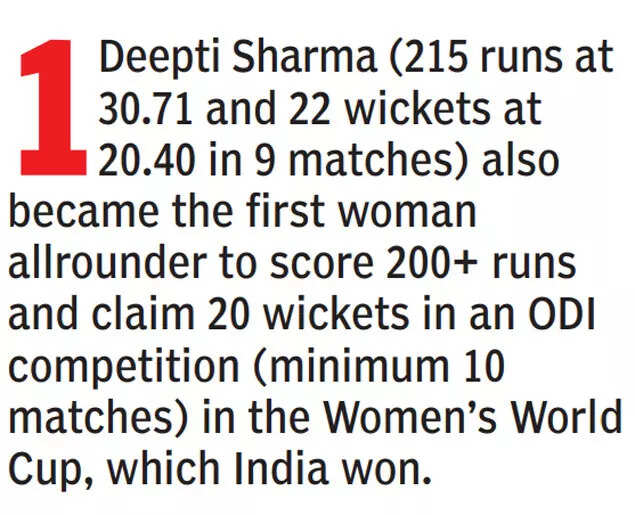
But the defining chapter of the year would come in the semifinal against Australia.Jemimah Rodrigues, who shuffled in and out of the setup over the past three years, delivered a career-defining unbeaten 127. Calm under pressure, fluent yet unhurried, she anchored India through their toughest examination, as Australia — the benchmark in women’s cricket — were finally subdued.If the batters set the tone, the bowlers ensured India never lost control. Spinner Deepti Sharma’s experience anchored the attack while the emergence of Sree Charani added freshness and bite. Medium-pacer Renuka Singh’s discipline with the new ball applied early pressure. Together, they transformed India into a side capable of defending totals and dictating terms.
The five-wicket semifinal win over Australia instilled conviction in a group that was already discovering its strength. In the final, India were assured and authoritative, outplaying South Africa to clinch the title by 52 runs — a performance befitting of champions.In a year that featured several standout Indian sporting moments, the women’s World Cup triumph stood apart not merely for the trophy but for what it represented.The title arrived nearly 47 years after India played their first One-Day International — against England at the Eden Gardens on Jan 1, 1978 — which also marked their maiden World Cup appearance. It crowned a journey that began long before global tournaments and prime-time broadcasts.
Indian women’s cricket has long been a story of perseverance. Played as early as 1913, the sport survived decades of neglect, limited funding, years without international matches and social resistance, with players often mocked for embracing a gentleman’s game. What carried them through was collective conviction — that their moment would come.That moment has been shaped by structural change: the BCCI merger, improved infrastructure, financial security, increased international exposure and the advent of the Women’s Premier League.Yet even in 2025, comparisons with the men’s game persist, often overshadowing achievement.On that winter night in Navi Mumbai, such comparisons felt unnecessary.Coming after heartbreak in the 2005 and 2017 World Cup finals, this time India’s women did more than win a World Cup. They authored the defining Indian sporting story of 2025 — one of belief rewarded, patience vindicated and a long, arduous journey finally illuminated. Something tells us, there’s more to come.
THE OTHER CONTENDERS
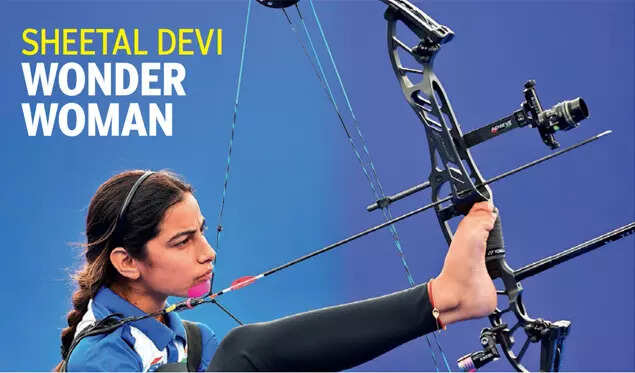
— By Sabi HussainSheetal Devi‘s journey from a remote village to a global sporting icon — overcoming congenital phocomelia — makes her a powerful symbol of courage and determination. Calling her the ‘wonder woman’ of Indian archery isn’t an exaggeration. The country’s youngest Paralympic medallist and a World and Asian Para Games champion, she has defied conventional logic — and the usual science of archery — by mastering a unique technique that uses her legs, shoulder and jaw to shoot from a seated position with world-class precision. Born without arms due to the rare condition, the 18-year-old from Loidhar village in Jammu’s Kishtwar district trailblazed her way to glory in 2025 with breathtaking, record-breaking highs.Sheetal became the first female armless world champion in paraarchery by winning gold in the women’s compound open event at the World Championships in Gwangju, South Korea, defeating Paralympic champion Oznur Cure Girdi of Turkiye in Sept. She also secured a team silver and a mixed team bronze at the same competition.Later, she became the first Indian para-athlete selected for an able-bodied international team, qualifying for the Asia Cup Stage 3 in Jeddah after finishing third in national trials against able-bodied archers. She has now set her sights on winning medals at events for able-bodied athletes next year.
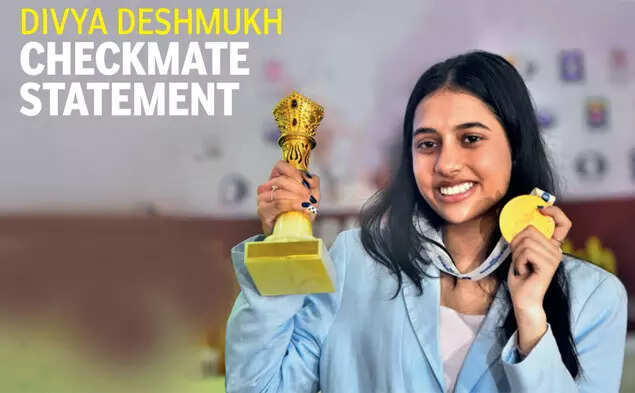
— By Amit KarmarkarYoung Divya Deshmukh made a telling statement on the board. The Nagpur girl, now 20, managed to achieve a remarkable first in Indian chess when she won the knockout Women’s World Cup in Georgia in July. Though the World Cup is Fide’s third-ranked women’s event, after the World Championship and Candidates, winning the tournament against an elite field — and clinching the GM title with it — makes Divya a contender for India’s Sportsperson of the Year.A hint of Divya’s real prowess showed in 2024 — not through the individual and team golds in the Women’s Olympiad, or the Asian women’s titles earlier, but in the Abu Dhabi meet. She drew with Yagiz Kaan and M Pranesh and defeated L Srihari in an open field. As she touched the Elo 2500 mark for the first time during that phase, a breakthrough in 2025 felt inevitable. Though Divya had a modest series in the FIDE Women’s GP, her preparation, daring approach and modern perspective kept her in a good space.Her World Cup scalps included the Chinese Zhu Jiner, Tan Zhongyi and Indians D Harika and K Humpy, three of them via faster tiebreaks. With that, she clinched a Women’s Candidates spot — a stepping stone to dethroning Ju Wenjun. Divya also rubbed shoulders with men over 11 classical rounds of the Fide Grand Swiss.
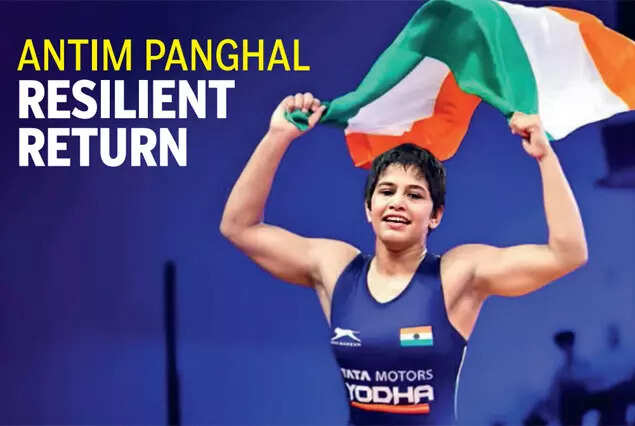
— By Sabi HussainFor a full year after the Paris Olympic heartbreak, wrestler Antim Panghal endured a range of emotions. She suffered a disappointing exit in the opening bout of the women’s 53kg category in Paris and was later deported from the French capital for trying to get her sister Nisha entry into the athletes’ village using her accreditation card. The 21-year-old two-time junior world champion suffered a mental breakdown and seriously contemplated quitting the sport as she confined herself to her home in Bhagana village in Haryana’s Hisar district and stopped all social interactions.“It was a tough period. I wasn’t quite myself. That one bout in Paris changed everything for me,” she had told this newspaper.With encouragement from her parents and friends, Antim chose to bury the Paris chapter once and for all. She returned to training under coach Siyanand Dahiya and won bronze at the Asian Championships in March besides securing gold at the Ulaanbaatar Ranking Series meet and the Polyák Imre and Varga János Memorial.Her big moment arrived in Sept this year when she won her second consecutive bronze at the World Wrestling Championships in Zagreb. “My next goal is to secure gold at the Asian Games in 2026. My preparations have already started,” she said.