

IIT-Bombay, NTPC lead India’s first underground carbon dioxide storage drilling project | Mumbai News
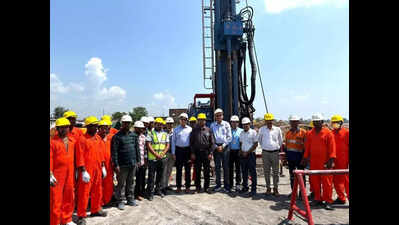
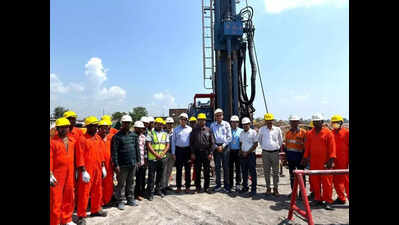
Mumbai: In a boost to India’s clean-energy and climate action efforts, NTPC and IIT-Bombay have successfully completed drilling the country’s first geological well in Jharkhand to test the feasibility of underground carbon dioxide (CO2) storage. The drilling of a second well in the vicinity has also commenced, primarily to monitor and study the behaviour of injected CO2 and its containment using multiple monitoring techniques. The success of the drilling project marks an important step in academia-industry collaboration in Carbon Capture, Utilisation and Storage (CCUS) and will also position the country closer to developing indigenous, large-scale solutions for reducing carbon emissions in line with its net-zero commitments. IIT-Bombay is the implementation agency for the project.The collaboration, facilitated by NITI Aayog, in Nov 2022, brought together NETRA-the R&D wing of NTPC, and the Department of Earth Sciences, IIT-Bombay in building India’s first geological storage atlas for coalbed methane rich coalfields. In Sept 2025, NTPC and the Powai institute commenced the country’s first dedicated drilling in Hazaribagh till the depth of 1,200 metres, for potential CO2 storage in the vicinity of a coal mining area and completed it last month. A second well drilling was initiated on Dec 21. Studies are underway to check the potential of drilling such wells in many other regions, including Mumbai High. The project will generate detailed feasibility and risk assessments for full-scale carbon capture and storage (CCS) development, including a commercial deployment plan. Preliminary studies indicate significant storage potential in the North Karanpura coalfield, with the Pakri-Barwadih block alone estimated to accommodate up to 15.5 million tonnes of CO2 over a 10-year injection period, said prof Vikram Vishal, project lead from IIT-Bombay.Explaining the need and implication of the project, Prof Vikram told TOI, “India produces roughly 2.95 billion tons of CO2 annually and almost a third of it comes from the power sector. As India pursues its net-zero ambitions, certain sectors will continue to emit CO2 due to the very nature of their industrial processes. While renewable energy, hydrogen and other clean technologies will play a crucial role in reducing emissions, they cannot entirely eliminate process-related CO2 emissions. Capturing this carbon is only part of the solution. Conversion into useful chemicals is limited by market demand and scale. At the volumes India is likely to deal with, ranging from hundreds of millions to nearly a billion tonnes of CO2, geological storage becomes unavoidable. Storing CO2 deep underground is therefore essential for industries, companies and the country as a whole to meet their net-zero targets.”Prof Shireesh Kedare, Director, IIT-Bombay, celebrating the landmark contribution, emphasised the role of the translational R&D in architecting the roadmap for India’s energy transition and decarbonisation.