India’s IT hiring in 2025: The boom is real, but not the one engineering students were waiting for |


For students enrolled in India’s IT and computer engineering programmes, the last two years have been unsettling. Placements stalled. Offer letters were deferred. Friends with strong degrees sat idle, refreshing inboxes that refused to respond. The great IT escalator—long assumed to carry every engineering graduate into stable white-collar employment—appeared to have broken down.Now, in 2025, the data says hiring has returned. According to Quess Corp’s report, IT Workforce Trends in India 2025, demand has climbed to 1.8 million technology roles, a 16% rise over 2024 and 31% higher than 2022 levels. On paper, this looks like vindication. The downturn, it seems, is over.Yet for students and fresh graduates, this recovery feels strangely distant. The jobs are back—but not necessarily for them. The rebound exists, but it is governed by new rules. And those rules reveal a labour market that has quietly grown more selective, more skill-heavy, and less forgiving of inexperience.
The rebound is real but it is not broad-based
The headline figures mask an important truth: The IT market has not returned to mass hiring. It has returned to targeted hiring.
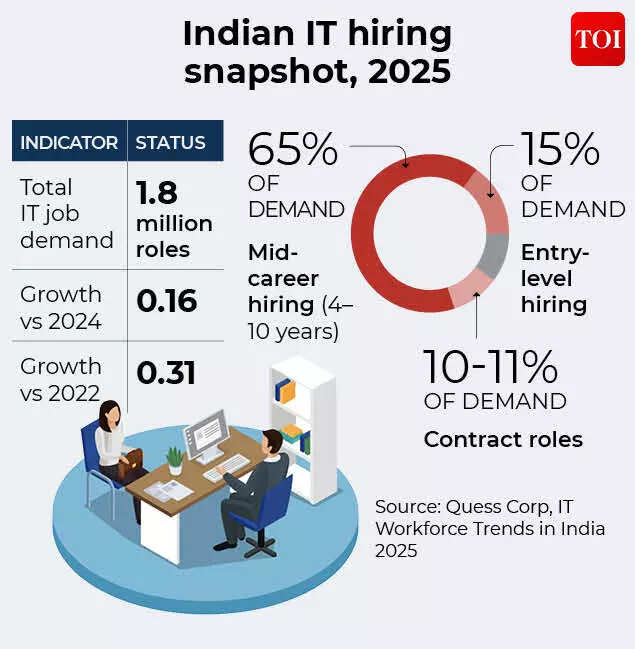
Entry-level hiring, once the symbolic heart of India’s IT success story, has become a narrow channel.
The labour market has reassembled itself around experienced professionals. People who can step into a role and deliver almost immediately. Entry-level hiring, once the symbolic heart of India’s IT success story, has become a narrow channel.For engineering students, the uncomfortable implication is this: A recovering market does not automatically translate into easier placements.
The centre of gravity has shifted: GCCs now dominate hiring
One of the most consequential shifts highlighted in the Quess report is the growing dominance of Global Capability Centres (GCCs)—the India-based technology and engineering arms of multinational firms.Once peripheral players, GCCs account for about 27% of all IT hiring demand in 2025, up sharply from around 15% in 2024, finds the Quess Corp survey. They are the fastest-growing segment in the ecosystem.According to Quess Corp’s IT Workforce Trends in India 2025 report, traditional IT services and consulting firms are seeing only modest growth of about 7–8 per cent. Hiring in these firms is therefore tight and skill-specific, not the broad-based headcount expansion that once absorbed large batches of engineering graduates.This distinction matters for students because GCCs do not hire at scale from campuses. They hire specialists. Their recruitment logic favours portfolio strength, prior internships, and hands-on exposure—criteria that sharply narrow the funnel for fresh graduates.
For freshers, the gate is narrower
As already mentioned, only 15% of total IT hiring in 2025 is entry-level. That number alone explains why placement stress continues despite positive headlines.Meanwhile, hiring of mid-career professionals (four to ten years of experience) command 65% of the market demand. Employers prefer reliability over promise, output over orientation.This is not a temporary imbalance. It reflects a structural re-pricing of risk. After years of uncertainty, companies are reluctant to invest heavily in training pipelines. Freshers are no longer assumed to be mouldable assets. They are evaluated as unfinished professionals.For students still in college, this means one thing: Graduating is no longer the finish line, it is the qualifying round.
Skills are no longer ‘value-adds’, they are entry tickets
Perhaps the clearest signal from the Quess report is how sharply demand has shifted towards specific skill clusters.
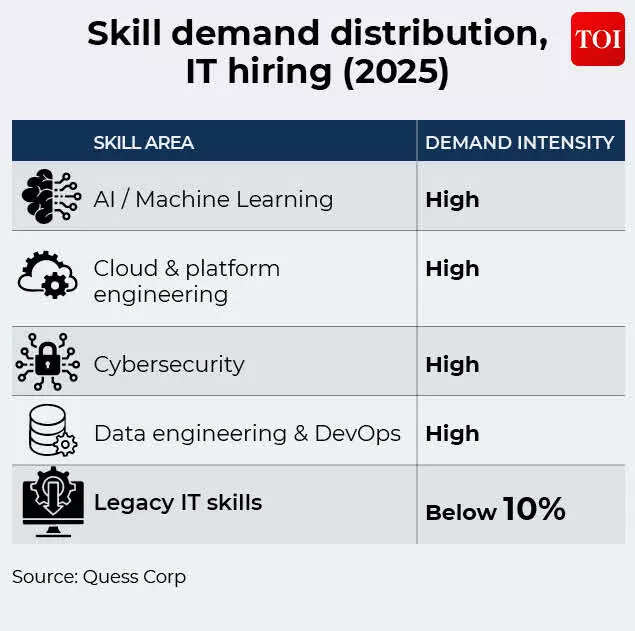
More than half of all IT jobs in 2025 are concentrated in advanced digital skills.
More than half of all IT jobs in 2025 are concentrated in advanced digital skills. Generalist roles—once the backbone of campus hiring—have shrunk dramatically. Legacy technologies, which sustained millions of early careers in the past, now account for less than one-tenth of demand.For engineering students, this has a simple but brutal implication: Degrees signal intent; skills signal employability.
Geography still favours metros—but the monopoly is weakening
Despite repeated predictions of geographic dispersal, India’s IT jobs remain overwhelmingly metro-centric. In 2025, around 88% of IT roles are still located in Tier-1 cities.However, the Quess’s projections suggest a slow but steady shift.
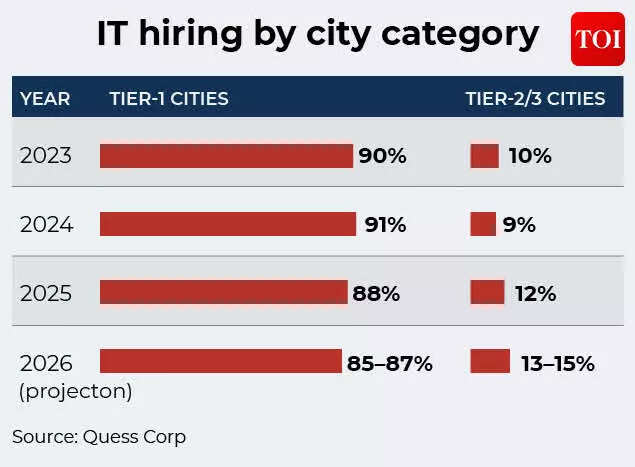
India’s IT jobs remain metro-centric.
Hybrid work, GCC satellite offices, and cost optimisation are pushing some growth into smaller cities. But this is evolution, not exodus. Students planning careers outside metros must still compete nationally, not locally.
The rise of contract work and what it means for freshers
Another undercurrent shaping the IT labour market is the expansion of contract hiring, now making up 10–11% of total demand, finds the Quess Corp report.For companies, contract roles offer flexibility. For young professionals, they offer entry—but with trade-offs. Shorter tenures, limited predictability, and the need for constant skill renewal become part of the career equation.This changes how early careers must be managed. Stability is no longer guaranteed by joining a big name. It is earned through relevance.
What IT engineering students must understand now
The 2025 recovery does not invalidate the IT dream—but it redefines it.The new market rewards:
- Skill proof over syllabus coverage
- Specialisation over general degrees
- Early exposure over late placements
- Adaptability over long-term certainty
For students currently studying IT, computer science, or allied engineering disciplines, the message is rather challenging. Those who treat college as a launchpad rather than a waiting room will find doors open. Those who rely solely on institutional pipelines will face longer waits.(With PTI inputs)