
Beyond the Big Three: Can anyone stop the Alcaraz-Sinner takeover in men’s tennis? | Tennis News


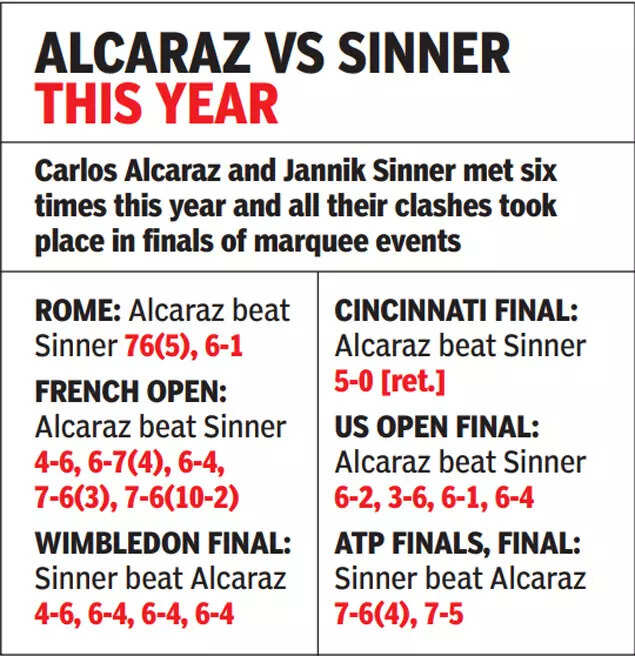
The instant Carlos Alcaraz’s two-hander sailed wide in the season finale, the tennis world had already turned its gaze to the next calendar. A rivalry of equal measure had been established, spice and steel.Go Beyond The Boundary with our YouTube channel. SUBSCRIBE NOW!Jannik Sinner’s repartee in Turin, an innovation hub of Italian industry, offered some counterweight to the duopoly after Alcaraz had claimed five straight wins against Sinner in 16 months, starting March 2024.One intriguing piece of statistics to emerge was the total points contested between Alcaraz and Sinner. In their 16 Tour-level and above meetings so far, they have contested 3302 points and have both won 1651 points each. But the 22-year-old Alcaraz leads the H2H 10-6. At a spectacularly curated farewell for Rafael Nadal at Roland Garros in May, the king of clay pressed on the importance of numbers in a rivalry. Nadal had Roger Federer and Novak Djokovic, and if that weren’t enough, from 2008 to 2016 there was Andy Murray, who made 11 Major finals, winning three.
“We were three-four of the best rivals,” Nadal said, “When you are only two, you can lose a little bit the motivation because the other starts losing or gets injured, but being four, always one of that four was winning a tournament.”As things stand, Sinner and Alcaraz are out in front, with the closest challenger being the 38-year-old Novak Djokovic, in the hunt for a historic 25th Grand Slam title.
There is no shortage of talent in the early to mid-20s, not unlike the Daniil Medvedev–Alexander Zverev cohort that ran headlong into the Fab Four at their peak. Two left-handers stand out: Ben Shelton, 23, ranked ninth and armed with a thunderous serve; and Britain’s Jack Draper, 24 and ranked 10, whose talent is evident, though the consistency required at the top remains elusive. Holger Rune, 22, suffered a left Achilles tendon injury in October and may not return to the Tour until the second half of 2026, but the Dane has fire both in his shot-making and his temperament.The biggest mover, however, has been Brazil’s João Fonseca. He began the year ranked 145 and, at just 19, has climbed to No. 24, the only teenager inside the ATP’s top-100. Still, it is hard to see Fonseca, who won a round at each of the four majors this year, threatening the duopoly in the coming season. Maybe in a couple of years, but not just yet.
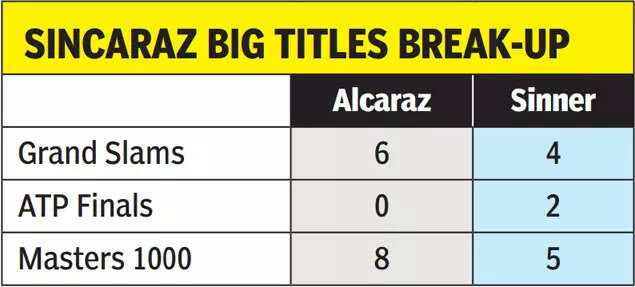
Restoring the balanceWhen Alcaraz and Sinner met in the final of a second successive Major in London’s leafy suburb in July, the air was heavy with questions, still thick with the residue of the gut-wrenching loss the Italian had suffered at Roland Garros, where he not only led by two sets to love but also held three consecutive match points in the epic clash.In Paris, there had been only a scattering of spectators backing the German-speaking Italian, who was returning to the Tour after serving a three-month doping ban following two positive tests for clostebol. At Wimbledon, the balance of support again favoured the six-time Major winner, broken only by the occasional cry of, “Janeeek, Janeeek!”. This time, though, Sinner silenced Centre Court with a level of play not unlike what his rival had summoned in Paris.When they met again in New York eight weeks later, Sinner was running on reserve. Even below his best, he was still good enough to reach the title match, but his opponent was operating at tropospheric levels. If Centre Court had taken so much out of Sinner, what, then, would it take for the four-time Major winner to challenge Alcaraz consistently?
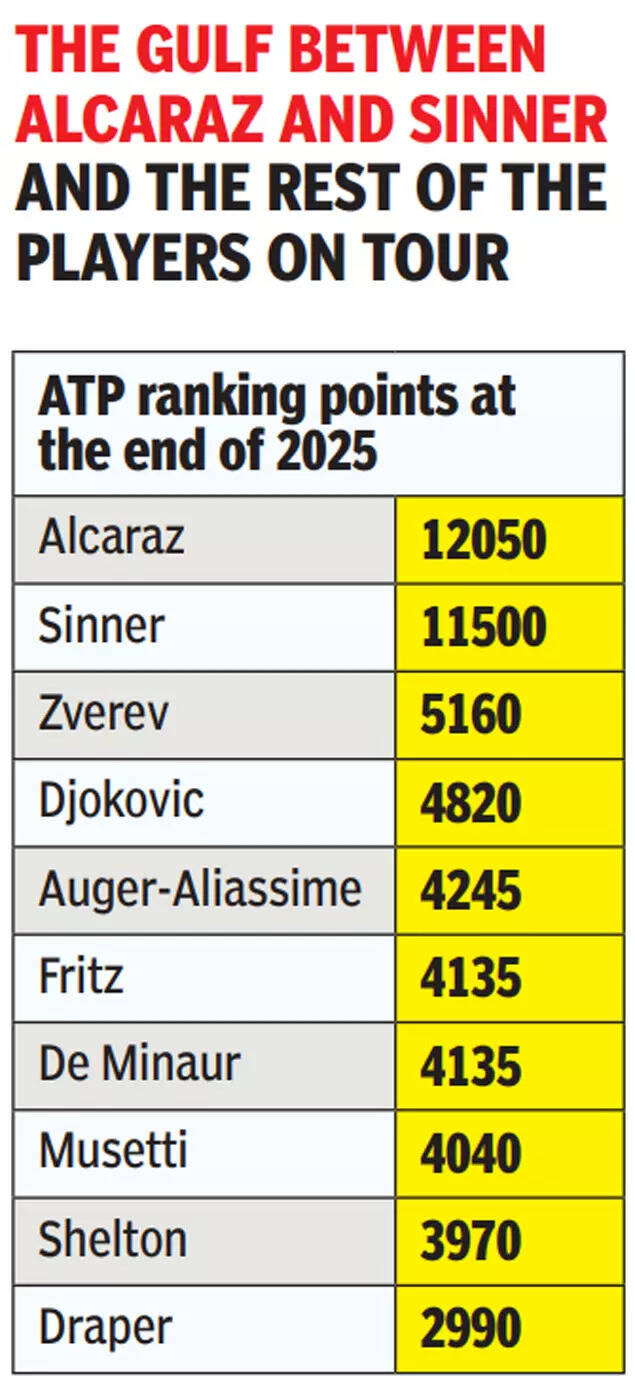
As the year progressed, Sinner’s team, at times looking dishevelled in the wake of doping violations of the spring of 2024, appeared largely settled, despite the controversial rehiring of trainer Umberto Ferrara, who, along with physiotherapist Giacomo Naldi, had been at the centre of that storm. With Australian Darren Cahill and tennis technocrat Simone Vagnozzi in his coaching corner, and physiotherapist Alejandro Resnicoff completing the circle, continuity gradually returned.Alcaraz, meanwhile, will head into the season-opening Australian Open next month aiming to become the youngest man to complete the career Grand Slam, but without long-time coach Juan Carlos Ferrero, from whom he parted ways not long after Thanksgiving.Ferrero, a former world No. 1, began working with Alcaraz when he was just 15 and once likened the Spaniard to his fourth child. “He’s like my fourth kid. I have three kids at home, and he’s the fourth,” Ferrero said in an interview.As brilliant as Alcaraz is, 2026 will pose a different kind of examination. Stripped of the voice that guided him from his early teens to the summit of the sport, Alcaraz will have to discover whether the instincts that set him apart can also sustain him.