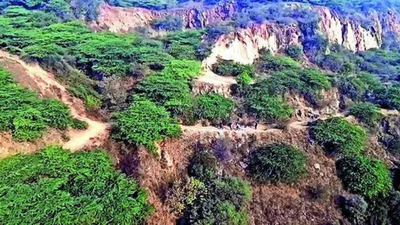
Himalayas and now Aravalis: ‘Rakshasutra’ against mindless development

On the upper reaches of the Gangotri valley, in the vicinity of glaciers and mountain streams, along the banks of the Bhagirathi-Ganga, the slopes harbour dense forests of deodar intermingled with chestnut, blue pine, silver fir, sea-buckthorn, Himalayan birch, Himalayan cypress, apricot and Indian tree hazel. To implement road widening via the Chardhaam Pariyojana (CDP), the Uttarakhand government has granted permission to the Border Roads Organisation (BRO) for felling up to 7,169 trees in these forests. This number includes 4,070 deodars and 494 fruit trees, such as apple, walnut, apricot, and cherry. The total land acquired would be 41.924 hectares of forest land and 1.4 hectares of field land, totalling 43.409 hectares.
This deodar forest is located in a 20-km stretch that includes the areas of Dharali and Harsil, which were severely devastated on August 5, 2025, due to glacial activity and flooding. The forest sits on avalanche debris and has five glacial streams cutting through it. Three of these streams were activated simultaneously on August 5, thereby wiping out the settlement of Dharali and the army camp in Harsil in seconds. Dharali was buried under 20 metres of debris brought by the glacial stream of Khir Ganga. Experts warn that if these trees, which are holding the debris in place, are uprooted, the entire area would become prone to landslides and Dharali-repeat disasters.
The 900-km CDP has triggered over 800 landslides and slope failures in its 800-km stretch across the three Chardham valleys of Badrinath, Kedarnath and Yamunotri. The remaining 100-km Gangotri stretch falls in the Bhagirathi Eco-Sensitive Zone (BESZ), which was demarcated to protect the last pristine 80 km of the Ganga left in India. Thus, the eco-zone has stringent rules prohibiting slope tampering and tree felling, which are being bypassed for this project.
Independent experts have submitted an alternative road design (DPR) to the Ministry of Road Transport and Highways (MoRTH), which reduces road width from 10 metres to a 5.5-metre tarred surface, with 7 metres along turns, and allows the comfortable passage of two vehicles while avoiding tree felling and dislodging of boulders. Originally, the 2018 MoRTH circular had itself stipulated 5.5 metres in hilly terrain to prevent instability and felling of “precious trees”.
The 10-metre tarred road of the CDP had been initiated in violation of this circular. This design, which protects the deodar forest and glacial streams, has been ignored. The forest department, in its clearance letter dated March 12, 2024, states the number of deodars as 4,070, with only two deodars having a girth of 0–10 cm. The number of trees with girth below 30 cm is stated as 2,583, of which 824 are deodars. But in a later submission, the forest department states that all trees below 30 cm are 4,366 and that these will be transplanted. In this document, the deodars marked for felling are 1,390. But if 824 deodars are below 30 cm and hence transplantable, and 1,390 are being cut, that amounts to 2,214 trees. The total deodars stated were 4,070. Hence, we have 1,856 deodar trees missing. And both documents refer to the exact same 43.409 hectares of acquired land.
According to the tree count conducted by the forest department, the average number of trees per hectare is roughly 158. But studies indicate that the expected average in this area is 350 trees per hectare, of which 75 per cent are deodars. These anomalies raise grave doubts. Moreover, the trees in the area have a huge girth, indicating 50–100 years of age, whereas the forest department figures make it look like a nursery. Further, the forest department signing off on these documents is the same department that, in March 2024, had forwarded the application for road widening with the astounding claim that this Jhangla–Dharali stretch, barely 10 km from Gangotri, did not fall in the Bhagirathi Eco-Sensitive Zone. Obfuscation of such critical facts is far-reaching in its impact, and yet no one is held accountable.
The solution of transplanting 4,366 trees is another whitewash. Transplanting has failed repeatedly, a recent example being Dehradun, where roughly 900 trees were transplanted for road widening. But now the High Court has asked for a survival rate after residents informed that these trees were dying. Moreover, in the case of Dharali, since the forest sits on avalanche debris, uprooting trees from their roots and digging slopes to transplant will destabilise the area even more than felling.
The CDP began as a mega-tourism project and then morphed into a defence project, which allowed it to bypass the Supreme Court order mandating a road width of 5.5 metres. MoRTH began this project by breaking the 900-km road into 53 parts of less than 100 km each to evade an Environmental Impact Assessment (EIA).
In 2023, the Uttarakhand state opposed a carrying capacity study ordered by the Supreme Court in the course of a PIL, stating that it could be counter-productive and that “the holistic set of various measures to support the sustainable development of the state would be overshadowed by only the measure of carrying capacity”. Flood zonation laws prohibit new construction within 100 metres of rivers. The eco-zone notification also stringently prohibits conversion of green land to non-green. But despite these regulations, infrastructure projects are being cleared with no scientific rationale or long-sighted vision.
A deodar, or the other varieties that provide a support system to a deodar forest, are the priceless heritage of the Himalaya. Generally, the final loss of trees far exceeds the official number stated because of slope failures triggered by cutting, landslides, and saplings that have not been counted. A forest is a complex ecosystem that mere transplantation cannot replace. And tree felling has a domino effect that the documents entirely ignore. A felled forest leads to drier soil, which triggers forest fires, which deposit soot on glaciers, which trigger glacial melt and flash floods, which in turn erode more forests and slopes. The cycle is vicious.
Mindless development is built on mindless regulations. To facilitate the decimation of the Aravalis, one of the oldest mountain ranges on Earth, the Supreme Court recently redefined a mountain, thereby excluding ninety per cent of the range and opening it up for “development”. In 2018, after the CDP matter was raised in the NGT, the Bhagirathi eco-zone clause prohibiting land-use change to non-green except for local residential needs was widened to include infrastructure and defence. Then, MoRTH amended the 2018 circular in 2020 from 5.5 metres to 10 metres in hilly terrain, without any scientific rationale. In 2021, a Justice DY Chandrachud-led Supreme Court bench also ignored the 200-plus landslides triggered by CDP hill cutting and permitted a 10-metre road width as a defence requirement. Its order stated: “This court, in its exercise of judicial review, cannot second-guess the infrastructural needs of the Armed Forces… This is impermissible.” In 2023, all linear strategic projects within 100 metres of the Line of Control were excluded from the Forest Conservation Act. But with border connectivity often cut due to landslides and with the creation of chronic landslide zones, this Himalayan blunder in judgement is indisputable.
Uttarakhand, especially, has borne the brunt of unprecedented disasters in the last decade. The horrific Kedarnath glacial lake outburst, the Asi Ganga floods, the Rishi Ganga glacial break, the avalanche debris flow at Dharali, Tharali, and the sinking of Joshimath are stark warnings that mindless development is exacerbating the devastation of climate change in the Himalaya.
The demolition of the Himalayas, and now the ancient Aravalli, and the excavation of Badrinath without any EIA, or the damming of the Ganga, is the demolition not just of life-sustaining ecology, but of Indian identity. We should stop calling what empties us, what weakens us, “progress”.
MoRTH minister Nitin Gadkari, in Parliament, assured the nation that there would be no tree felling in the CDP. Yet today, we are on the brink of losing another pristine forest. The Rakshasutra tied by citizens around magnificent cedars on December 6, 2025, is, in fact, a call for protection against all mindless and self-destructive development.
Disclaimer
Views expressed above are the author’s own.
END OF ARTICLE