

Rajasthan: Over 1,230 mine leases exist across Aravalis in the state; Rajsamand district alone accounts for over 540 | India News
JAIPUR: Over 1,230 mining leases, most of them disputed, continue to exist across Rajasthan’s Aravali region. Together, these leases cover 17,393 hectares within the Aravali system.“At present, most leases in the Aravalis are under dispute and pending before courts. Some mines are closed, while others continue to operate,” a senior mining official said.Incidentally, Rajasthan mining department was considering a proposal to lease out additional pits for excavation in the Aravalis but the Centre invoked a blanket ban on the grant of new mining leases in the mountain range following public outcry over a proposed “new definition” of one of the world’s oldest mountain ranges.An official source said, “The mining department issued notifications for 126 new leases in Nov 2025. Of these, 50 are located within Aravali districts, while 76 fall outside the Aravali region.”
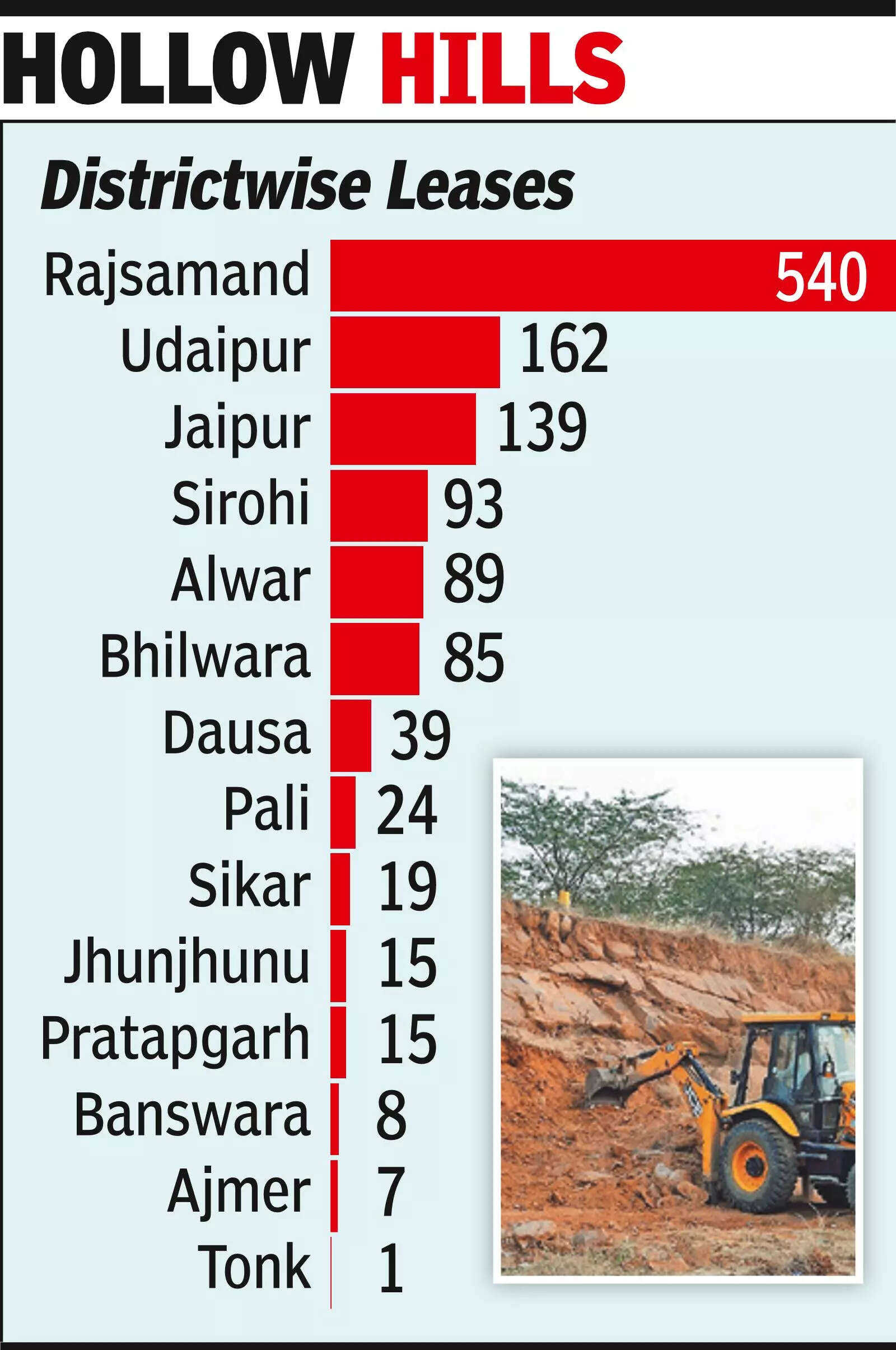
District-wise data highlights the scale of concentration, with Rajsamand district alone accounting for over 540 leases. Udaipur follows with 162 leases and Jaipur has 139. Alwar, Sirohi, and Bhilwara together account for over 250 leases, reflecting how deeply mining has penetrated the Aravali belt.Mining expert Pradeep Singh said the new ban does not cancel existing permissions retrospectively, allowing hundreds of leases to continue, particularly in Rajasthan. “In many areas where leases are operational, environmental degradation is visible and, in several places, irreversible. Hills have been hollowed out, forest cover has thinned, and natural drainage systems have been disrupted,” he said.Across Rajasthan, the mining footprint extends far beyond the Aravalis. The state has 16,116 mining leases, of which around 10,060 are operational, along with nearly 18,000 quarry licences.Mining expert Kishore Kumawat said area-wise data within the Aravali region shows Udaipur accounting for 6,084 hectares under mining, followed by Sojat with 2,575.4 hectares, Bhilwara with 1,229 hectares, and Rajsamand with nearly 800 hectares.