
Women’s safety in India: Between official data and lived reality in 2025 | India News


Women’s safety remains one of India’s most urgent and complex public policy challenges in 2025, cutting across domestic, public, and increasingly digital spaces. Despite decades of legislative reform, expanded policing frameworks, and growing public awareness, violence against women continues to persist in multiple forms, ranging from domestic abuse and sexual assault to trafficking, cyber harassment, and workplace exploitation.These crimes are not isolated acts but are embedded within broader structures of gender inequality, social stigma, and uneven access to justice. As India debates legal safeguards and governance reforms, official crime data offers an important, though incomplete, window into the scale and nature of the problem.Every reported crime carries a backstory that never makes it into the case file. Before the FIR, there is the moment of doubt, whether to speak, whom to trust, and what might follow. For countless women in India, that moment ends in silence.That silence is in reality filled with a lot of calculations – the fear that people might not believe you, families asking them to “let it go” because of the risk of retaliation or to protect family honour, the cost of legal battles that can go for years, and the silent understanding that the road to justice, even when promised, can be unforgiving. For most women, safety is not a fixed condition. It is something worked out every day — by calculation which roads to avoid, staying quiet in unfamiliar spaces, adjusting behaviour, and living with harm that feels easier to manage than to report.

.
In 2025, crime data remains the main way women’s safety in India is judged. These numbers shape headlines, policy debates, and official claims of progress. But they reflect only those cases that enter the criminal justice system. Far more experiences remain outside the record — abuse within homes, harassment in public spaces, threats online — incidents that never become complaints because the cost of speaking up feels higher than the harm itself.
What the numbers show — and what they don’t
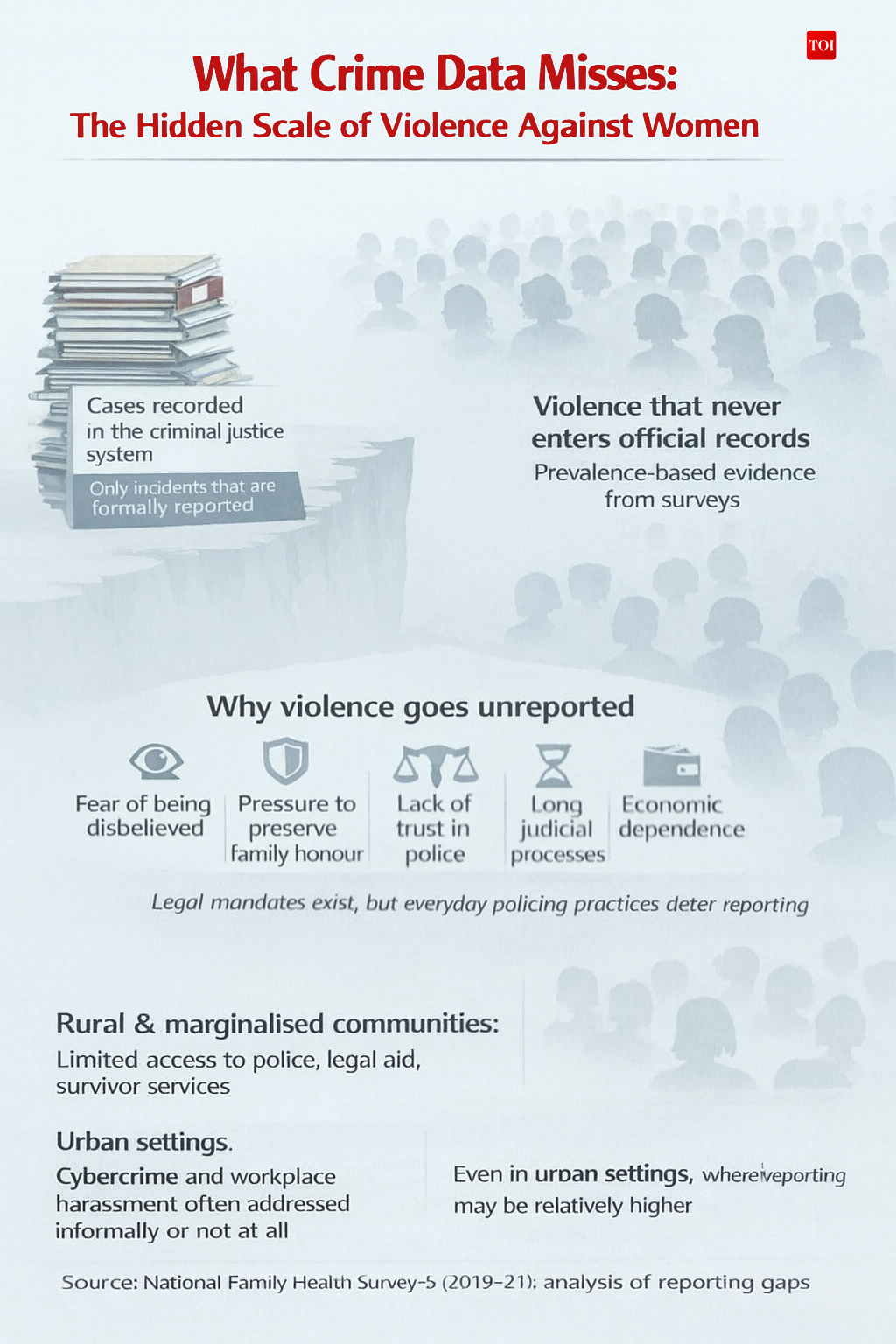
The most recent comprehensive figures from the National Crime Records Bureau (NCRB) are from 2022. Since then, no complete official dataset has been available, leaving a gap in understanding more recent trends.In 2022, India recorded 4,45,256 cases of crimes against women, reflecting a 4 per cent increase from the previous year and translating to an average of 51 complaints every hour. The national crime rate stood at 66.4 cases per lakh women. While these numbers point to the persistence of gender-based violence, they also reveal sharp regional disparities. Union Territory Delhi reported a crime rate of 144.4, more than double the national average, while Haryana (118.7) and Telangana (117.6) also recorded significantly higher rates.Such variations raise critical questions: do higher numbers indicate greater prevalence of crime, better reporting mechanisms, or a combination of both?Official statistics, however, capture only those incidents that enter the formal criminal justice system. A substantial body of evidence suggests that a large proportion of violence against women remains unreported, particularly when it occurs within households or involves perpetrators known to the survivor. Data from the National Family Health Survey–5 (2019–21) paints a starkly different picture of women’s lived experiences.
.
According to the survey, nearly one in three ever-married women in India—32 per cent, has faced physical, sexual, or emotional violence at the hands of their husbands at some point in their lives, while 6.1 per cent reported experiencing sexual violence. The contrast between these prevalence-based findings and police-recorded crime figures highlights a persistent gap between reality and reporting.This gap is shaped by multiple factors: fear of retaliation, social pressure to maintain family honour, lack of trust in law enforcement, prolonged judicial processes, and economic dependence. In rural areas and among marginalised communities, these barriers are often compounded by limited access to police stations, legal aid, and survivor support services. Even in urban settings, where reporting may be relatively higher, cybercrime and workplace harassment frequently fall through regulatory cracks or are addressed through informal mechanisms rather than criminal complaints.In 2025, crime data remains an indispensable tool for understanding trends, allocating resources, and holding institutions accountable. Yet numbers alone cannot capture the full extent of women’s vulnerability, resilience, or the systemic failures that allow violence to persist. This feature examines what India’s crime statistics reveal about women’s safety—and, just as importantly, what they leave out, by situating official data alongside social realities, institutional constraints, and the voices often missing from the record.
Reporting versus reality: When FIRs reflect access, not incidence
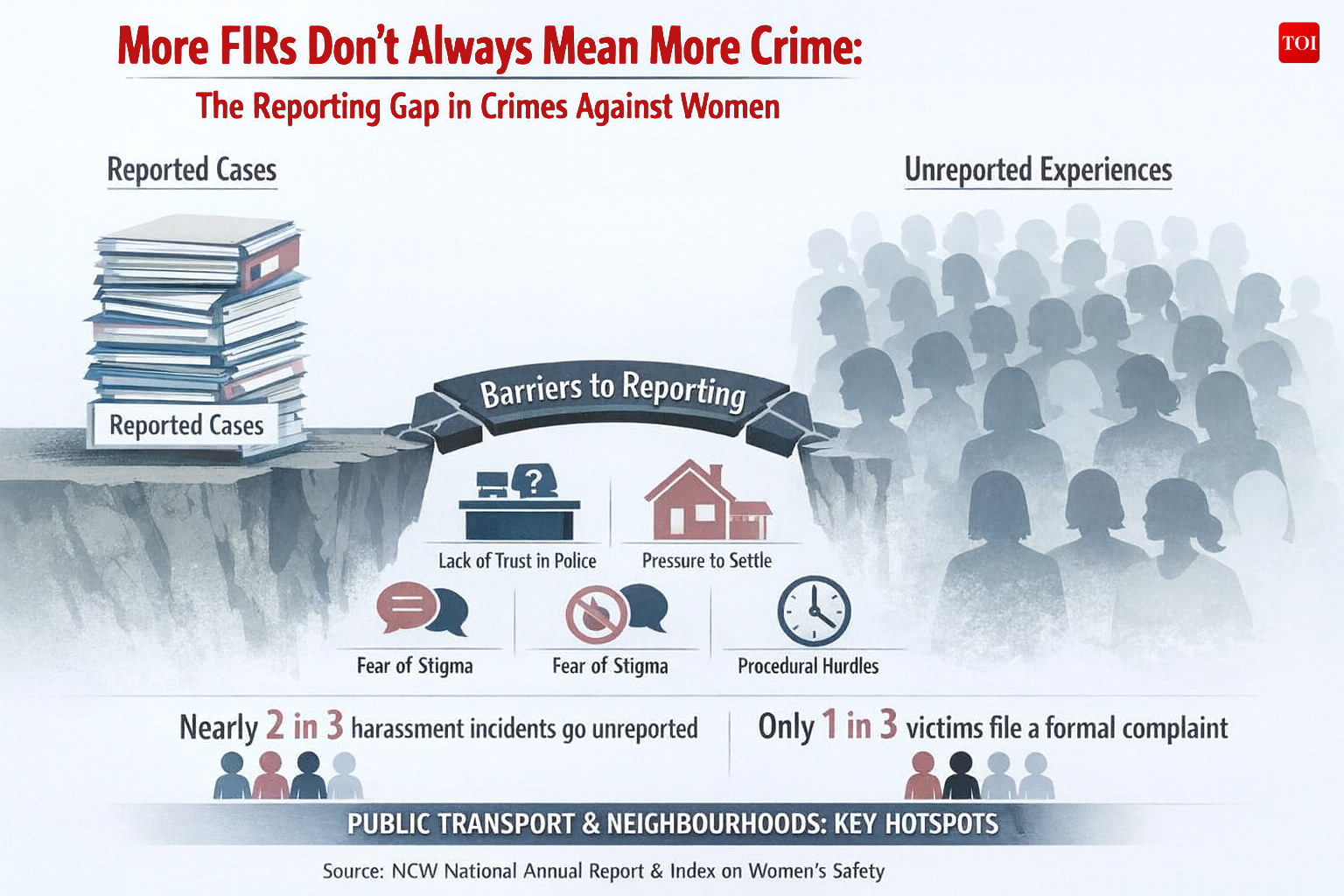
An increase in the number of First Information Reports (FIRs) registered does not automatically signal a rise in crime; in many cases, it reflects changes in reporting behaviour, policing practices, and legal awareness. This distinction is particularly important when interpreting data on crimes against women, where historically low reporting has long masked the true scale of violence.One key factor behind higher FIR counts is improved access to the criminal justice system. Supreme Court rulings mandating the compulsory registration of FIRs for cognisable offences, coupled with state-level women’s help desks, online complaint portals, and dedicated women’s police stations, have lowered procedural barriers that previously discouraged survivors from coming forward. In such contexts, rising FIR numbers may indicate institutional responsiveness rather than an actual surge in incidents.Shifts in social attitudes also play a role. Greater public discussion around gender-based violence, through media coverage, civil society advocacy, and movements demanding accountability, has contributed to increased awareness of legal rights among women.
.
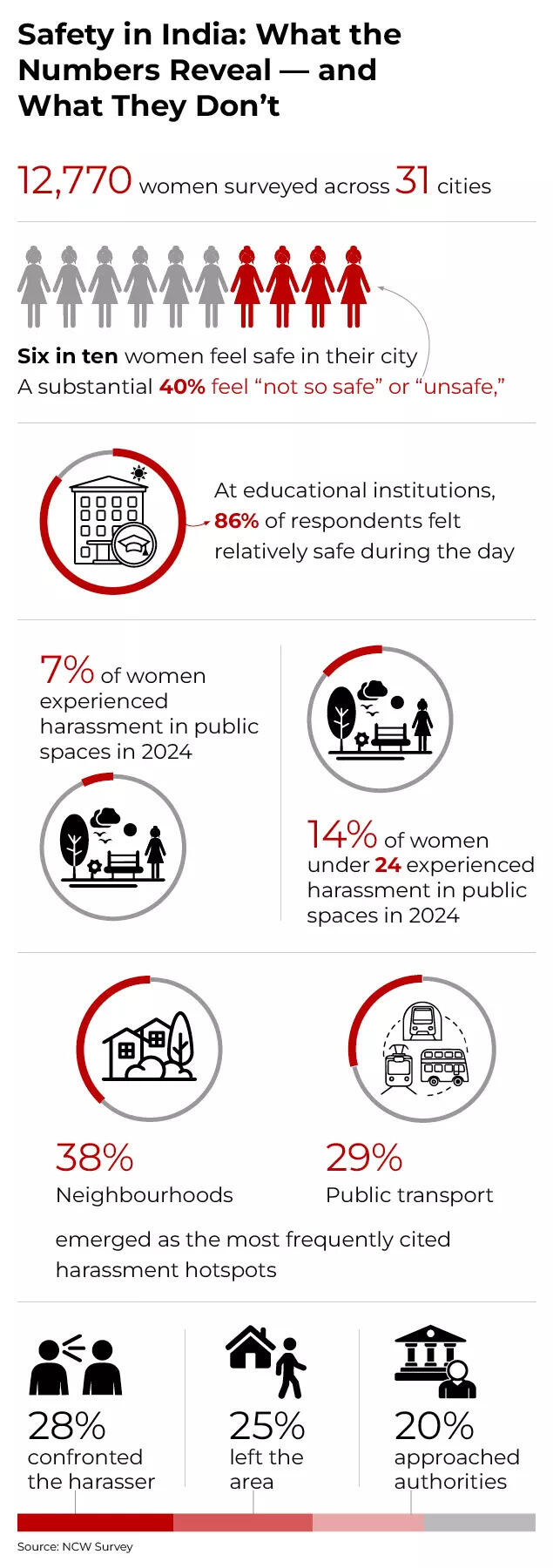
At the same time, increased FIR registration does not eliminate concerns about underreporting. Crimes such as domestic violence, marital sexual abuse, cyber harassment, and trafficking remain significantly underrepresented in police data. In many cases, complaints are withdrawn, informally “settled,” or never converted into FIRs due to pressure from families or local authorities. Moreover, higher FIR volumes are not always matched by proportional improvements in investigations, charge-sheeting, or convictions, raising questions about whether the system is equipped to handle greater reporting effectively.Recent findings from the National Annual Report and Index on Women’s Safety, released by the National Commission for Women (NCW), further underline the limits of relying solely on official crime statistics to assess women’s safety. Based on a survey of 12,770 women across 31 cities, the report seeks to document unreported harassment, everyday experiences, and perceptions of safety that rarely enter police records. India received a national safety score of 65 per cent, with six in ten women saying they felt safe in their city. However, a substantial 40 per cent still described themselves as “not so safe” or “unsafe,” revealing a significant perception gap.
.
The data shows that while educational institutions are viewed as relatively safe by 86 per cent of respondents during the day, feelings of safety decline sharply at night and in off-campus spaces. The survey also found that 7 per cent of women reported experiencing harassment in public spaces in 2024, a figure that rises to 14 per cent among women under 24, identifying young women as a particularly vulnerable group. Crucially, the report highlights pervasive underreporting, with nearly two-thirds of harassment incidents never formally reported, suggesting that NCRB figures capture only a fraction of the problem. Neighbourhoods (38 per cent) and public transport (29 per cent) emerged as the most frequently cited harassment hotspots.Women’s responses to harassment varied widely: 28 per cent confronted the harasser, 25 per cent left the area, and only 20 per cent approached authorities reflecting low confidence in institutional redress. Indeed, just one in three victims filed a formal complaint, pointing to enduring trust deficits in policing and complaint mechanisms, and reinforcing the gap between lived experience and recorded crime.
The violence that never reaches the police
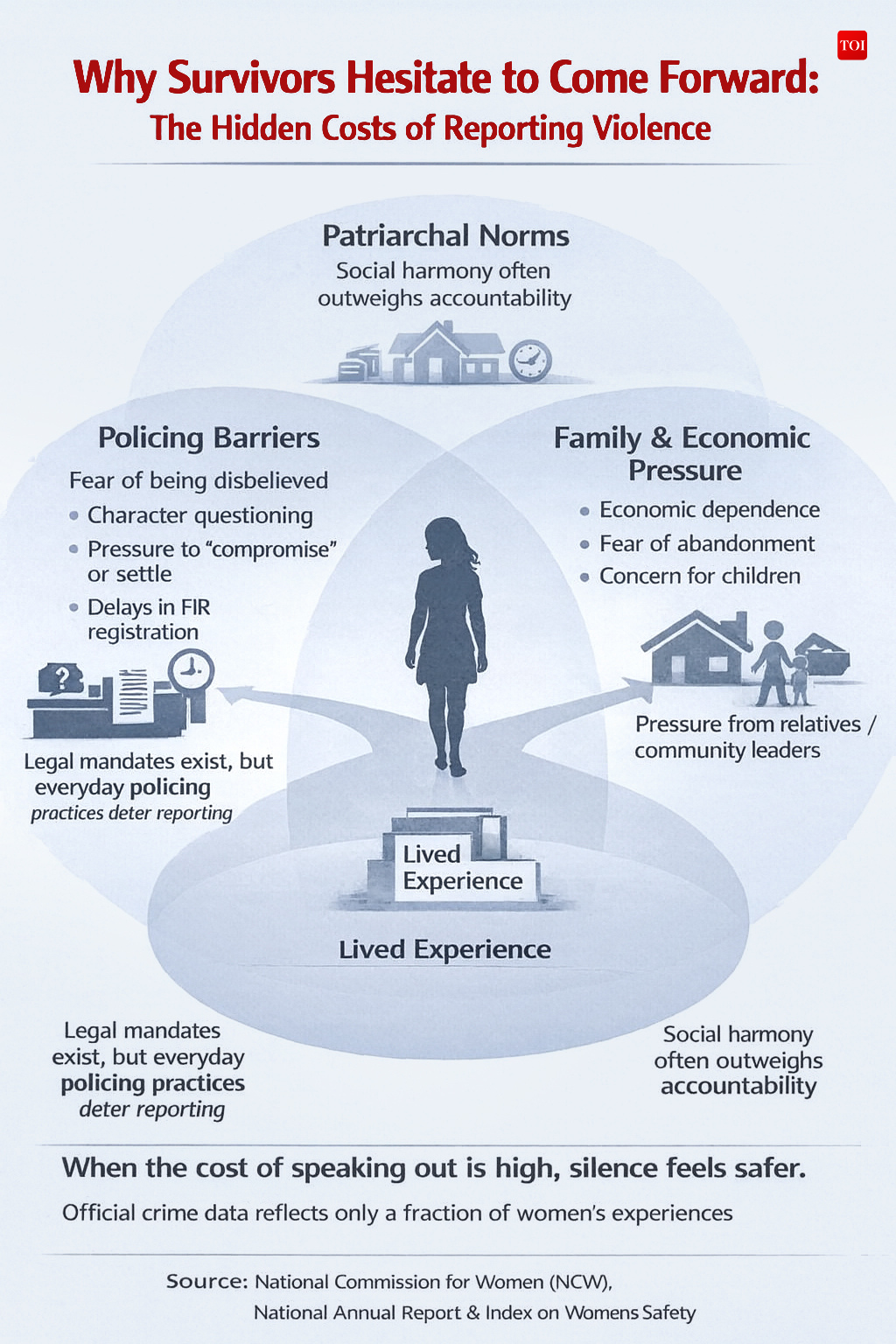
For many survivors of violence, the decision to report an offence is shaped less by the severity of the crime than by the social and institutional costs of speaking out. Policing structures, patriarchal norms, and sustained pressure from families and communities combine to create formidable barriers to reporting, particularly in cases involving sexual violence, domestic abuse, or harassment by known perpetrators. While legal frameworks mandate the registration of complaints, the lived experience of engaging with the criminal justice system often deters survivors from approaching it in the first place.Interactions with the police remain a significant point of friction. Survivors frequently cite fear of being disbelieved, questioned about their character, or pressured into compromise rather than a formal complaint. In cases of domestic violence or sexual assault, women are often encouraged to deal with matters in private spaces, reflecting deeply ingrained attitudes that prioritise social harmony over individual justice. Procedural hurdles, such as repeated visits to police stations, insensitive questioning, or delays in registering First Information Reports, further discourage reporting, especially for women with limited mobility, financial dependence, or caregiving responsibilities.
Policing, patriarchy, and pressure
Patriarchal expectations within families and communities add another layer of pressure. Survivors may be warned that reporting violence will bring shame, damage marriage prospects, or invite social ostracism. In intimate partner violence, economic dependence and concern for children’s welfare frequently compel women to endure abuse in silence. Young women, in particular, face heightened scrutiny, with families often prioritising “reputation” over accountability, discouraging formal complaints even when harm is severe.
.
These pressures are compounded by structural weaknesses in survivor support systems.Together, policing practices, patriarchal control, and social pressure create a climate where silence appears safer than disclosure. As a result, official crime data captures only a narrow slice of women’s experiences, masking the depth of violence that continues to shape everyday life.
Statistics and silence: What trauma leaves undocumented
Crime data is designed to count incidents, not to measure the enduring weight of trauma or the complex realities of survival. While statistics can indicate how many cases were reported, registered, or prosecuted, they remain largely silent on what violence does to women’s bodies, minds, livelihoods, and relationships long after the event. The aftermath of abuse, fear, anxiety, depression, disrupted education or employment, and fractured social ties rarely appears in official records, even though these consequences often shape a survivor’s life more profoundly than the crime itself.Numbers also fail to capture the uneven paths to survival. For many women, continuing daily life involves constant negotiation: avoiding certain routes, abandoning jobs, changing schools, or remaining in unsafe homes due to financial dependence or lack of shelter. These acts of adaptation and endurance are invisible in crime statistics, which treat incidents as discrete events rather than ongoing experiences. A closed case or a withdrawn complaint may signal resolution on paper, but it often masks unresolved harm or coercive compromise.Equally absent from the data are the cumulative effects of repeated, low-level violence, verbal abuse, intimidation, stalking, and digital harassment that may not meet reporting thresholds but steadily erode a sense of safety and autonomy. Crime figures can show whether violence is counted, but not whether dignity is restored. Without incorporating survivor-centred perspectives, trauma-informed indicators, and long-term outcomes, data risks reducing deeply personal suffering to abstract totals, obscuring both the cost of violence and the resilience required to live with it.