
Explain in person ‘inaction’ over 36 polluting sites: HC to BMC chief, MPCB official | Mumbai News
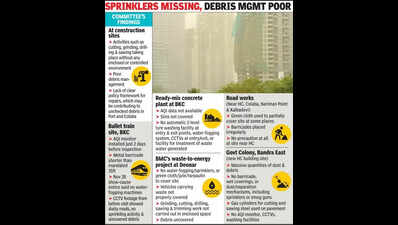

Mumbai: Observing that a ground reality report by a four-member panel prima facie indicates non-compliance with air pollution control guidelines at all 36 sites surveyed, Bombay high court directed BMC chief Bhushan Gagrani and Maharashtra Pollution Control Board’s (MPCB) member-secretary to appear in person on Tuesday morning. “We have formed a prima facie opinion that the municipal commissioner and the member secretary of MPCB should personally explain the inaction on the part of the officers concerned”, said a bench of Chief Justice Shree Chandrashekhar and Justice Gautam Ankhad. It orally said stop-work notices ought to be issued at non-compliant sites.The court-appointed panel’s report indicated that on-ground implementation of civic guidelines to curb air pollution was lacking, and compliance, where seen, was “cosmetic”.The panel found a “recurring pattern of incomplete or inconsistent compliance” at the bullet train project site, a ready-mix concrete (RMC) plant and the Metro 2B site at BKC. “The RMC plant showed the most serious non-compliance,” it said. It said demolition activities in Bandra East at the govt colony where the new HC complex is planned were found to be “generating massive amounts of dust and debris, which were scattered openly across premises” with “no barricades, wet coverings or dust suppression mechanisms in place”. Senior counsel Darius Khambata, the amicus curiae (friend of the court to assist), cited and read findings from the report. Senior counsel S U Kamdar for BMC sought the matter be deferred by a few days to enable the civic chief to read the report. The CJ-led bench orally said, “Nothing doing… Not even one day. We are summoning them [on Tuesday].” The bench, hearing a suo motu PIL to tackle rising air pollution in Mumbai and neighbouring areas, asked if the sites visited by the panel members—advocates Karan Bhosale, Namrata Vinod and Anand Mallya, and forest conservator Anita Patil—were compliant. Khambata said none were. Senior counsel Ashutosh Kumbhakoni for MPCB said action would be taken and was being contemplated. The CJ, dictating the order, said, “We have been taken through some parts of the report prepared by the court-appointed committee running into 74 pages.“Khambata said the report prepared by the committee and the observations and findings demonstrate a complete lack of monitoring of the polluting sites. “We have also taken note of the fact that steps were taken by the authorities after this court took suo motu cognisance of the poor air quality in Mumbai and the surrounding areas. The report dated Dec 15 was after the panel visited sites where AQI (air quality index) was poor,” said HC. The panel found the condition of MPCB’s air monitoring station in Mahape, Navi Mumbai, to be deeply alarming, reflecting systemic neglect and operational failure. “The outdoor air quality display was completely non-functional, down since at least Dec 11,” it said. At Fort, Cuffe Parade and Colaba in south Mumbai, it found poor adherence to BMC’s guidelines at four construction and redevelopment sites. The issues involved were not minor lapses but fundamental shortcomings in basic dust control and site management measures, although there was significant scope for corrective action, it said. The report said three of the four were “almost entirely non-compliant with the basic pollution control and safety measures” required under the BMC guidelines. At one site, an AQI monitor was installed, but its placement was on the ground floor of the 20-storey under-construction building. The remaining three sites showed widespread and repeated breaches of the required norms, the report said. Compliance across 17 under-construction sites, three RMC plants, seven road sites and five infrastructure sites was more “reactive, rather than proactive,” with compliance intensifying after HC’s suo motu PIL hearing following the recent spike in Mumbai’s AQI. “Water sprinklers, fogging and smog guns are deployed in a limited, ad hoc or cosmetic manner and appear largely confined to areas where authorities claim clear jurisdiction”, and vehicles carrying demolition waste had no tracking system, while road cleaning activities were “often spreading pollution”, not suppressing it, with no wetting measures, the panel said. It recommended “urgent action” to ensure complete implementation of existing guidelines, real-time monitoring, centralised data integration, differential standards by activity type and accountability at every site. Without these measures, it cautioned, the AQI will deteriorate further and “public health risk will persist unabated”.