
India-New Zealand FTA: Zero duty on 100% Indian exports – what the deal means for trade, MSMEs & Indian workers & students
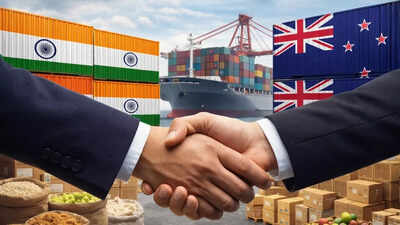
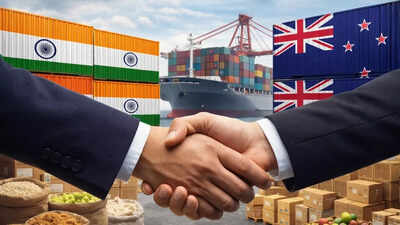
India-New Zealand trade deal: Prime Minister Narendra Modi and his New Zealand counterpart Christopher Luxon on Monday had a telephonic conversation and announced finalising the India-New Zealand Free Trade Agreement (FTA). Both leaders stressed that this FTA would help enhance trade, investment, innovation, and shared opportunities between the two countries.Negotiations for the trade deal began during New Zealand Prime Minister Christopher Luxon’s visit to India in March 2025, with both sides positioning the pact as a major step towards deepening bilateral economic ties. The agreement is expected to significantly enhance economic engagement, improve market access, encourage investment flows and strengthen strategic cooperation between the two countries. It is also projected to create new opportunities for innovators, entrepreneurs, farmers, MSMEs, students and youth across a wide range of sectors.
India-New Zealand Free Trade Agreement: Top Points To Know
- In a major boost for India, once the FTA is in place, Indian exports to New Zealand will get zero-duty access, with tariff elimination across all tariff lines. The pact is expected to benefit farmers, MSMEs, workers, artisans, women-led enterprises and youth, while creating new opportunities for labour-intensive sectors such as textiles, apparel, leather and footwear.
- Manufacturing-oriented sectors including engineering, automobiles, electronics, machinery, plastics, pharmaceuticals and chemicals are also set to gain from the agreement, which aims to deepen trade and economic cooperation between the two countries.
- The trade deal aims to expand cooperation in services, mobility, goods, investment and trade facilitation, with the aim of doubling bilateral trade over the next five years.
- As part of the deal, New Zealand has committed to investing $20 billion in India over a 15 year period, following a framework similar to the European Free Trade Association model. The proposed investments are expected to target manufacturing, infrastructure, services, innovation and job creation, providing a significant boost to India’s investment landscape.
- The agreement also places strong emphasis on agriculture. Indian farmers are expected to gain improved access to New Zealand’s market for products such as fruits, vegetables, coffee, spices, cereals and processed foods.
- Through initiatives such as the Agricultural Productivity Partnership, Centres of Excellence and access to New Zealand’s advanced agricultural technologies, farmers are expected to benefit from higher productivity, improved quality and increased incomes. Targeted measures for horticultural products including honey, kiwifruit and apples are aimed at supporting sustainable growth in the sector.
- At the same time, India has protected sensitive domestic sectors under the agreement. Agriculture and allied products including dairy, sugar, coffee, spices, edible oils, precious metals such as gold and silver, precious-metal scrap, copper cathodes and rubber-based products have been safeguarded to protect farmers, MSMEs and domestic industries.
- The FTA opens new avenues for India’s services sector across areas such as information technology and IT-enabled services, finance, education, tourism and construction.
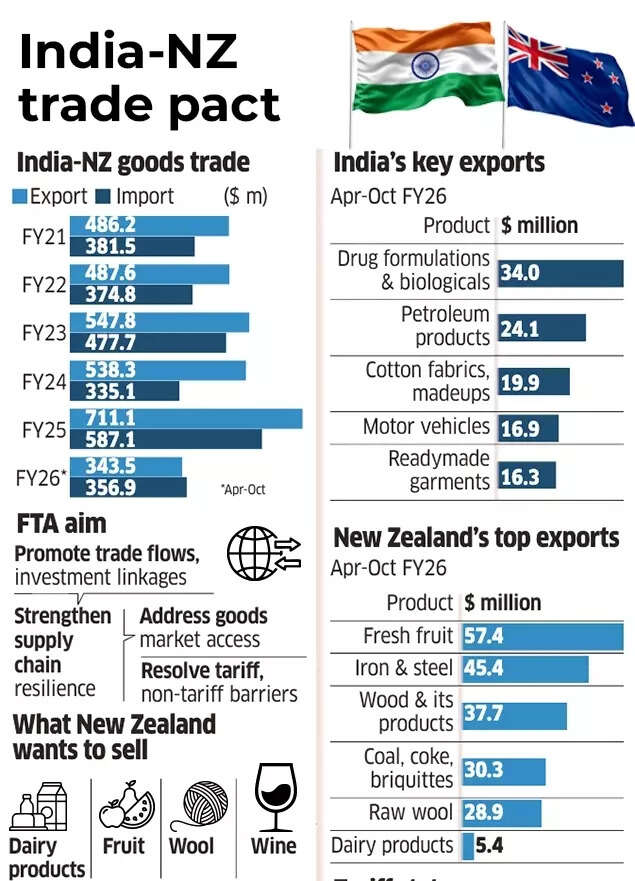
India-NZ trade details
- A key pillar of the agreement is services and mobility. New Zealand has offered market access in 118 services sectors and sub sectors and extended Most Favoured Nation treatment in 139 services sectors. India, in turn, has granted New Zealand market access in 106 service sectors and MFN treatment in 45 sectors. The agreement also includes an annex on health and traditional medicine services to promote trade in these areas, marking the first time New Zealand has signed such an annex with any country.
- Mobility provisions feature prominently in the pact. For the first time, New Zealand has signed an Annex on Student Mobility and Post Study Work Visas with another country. The arrangement places no numerical limits and guarantees Indian students the right to work 20 hours per week. Post study work visas have been provided for up to three years for graduates with bachelor’s degrees in Science, Technology, Engineering and Mathematics, up to three years for master’s degree holders and up to four years for doctoral graduates.
- The agreement also creates a new pathway for Temporary Employment Entry Visas, allowing up to 5,000 Indian professionals in skilled occupations to stay in New Zealand for a maximum period of three years. Eligible categories include AYUSH practitioners, yoga instructors, Indian chefs and music teachers, along with professionals from sectors such as information technology, engineering, healthcare, education and construction. In addition, a Working Holiday Visa arrangement will allow 1,000 young Indians to travel to New Zealand each year with multiple entries for a 12 month period.
- On the goods front, India’s simple average MFN tariff of 16.2 percent will fall to 13.18 percent once the agreement comes into force, further reducing to 10.30 percent after five years and reaching 9.06 percent by the tenth year. Market access has been extended on 70.03 percent of tariff lines, while 29.97 percent have been excluded, largely covering sensitive sectors such as dairy, select animal and vegetable products, sugar, fats and oils, arms and ammunition, gems and jewellery, and copper and aluminium products.
Christopher Luxon shared in a post on X, “I’ve just spoken with India’s Prime Minister Narendra Modi following the conclusion of the NZ-India Free Trade Agreement. The FTA reduces or removes tariffs on 95% of our exports to India. It’s forecast that NZ exports to India could increase $1.1B to $1.3B per year over the coming two decades. Boosting trade means more Kiwi jobs, higher wages and more opportunities for hard working New Zealanders. The agreement builds on the strong friendship between our two countries. India is one of the fastest-growing economies in the world, and this gives Kiwi businesses access to 1.4 billion Indian consumers. Our Government is relentlessly focused on fixing the basics and building the future – with new trade deals like this helping to grow our economy so all Kiwis can get ahead.”In the fiscal year 2024-25, bilateral merchandise trade stood at $1.3 billion, while the total trade in goods and services was approximately $2.4 billion in 2024, with services trade alone accounting for $1.24 billion.