‘Greatest challenge since 1971’: House panel flags rising Pakistan, China influence in Bangladesh; what steps can India take?
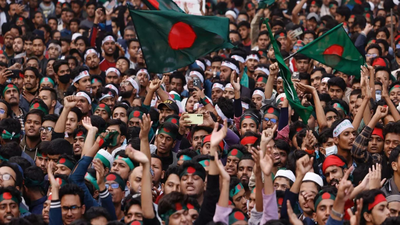
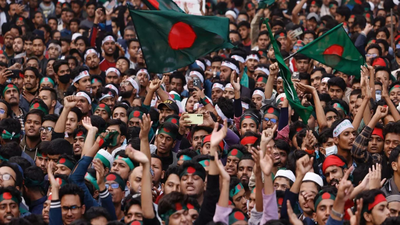
NEW DELHI: A parliamentary standing committee on external affairs has warned that India is facing its most significant strategic challenge since the 1971 war, due to the evolving political and security situation in Bangladesh, pointing to the resurgence of Islamist forces, weakening domestic political structures and growing influence of China and Pakistan in Dhaka.The committee on Thursday tabled its 9th report titled ‘Future of India-Bangladesh Relationship’ in the Lok Sabha. The panel, chaired by Congress MP Shashi Tharoor, said that while the situation does not pose an immediate existential threat to India, it represents a deeper, long-term strategic test with implications for regional stability and India’s neighbourhood policy.“India faces its greatest strategic challenge in Bangladesh since the Liberation war of 1971. While the challenge in 1971 was existential, a humanitarian and a birth of a new nation, the latter was of a graver, a generational discontinuity, a shift of political order, and a potential strategic realignment away from India,” the report said quoting an expert. The committee took into account multiple testimonies from government officials and non-governmental experts, the panel also noted that Bangladesh’s ongoing political transition and shifting external alignments could reshape India’s security and foreign policy environment over time.According to the panel, a key source of uncertainty is the declining political dominance of the Sheikh Hasina-led Awami League. While the party secured 224 of 300 seats in the January 2024 elections, the panel flagged an estimated voter turnout of around 40 per cent, which raises concerns over popular participation, political legitimacy, institutional control and public confidence.On the stay of former Bangladesh PM Sheikh Hasina in India the panel said, “The Committee note that the stay of former Prime Minister of Bangladesh, Sheikh Hasina, in the country and India’s approach in this regard is guided by its civilisational ethos and humanitarian tradition of offering refuge to individuals facing circumstances of grave distress or existential threat,” the report said.” The panel recommended that the government should “continue to uphold its principled and humanitarian approach”, consistent with India’s values and international responsibilities, while ensuring that such situations are “managed with due sensitivity”.The committee also pointed towards the emergence of youth-led nationalist sentiment alongside a renewed presence of Islamist groups, warning that the combination could act as a destabilising force with implications for both Bangladesh’s internal security and the wider region.Another major concern flagged by the panel is the expanding footprint of China and Pakistan in Bangladesh. It said these developments could dilute India’s traditional influence in Dhaka and complicate New Delhi’s strategic calculus in its immediate neighbourhood. “…The event was marked by collapse of Awami League dominance, the surge of youth-led nationalism, the re-entry of Islamists and intensifying Chinese and Pakistani influence collectively..if India fails to recalibrate at this moment, it risks losing strategic space in Dhaka not to war, but to irrelevance,” report added.The ministry of external affairs told the committee that India has made concerted efforts to insulate bilateral ties from recent political developments and to continue engagement with Bangladesh’s interim government, while supporting the wishes of the Bangladeshi people.On the question of collaboration between both nations, the route through SAARC and BIMSTEC also came up to which the foreign secretary told the panel, until Pakistan changes its state policy of cross border terrorism there can be no conversation around reviving SAARC.“We have made it very clear to anybody and everybody in SAARC who is coming up to us with proposals for reviving it that we cannot have dialogue and terrorism go on at the same time. Until Pakistan changes its policy of crossborder terrorism as an instrument of State policy, there is no possibility of going forward with SAARC. I did make the point also that BIMSTEC does pretty much everything that SAARC does and then some other things and since the organisation is headquartered in Dhaka, it would be useful if Bangladesh takes it forward. I must say that there was no pushback against it….” the report quoted foreign secretaryThe panel, however, questioned why Indian authorities failed to anticipate the political crisis despite what it described as warning signals and extensive media reporting ahead of the developments. In response, the government said the situation in Bangladesh is being monitored on a priority basis with continuous assessments underway.Concluding its report, the committee stressed that Bangladesh’s evolving political trajectory and external alignments would require sustained attention from India, given the country’s central role in regional stability.In its suggestions the committee said, “The Committee urge the Government to continue advocating a democratic, stable, peaceful, people-centric, forward-looking and inclusive Bangladesh, firmly anchored in the spirit of 1971 and mutual respect. The Committee further recommend that the Government should maintain sustained diplomatic engagement with all political, social, and civil society stakeholders in Bangladesh to foster an environment of trust and dialogue. Such engagement should be complemented by Track II and Track 1.5 diplomacy, involving Parliamentary exchanges, think tanks, academia, media, and cultural organizations, to strengthen people-to-people connections and counter misperceptions.”