
India’s groundwater crisis: Which states are heading towards ‘Day Zero’ first | India News
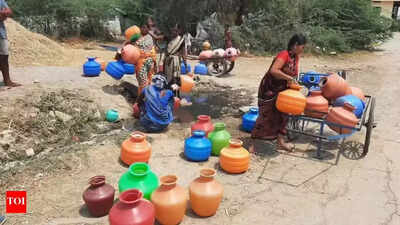
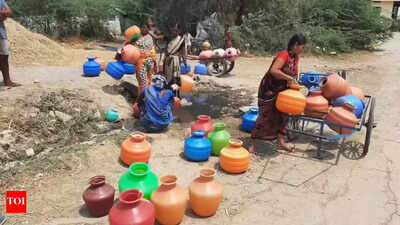
In a narrow lane of India, men and women wait quietly with plastic drums lined in rows. Some squat, some sit, with eyes fixed on the bend ahead. Suddenly, the silence breaks. A water tanker reverses into the alley, its engine drowning out the waiting. Young men rush forward, climbing atop the truck, lowering pipes into the tank. Within moments, quiet order unravels into chaos. Hundreds of kilometres away, in rural India, women walk long distances to empty wells, dried-up tubewells and shrinking water bodies, hoping to find a few litres of water.Just because some cities suffered floods doesn’t mean you have water. For a country that supports nearly 17% of the world’s population with just 4% of its freshwater resources, water scarcity has become a daily reality, and not just a distant threat.With India’s population expected to rise from 1.3 billion to nearly 1.7 billion by 2050, the question is no longer whether India is facing a water crisis.But how soon parts of the country will run out!
What is a water crisis? How severe is it in India?
A water crisis occurs when the availability of safe, usable water falls short of demand. The World Bank defines water scarcity as a situation where annual per capita water availability drops below 1,000 cubic metres.India is steadily moving towards this threshold.Despite supporting 17% of the world’s population, India has access to only 4% of global freshwater resources. According to NITI Aayog’s Composite Water Management Index (CWMI), the country is facing the worst water crisis in its history, with nearly 600 million people experiencing high to extreme water stress.India’s per capita water availability stood at 1,486 cubic metres in 2021, placing it in the water-stressed category (below 1,700 cubic metres). Government estimates suggest this could fall further to 1,341 cubic metres by 2025 and 1,140 cubic metres by 2050, pushing large parts of the country closer to scarcity.
A shrinking global water reserve
Globally, freshwater reserves have declined sharply over the last two decades, with losses estimated at 324 billion cubic metres every year, enough to meet the annual water needs of 280 million people.According to the Union minister of Jal Shakti releases Dynamic Ground Water Resource Assessment Report of the Country for the Year 2025, “Groundwater assessment units across India are categorised as safe, semi critical, critical and over exploited, based on the ratio of annual groundwater extraction and replenishment in the phreatic aquifer. The assigned categories aid in planning, management, and regulation of the country’s groundwater resources.”Water consumption worldwide increased by 25% between 2000 and 2019, with nearly a third of that growth occurring in already water-stressed regions, the report stated.Northern India figures prominently among these drying zones, alongside parts of northern China, Central America and the southwestern United States. Rising temperatures, erratic rainfall, worsening droughts and unsustainable land and water use have accelerated the decline.For India, the implications are stark. Agriculture, livelihoods, urban growth and ecological sustainability all hinge on groundwater, the country’s most heavily used and least regulated water source.
Groundwater: India’s invisible lifeline
Groundwater forms the backbone of India’s water security. According to the 2019 NITI Aayog report, the Central Groundwater Board (CGWB) stated that the contribution of groundwater is nearly 62% in irrigation, 85% in rural water supply and 45% in urban water supply.Yet this invisible lifeline is being drawn down faster than it can be replenished. As per the Dynamic Ground Water Resource Assessment 2025, India’s total annual groundwater recharge stands at 448.52 billion cubic metres (bcm).After accounting for natural discharge, the annual extractable resource is estimated at 407.75 bcm. Current extraction has reached 247.22 bcm, pushing the national stage of groundwater extraction to about 60.6%.While the national average may suggest moderate stress, the reality on the ground is far more uneven.Out of the total 6,762 assessment units, around 25% have been categorised as Overexploited, Critical, or Semi-Critical. These are areas where extraction is approaching or exceeding natural recharge, a warning sign that aquifers are under severe stress.
States/cities staring at ‘Day Zero’
The most vulnerable regions are concentrated in three broad zones:
- Northwest India: Punjab, Haryana, Delhi and western Uttar Pradesh — where groundwater recharge exists but indiscriminate withdrawal, driven largely by agriculture, has led to over-extraction.
- Western India: Rajasthan and parts of Gujarat — where arid conditions limit natural recharge.
- Southern peninsular India: including Karnataka, Tamil Nadu, Telangana and Andhra Pradesh, where hard, crystalline aquifers have low storage capacity.
States with the highest proportion of over-exploited and critical units include Punjab, Haryana, Rajasthan, Tamil Nadu and Delhi. In Punjab, groundwater extraction stands at over 156% of annual recharge. Rajasthan follows closely at 147%, while Delhi’s extraction level exceeds 90%, placing it in the critical category.Urban centres are not immune. NITI Aayog has warned that 21 major Indian cities, including Delhi, Bengaluru and Chennai, face the risk of depleting their groundwater reserves. Chennai already experienced ‘day zero’ in June 2019, when all four major reservoirs of the big city reservoirs ran dry. People had to line up for hours to wait for a small allocation of water brought in by trucks from other areas.A BBC report, citing UN projections, ranked Bengaluru second after Brazil’s São Paulo, among 11 global cities at risk of running out of drinking water. As water levels drop and summer temperatures rise, cities are imposing restrictions.In Bengaluru, authorities have banned the use of potable water for non-essential activities such as washing cars and watering gardens. Yet questions remain over whether fines and regulations alone can avert a full-blown crisis.In rural areas, the crisis manifests differently, in longer walks for water, abandoned wells and failed crops.
Why is India running out of water?
Experts point to multiple, interconnected causes:
- Rising demand: India’s water demand is expected to outstrip supply by 2030
- Agricultural overuse: Water-intensive crops like paddy in Punjab and Haryana
- Encroachment of water bodies: Lakes and ponds disappearing, especially in cities like Bengaluru
- Climate change: Erratic monsoons and declining river flows
- Pollution: Industrial waste, sewage, and mining contaminating groundwater
- Weak regulation: Outdated laws like the Easement Act of 1882, which ties groundwater ownership to land
- Fragmented governance: Separate authorities for surface and groundwater management
- Public apathy: Water treated as a free, unlimited resource
Groundwater overuse and contamination
India is the largest user of groundwater in the world, accounting for over 25% of global groundwater extraction. The consequences are severe:
- Nearly 70% of groundwater sources are contaminated
- India ranks 120th out of 122 countries on the global water quality index
Groundwater extraction in India is assessed using data from the Minor Irrigation Census and sample surveys conducted by State Ground Water Departments. According to the National Compilation on Dynamic Ground Water Resources of India, 2025, the country’s total annual groundwater extraction is estimated at 247.22 billion cubic metres (bcm).The agriculture sector remains the largest consumer, accounting for 87% of total extraction, or 215.10 bcm. Domestic use contributes 11% (27.89 bcm), while industrial use accounts for the remaining 2% (4.23 bcm).Water-intensive cropping patterns, such as paddy cultivation in Punjab and Haryana, and it continues to strain aquifers, even in regions where rainfall is relatively adequate. As India’s population grows and incomes rise, food demand is expected to surge.According to the NITI report, India’s population is expected to increase to 1.66 billion by 2050. At the same time, per capita income is estimated to increase by 5.5% per annum. With increasing population and purchasing power, the annual food requirement in the country will exceed 250 million tons by 2050. The total demand for grains will increase to 375 million tons including grain for feeding livestock by 2050.”“This will increase the demand for food. The surge in demand for these water-intensive crops will, ceteris paribus, multiply our current agricultural consumption of water,” it added.State and UT-wise classification shows:
- Over-exploited (>100%): Haryana, Punjab and Rajasthan
- Critical (90–100%): Delhi
- High stress (70–90%): Tamil Nadu and Puducherry
- Moderate to low stress (<70%): All remaining states and UTs, including Andhra Pradesh, Uttar Pradesh, Karnataka, Maharashtra, Telangana, West Bengal, Gujarat, Madhya Pradesh, and several northeastern states.
Despite a national average that masks local crises, groundwater stress is highly concentrated. More than 25% of administrative units fall under over-exploited, critical or semi-critical categories in nine states and UTs: Haryana, Karnataka, Madhya Pradesh, Punjab, Rajasthan, Tamil Nadu, Uttar Pradesh, Delhi and Puducherry.These regions face the highest risk of aquifer depletion, underscoring the urgent need for targeted groundwater management, crop diversification and demand-side interventions.Rainfall remains the primary source of groundwater recharge in India, but its distribution varies widely across regions and seasons. Most of the country receives rainfall during the southwest monsoon, while long dry spells dominate the rest of the year.
State-wise groundwater stress: What the data shows
Groundwater levels typically fall before the monsoon and recover partially during and after it. However, CGWB data shows that in 2024, more than 57% of monitored wells recorded a fall in water levels compared to the previous year, with significant declines observed in states such as Punjab, Rajasthan, Delhi, Maharashtra, Telangana and Uttar Pradesh.Geology further complicates the picture. Karnataka: According to the National Compilation on Dynamic Ground Water Resources of India, 2025, Karnataka’s annual groundwater recharge is estimated at 19.27 bcm, while extractable resources stand at 17.41 bcm. While recharge and extractable resources have increased marginally from 2024, extraction has also risen slightly. Overall, the state has seen a modest improvement, with extraction levels dropping from 68.44% in 2024 to 66.49% in 2025.Maharashtra: Central Maharashtra, a drought-prone region receiving only 400–700 mm of rainfall annually, remains heavily dependent on groundwater. The state’s annual groundwater recharge is estimated at 33.89 bcm, with extractable resources of 31.99 bcm. Extraction stands at 16.57 bcm, translating to a stage of extraction of 51.79% — a slight improvement from 2024.Punjab: Punjab remains among the most over-exploited states. Its annual groundwater extraction (26.27 bcm) far exceeds its extractable resource (16.8 bcm), pushing the stage of groundwater extraction to 156.36%.Although extraction has marginally declined from 2024, the state continues to draw far more water than it replenishes, largely due to water-intensive agriculture.Rajasthan: Rajasthan’s groundwater situation is similarly alarming. With an annual extraction of 17.10 bcm against extractable resources of 11.62 bcm, the stage of extraction stands at 147.11%. Despite slight improvements in recharge, over-extraction remains entrenched.Delhi: Delhi’s groundwater extraction stands at 92.10%, placing it in the critical category. While extraction has reduced slightly since 2024, the city remains heavily dependent on groundwater to meet domestic demand.
What is being done by govt?
Jal Shakti Abhiyan (JSA): To address India’s growing water crisis, the government has rolled out a series of initiatives aimed at conservation, recharge, and equitable access to water. One of the key programmes is the Jal Shakti Abhiyan (JSA), launched in 2019 as a nationwide movement to promote water conservation, groundwater recharge and rainwater harvesting. Atal Bhujal Yojana: Another major intervention is the Atal Bhujal Yojana, which emphasises sustainable groundwater management through community participation, improved recharge and regulated extraction.Atal Mission for Rejuvenation: In urban areas, the Atal Mission for Rejuvenation and Urban Transformation (AMRUT) 2.0 supports rainwater harvesting through stormwater drainage systems and promotes groundwater recharge via aquifer management plans.GIS based platform: To improve transparency and monitoring, the Central Ground Water Board (CGWB) has developed a GIS-based public platform called the India Groundwater Resource Estimation System (IN-GRES). The portal visualises groundwater recharge, extraction, rainfall and categorisation at the level of individual assessment units, allowing comparisons with previous years. Yet, even as policies and programmes expand on paper, a parallel and troubling reality persists.
The invisible crisis beneath our feet
India’s water crisis is not just about scarcity, but governance. Groundwater ownership laws dating back to the Easement Act of 1882 allow landowners to extract water beneath their land with few restrictions. Fragmented water management, weak enforcement and limited public awareness have allowed overuse to continue unchecked.While government initiatives, from the Jal Shakti Abhiyan and Atal Bhujal Yojana to large-scale rainwater harvesting and aquifer mapping programmes, aim to reverse the trend, experts warn that without behavioural change, crop diversification and strict regulation, these measures may not be enough.Water budgeting, which treats water like a financial account, balancing availability against demand is also increasingly being seen as a crucial tool to identify stressed regions before they reach breaking point.Behind this lies a darker reality, an informal and often illegal groundwater trade. Tankers extract water from over-exploited aquifers, frequently without regulation or quality checks, accelerating depletion while raising concerns over contamination.For now, the scenes of tankers, queues and dried wells serve as a warning. India may not be out of water yet, but in many places, it is running out of time. This underground trade, operating largely unchecked risks pushing India towards a long-term groundwater collapse tomorrow.