

Kogilu demolitions: Aadhaar not enough, officials struggling to verify evictees eligible for free housing | Bengaluru News
[ad_1]
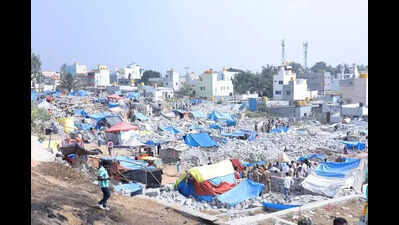
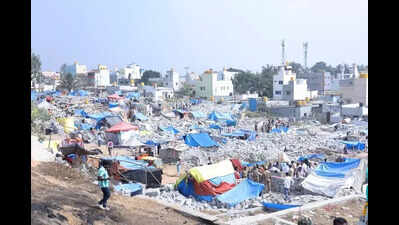
Bengaluru: The Karnataka govt is facing a major challenge in identifying eligible beneficiaries for free alternative housing among residents whose houses were demolished in Waseem Layout and Fakir Colony of Yelahanka’s Kogilu village last month.Preliminary survey data has revealed nearly 94% of the evicted families have Aadhaar cards, making it difficult to distinguish long-term Bengaluru residents from ineligible occupants. Of 165 families surveyed, 158 of them had Aadhaar cards. Among these, around 78 families were found to be residents of Bengaluru, and around 92 families had a valid ration card. In both the colonies, around 117 houses were demolished on Dec 20.
Despite most evicted families possessing Aadhaar cards, far fewer possessed supporting documents such as ration cards, income certificates, voter IDs, or domicile proof, according to the survey findings accessed by TOI. Many families lacked documents linking them to Bengaluru or Karnataka, complicating the screening process for free housing. Officials said Aadhaar cards alone cannot establish eligibility, as these do not prove length of stay, local residency, or entitlement under housing schemes. “Getting an Aadhaar today is relatively easy. That alone cannot be the basis for allotting govt houses,” a senior official involved in the survey said, adding multiple layers of verification were being followed. Multi-layered verification process The state govt publicly stated only eligible evictees — not encroachers — will be rehabilitated, with alternative housing proposed under existing state and central housing schemes. Eligibility will be determined based on a combination of documents, including ration cards, voter IDs, income certificates, and police verification. As part of the process, officials are also cross-verifying data with the food and civil supplies department, checking ration card databases, and sending select cases for police verification to establish identity, residency, and background. Officials said this process is being prioritised for the evicted families whose eligibility is unclear. The preliminary survey has also collected data on language, place of origin, and duration of stay, the officials said, noting that while nationality verification is the first step, the larger challenge lies in establishing local residency as required under the law. After establishing citizenship and identifying any non-Indian residents, the data will be filtered to ascertain how many residents are from Karnataka and, subsequently, how many qualify as long-term Bengaluru residents. Such multi-layered scrutiny is essential to ensure only genuine beneficiaries are identified for rehabilitation, said the official. Minister QUOTE We gave a clear mandate to the survey teams to identify genuine beneficiaries strictly as per prevailing govt rules and norms. Multiple departments – revenue, GBA, police, and housing are involved in this process. I am not interfering at the survey level because any intervention can distort the process. The teams are doing their job, and if they face difficulties, they will report it to us – Krishna Byre Gowda, revenue minister
[ad_2]
Source link