

Jayashree Chakravorty’s earth songs at KMB
[ad_1]
At Kochi Muziris Biennale’s Anand Warehouse, Mattancherry in Kerala, Reena Lath of Akar Prakar Gallery, unveils Jayashree Chakravorty’s moorings of momentous journeys and the fragility of the earth.
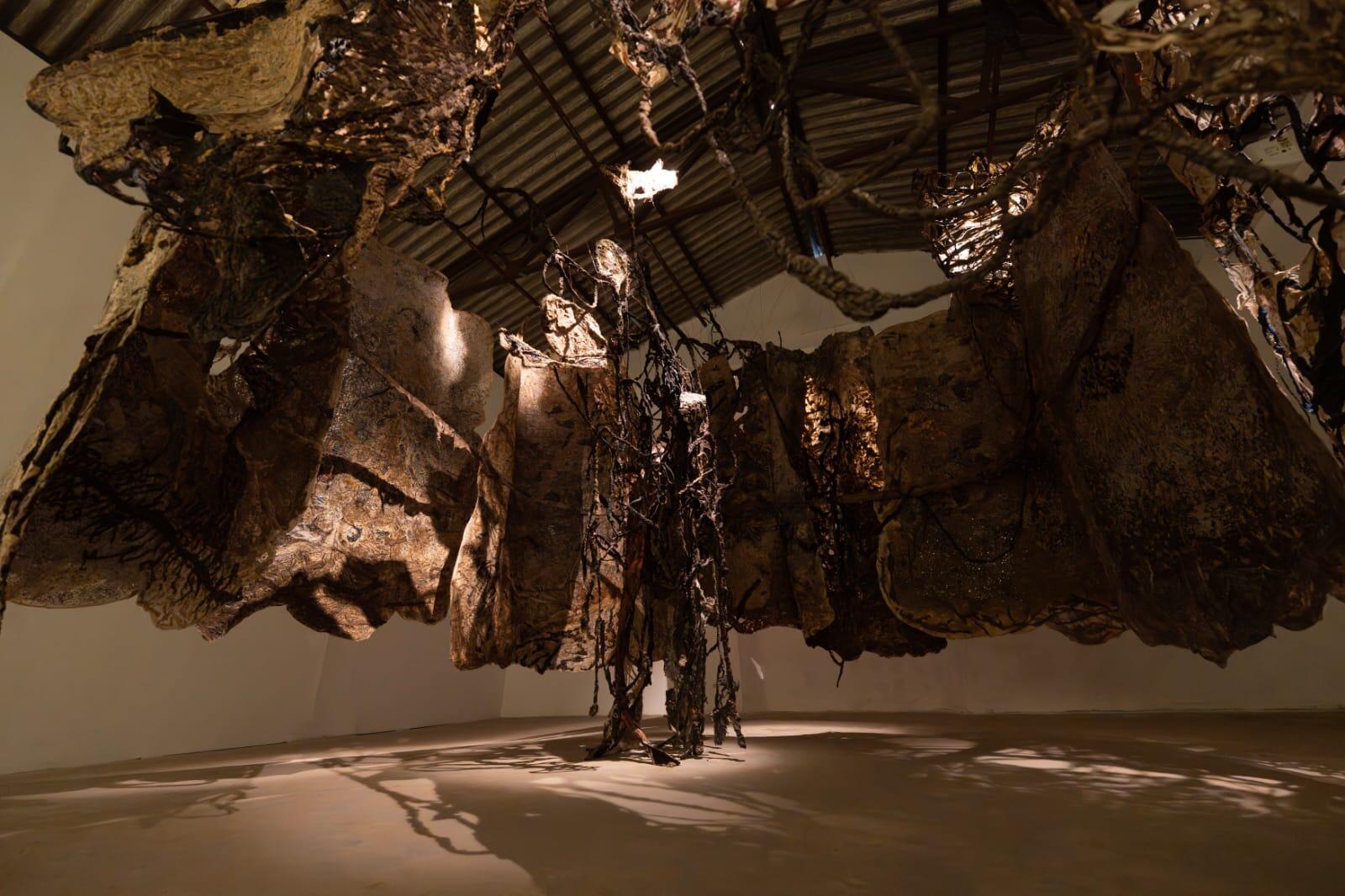
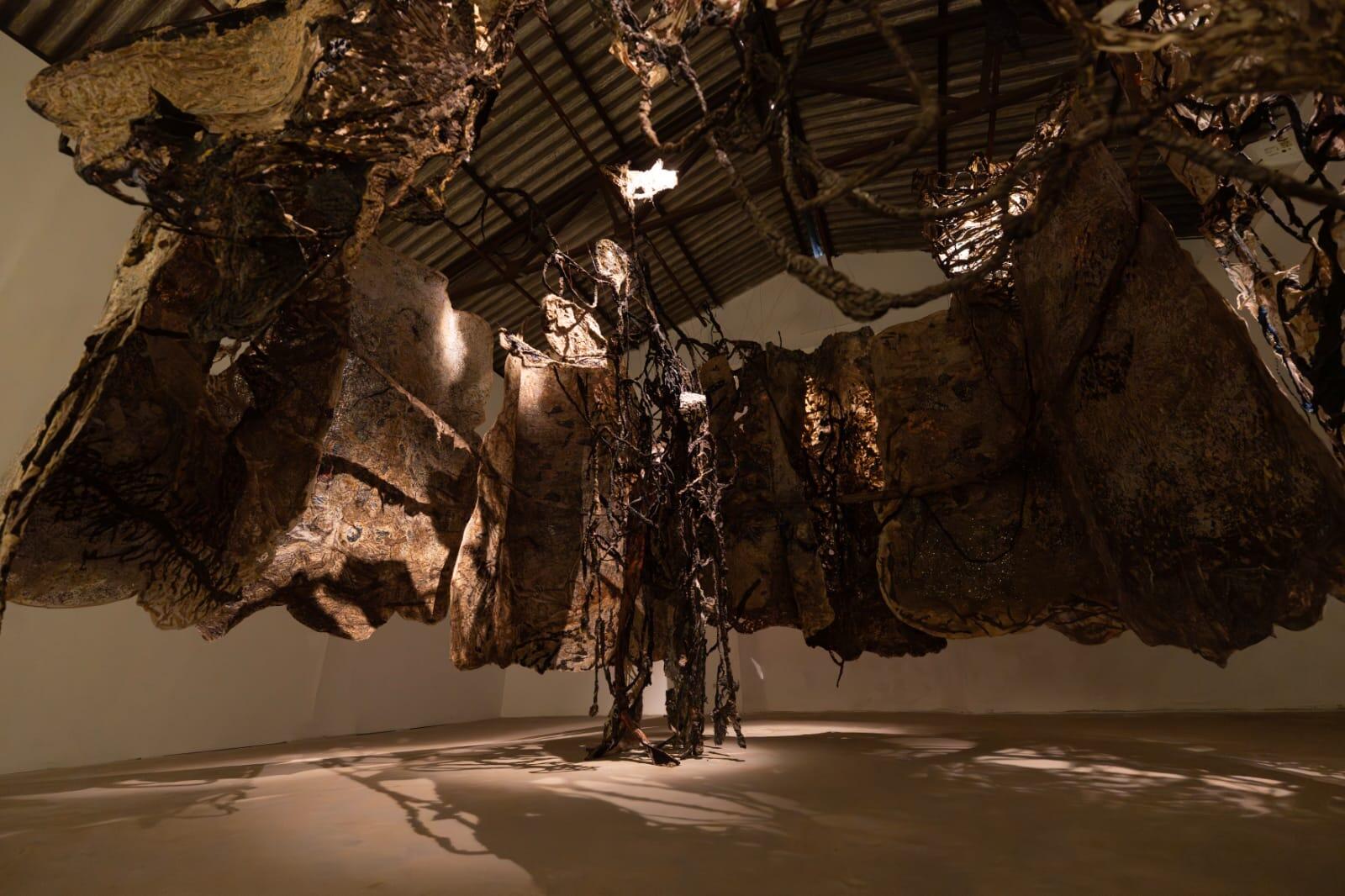
Monumental and contemplative is Shelter for the Time Being, an enchanting open ended organic form of overlapping, bustling, rough-hewn fragments, hanging loosely.
Mesmerising, multiple forms and images slowly and subtly emerge through the dense, yet translucent and opaque contours that produce the illusion of a fragmented yet fractured installation created in the charisma of its own cohesive corollaries.
Texture and botanical terrain captured in the dynamics of grainy gravitas create an amalgam of analogies that talk to us about Jayashree’s love for landscape as well as the land she inhabits.

As an artist of distinction, her history is one of admiration. She was an artist in residence at Aix-en-Provence from 1993-95, where she was influenced in the formative years of her practice by the French movement Supports/Surfaces, especially by Claude Viallat.
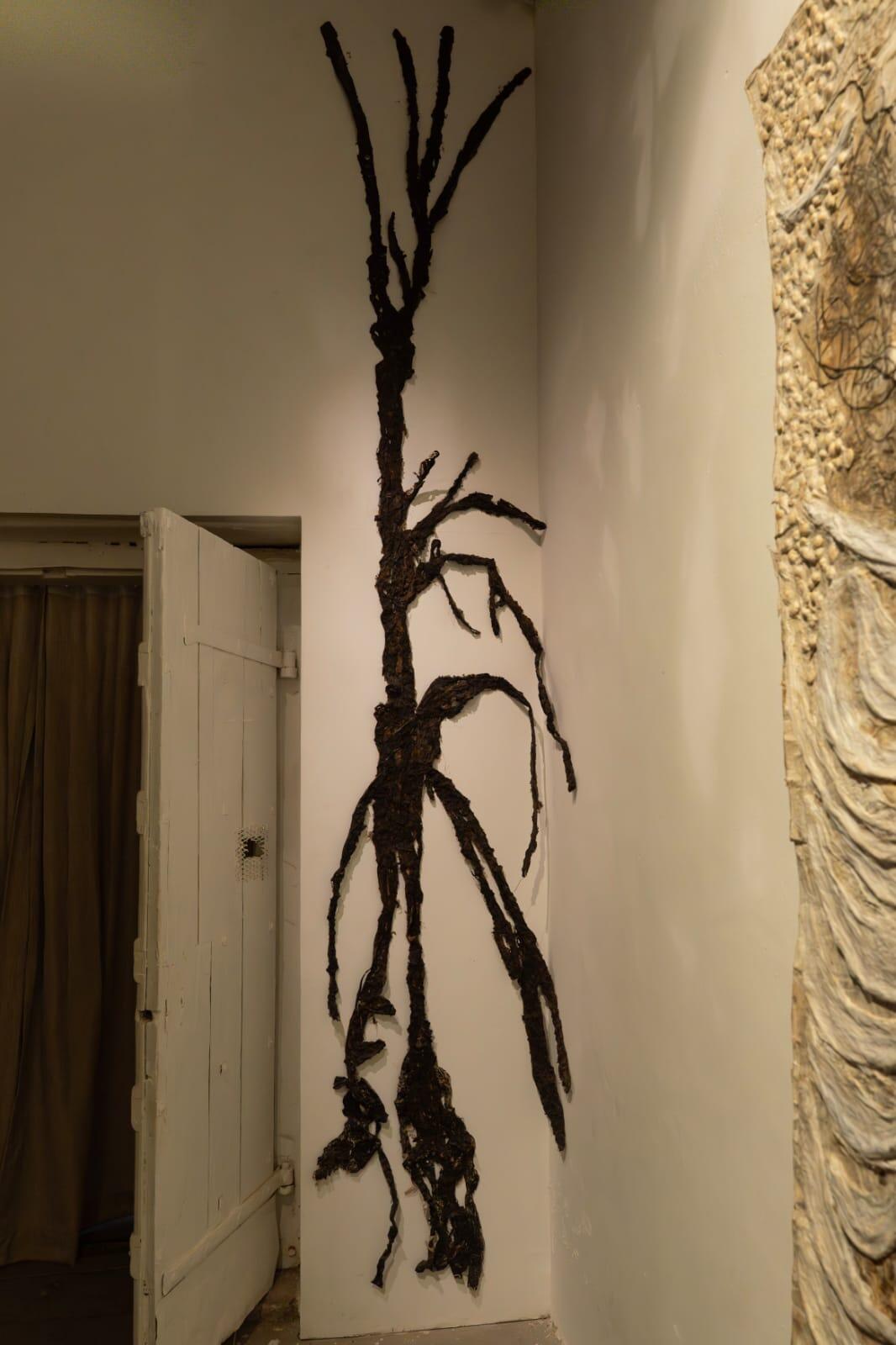
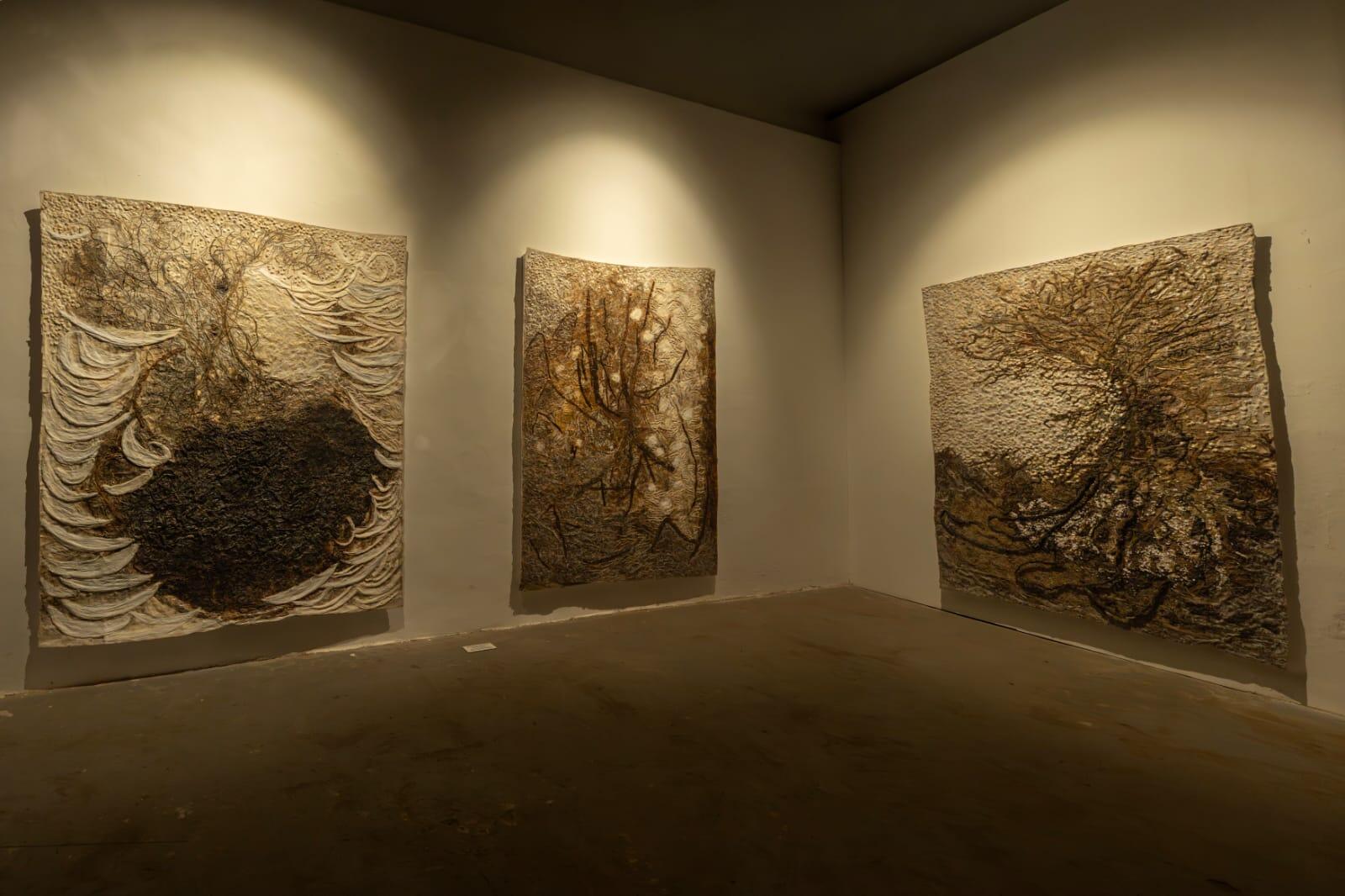
Inventing her own creative techniques, using organic material and varied kinds of Nepali handmade paper, her installations remain unique in their conception and execution.The three singular works on the wall become the accompaniment to the medley of ecological echoes.
Compositions of silent conversations

Her large installation wraps itself around your senses in a medium and methodology that have evolved over a long period of time. She has stated earlier that over many years she focused on the follies of blind human beings, unaware of the self-destructive consequences of ravaging nature.
Born in Tripura, trained at Shantiniketan, MS University Vadodara and Paris, Jayashree’s love for nature is something that she has always celebrated through the works that she builds upon.
In an interview with this critic in 2017, she said: “ My love for plants grew out of this habit of noticing plants for a long time, colours and patterns as they got more dense and fused together. I studied the changes and the cohesion that happened through the monsoon as well as summer months at Salt Lake. That is how I started gathering small bits and pieces. Like vegetation that mixes with the nurturing soil, when I paint, the twigs, leaves and thorns growing across also become part of the composition.”
Trio of soliloquies
At Kochi, the viewers are amazed at the connotation and the comprehensive character of the tensile nature of colours used in the mesmerising collages.
In an interview, she had said: “ I often use subtle yet cohesively collaborative colours. That gives another kind of dimension. I am not afraid of using anything — clay, tea dust, acrylic, jute cloth, tissue, glass pieces, beads. Its like a collage that is mapping a journey. The footprints are mine. I just enjoy it.”
Besides areas of earthy cream is a soiled sepia in three works she titles, Fertile, Emerging and Energy. We can sense that long ago she has given free rein to her imagery and banished conventions of composition.
But in her contemplative idioms of abstraction is a meandering mosaic of memories and her intrinsic proximity to nature. It wouldn’t be wrong to say that France gave her the alacrity of expressionist technique and Shantiniketan the cross-hatched magic and caprice of composition.
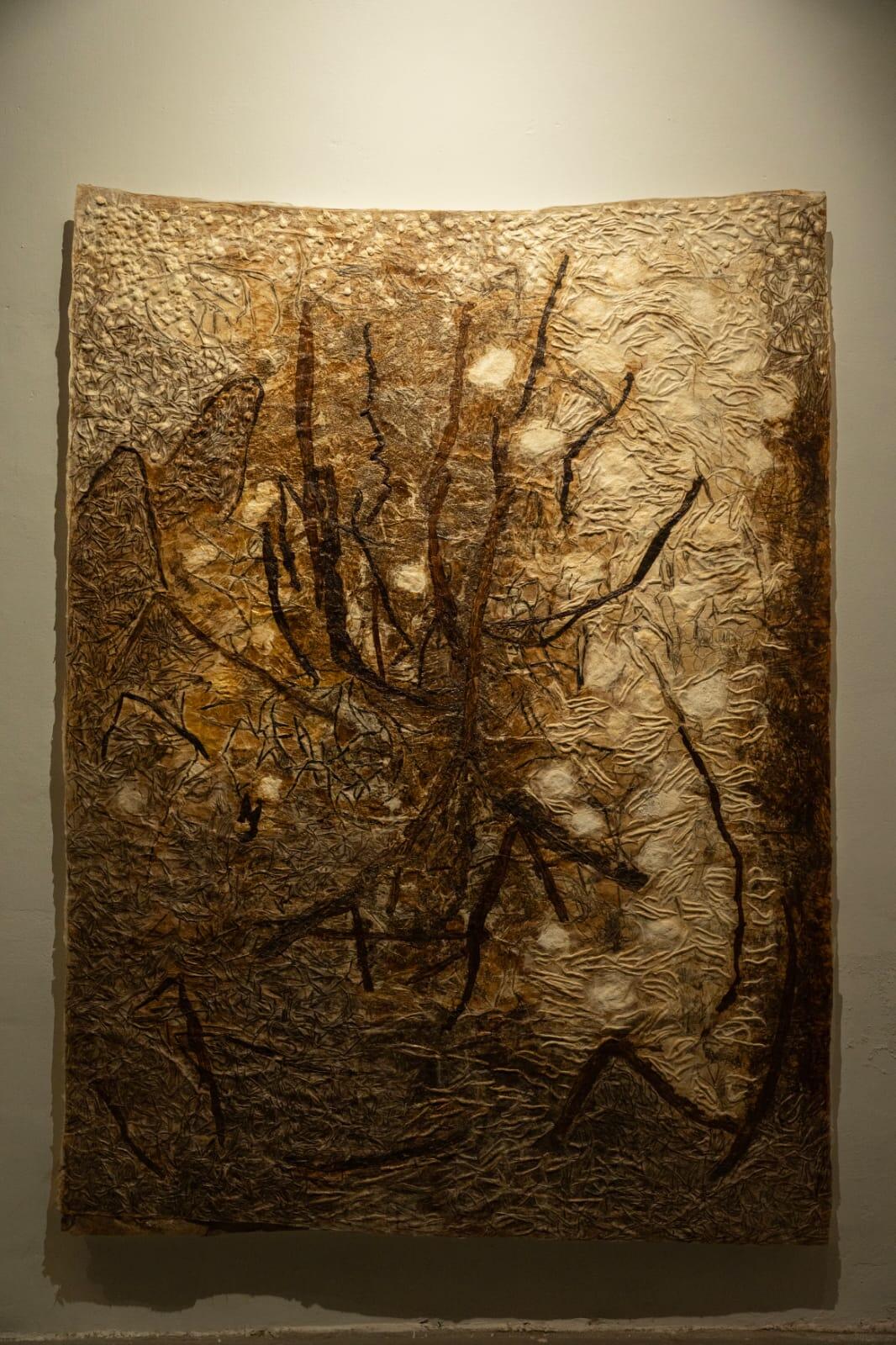
Materials and Nature
The matrix and mosaic of organic material are amply evident in these works. These large works feature assiduously built-up surfaces composed of writhing roots, an assortment of seeds, needlelike dried grasses, bits of string, tea stains, and sheets of translucent paper, all held together with a special white glue.
Powerful expressionistic lines create dark webs while a flurry of small white circular orbs of paint generate crests of pigment.
Her love for materials gathered from nature’s debris, woven together fragmented scraps of cotton fabric, and handmade Nepali lepcha paper to create her own synergy within a synthesis that hums like an earth song very much in the rhythms of cadences we hear in Rabindra Sangeet melodies in Tagorean compositions.
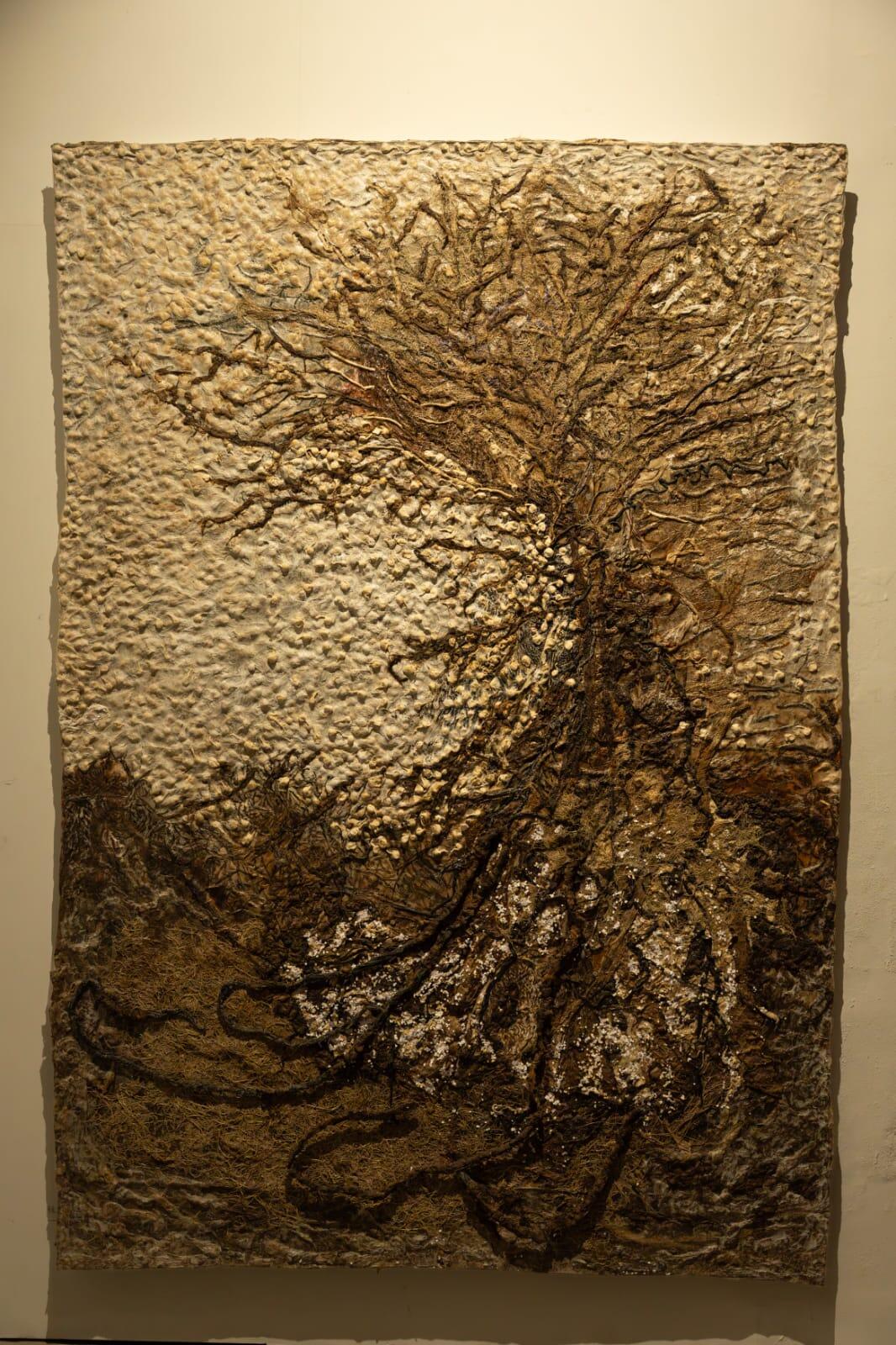
Within these three works, we see a distillation of the fascinating world of botanics that creates glow worm effects in the chapter of her explorations with materiality. To recreate a site-specific vegetation, with humble elements like tea and tobacco leaves, roots and stems, and meld them into the delicate Nepali paper and give it a little textural nuance with the fibres of jute, is indeed an act of indelible ingenuity.
Shantiniketan and Salt Lake
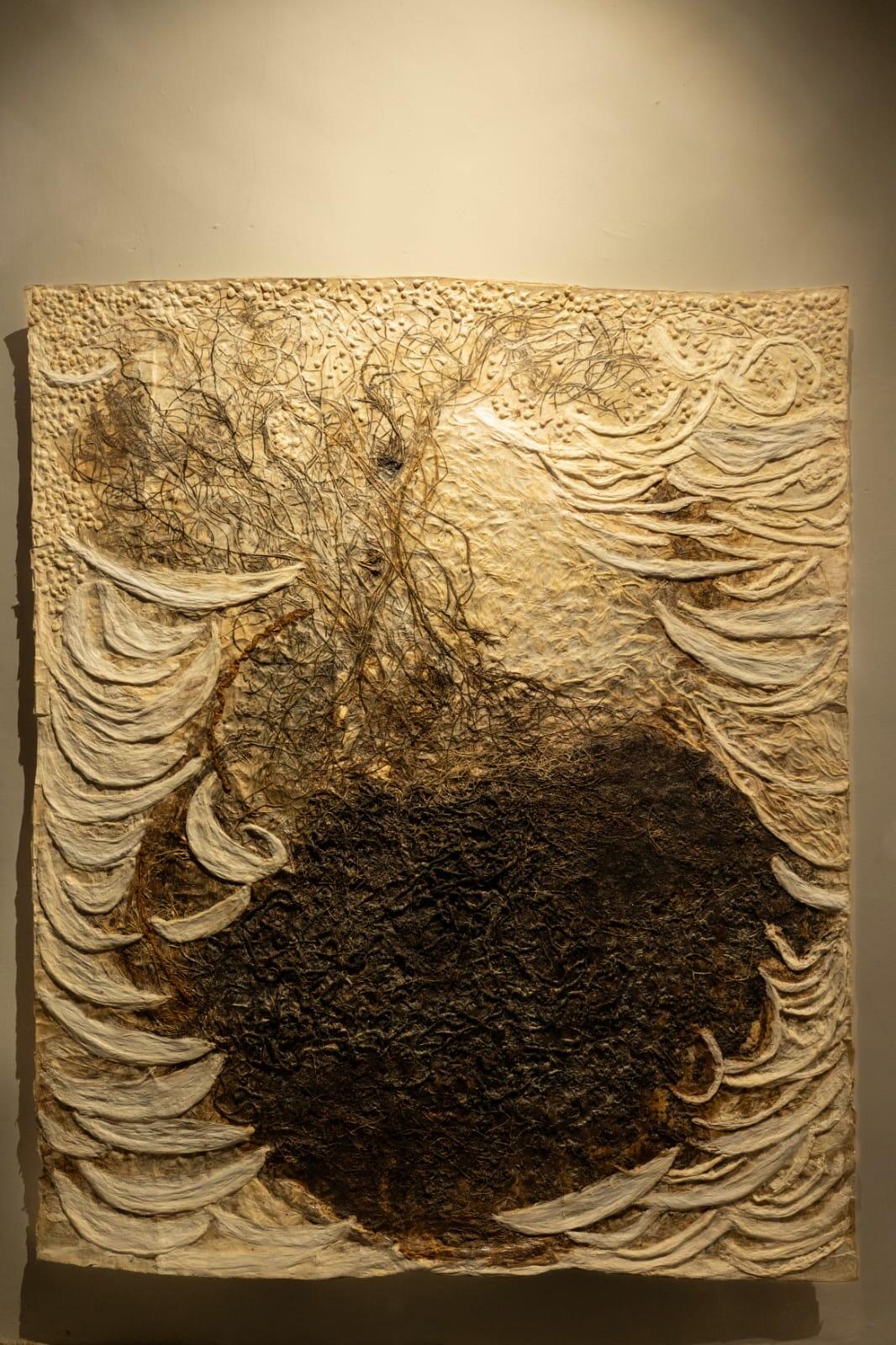
The finesse and intricate detailing itself is an act of nostalgia for her. “It was during my Shantiniketan days that I learnt to be a keen observer,” reminisces Jayashree.
She recalls how she picked up the sharp chiaroscuro and distinctive linearity of Rabindranath Tagore’s style, understood Binode Behari Mukherjee’s radiant colours, and Ramkinkar Baij’s exquisite draughtsmanship, which would be added to her own aesthetics.
“ Working on paper is a passion for me. Nepali paper has texture. I create colours with materials to add another dimension. I use clay, tea dust and tobacco leaves to add to the textures. The footprints are mine. What remains is what you can bring from within,” she explains.
“Over the years, I started bringing elements of what I saw around into my art—it is an ongoing process. But wherever I go, I always carry Salt Lake within me,” says the Salt Lake dweller.
Disclaimer
Views expressed above are the author’s own.
END OF ARTICLE
[ad_2]
Source link