
Why you should never kill a centipede in your home |
[ad_1]

Centipedes are generally regarded as disturbing creatures with their rapid movement, sudden appearance, and being out of place on a tiled floor or a painted wall. Most people react to their sight by the need to kill or spray them. This action is usually driven by the feeling of discomfort rather than danger. However, the presence of a centipede inside the house should not be regarded as a threat, nor as a sign of decay or infestation. It indicates a limited range of environmental conditions and other organisms that are less visible, but coexist. Scientific observation treats house centipedes as functional predators adapted to enclosed spaces, not as aggressive intruders. Their interaction with human occupants is incidental, brief, and usually avoidant. Killing them addresses a moment of fear, not an underlying problem.
Why centipedes appear indoors
Centipedes enter houses for the same reasons many small animals do: shelter, moisture, and food. Gaps in masonry, loose skirting boards, drains, and utility openings provide routes into spaces that resemble their natural hiding places outdoors. Bathrooms, basements, and storage rooms offer stable humidity and limited disturbance, which suits their physiology.A centipede rarely appears unless other arthropods are already present. They follow prey rather than people. Seasonal shifts, heavy rainfall, or temperature drops often push insects indoors, and centipedes follow that movement. Their appearance is therefore reactive, not spontaneous.The reasons killing them is unnecessary are tied to their role and biology:
- The hunting role centipedes play inside homes
- Centipedes avoid humans rather than attack
- The slow and limited breeding of house centipedes
1. How centipedes keep other indoor insects in check
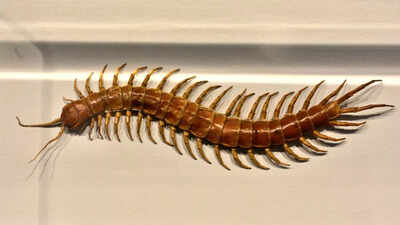
House centipedes survive entirely by hunting other arthropods. Their diet includes cockroaches, silverfish, ants, termites, spiders, flies, and beetle larvae. They do not consume crumbs, fabrics, wood, or stored goods. In ecological terms, they sit at the top of a small indoor food chain, shaped by prey availability rather than human activity.Their body structure is a clear indication of their role. The long legs enable the centipede to move quickly across uneven surfaces and vertical walls. The highly sensitive antennas help them to detect vibrations and chemical traces that are left by other insects. The venom, which is injected through the modified front limbs of the prey, paralyses it within seconds. Studies of domestic environments show that centipedes are nocturnal hunters; they move through the cracks and the concealed edges and then return to their hiding place after the feeding is complete.Population studies conducted in residential buildings show that centipede numbers rise and fall in step with insect populations. When prey declines due to seasonal dryness or reduced humidity, centipedes disappear without intervention. They do not overpopulate independently. This dependency limits their presence and prevents unchecked growth.By removing centipedes while leaving the prey population intact, the balance shifts in favour of insects that reproduce faster and cause more disruption. The centipede’s role is suppressive rather than destructive, exerting continuous pressure on species that humans typically regard as pests.
2. How risky centipedes really are to humans
Despite their appearance, centipedes pose little risk to humans. Bites are uncommon and usually occur only when the animal is trapped against the skin or handled directly. Clinical reports describe localised pain, mild swelling, and redness that resolve without treatment. Serious reactions are rare and not supported by population data.The venom used to immobilise insects is not adapted for use against mammals. Its biochemical activity targets invertebrate nervous systems with high specificity. The structure of the centipede’s mouthparts also limits their ability to penetrate human skin effectively. In most encounters, centipedes flee rather than defend themselves.They are not carriers of human pathogens and do not feed on blood. They also do not seek warmth from bodies or bedding. Furthermore, they do not infest clothing, mattresses, or food storage areas. Their presence in living areas is mostly temporary and accidental, attributable to the disruption of their hiding places or changes in moisture.A study published in Toxins classifies centipedes among the least harmful indoor arthropods. Fear surrounding them is driven by speed and unfamiliar form, not by documented injury or disease transmission.
3. Why centipedes do not infest homes
Centipede reproduction does not create household problems. Females lay eggs in concealed, damp environments where temperature and humidity remain stable. Outdoors, this may include soil or leaf litter. Indoors, suitable conditions are limited and often transient.They do not build nests, do not gather in groups, and do not form colonies. Juveniles are solitary from an early stage and rely on a steady supply of small prey to survive. In dry or disturbed environments, mortality is high. This restricts successful reproduction inside homes.Long-term monitoring of residential buildings shows that repeated sightings usually involve the same individual rather than successive generations. House centipedes can live for several years, which explains their persistence in a specific area. Longevity is often mistaken for infestation.Their reproductive rate is slow compared to common household insects. Without chronic moisture problems and abundant prey, populations cannot establish or expand. Killing individual centipedes does not alter these conditions and does not prevent others from entering if the environment remains suitable.Also Read | You should NOT plant these 5 trees in your yard; know why
[ad_2]
Source link