

Tiger census kicks off in Karnataka, forest capacity under lens | Bengaluru News
[ad_1]
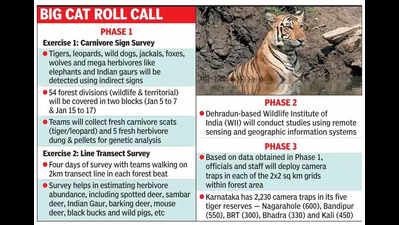
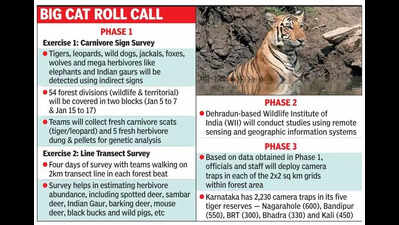
Bengaluru: Karnataka Monday kicked off the tiger census across all five tiger reserves and other protected forests in the state as part of the 6th All-India Tiger Estimation (AITE) exercise, held quadrennially since 2006. Forest department launched the 1st phase of the exercise in the five reserves Monday. The remaining two phases will follow, with the final results expected to be published in 2027.Karnataka began preparations for the census four months ago. “We trained about 61 frontline staff and forest officials at a training of trainers (ToT) workshop for southern states held at Bandipur–Mudumalai Tiger Reserve in Sept 2025. These trained personnel subsequently trained the rest of the department across all 13 forest circles between Oct and Dec 2025,” forest minister Eshwar Khandre said.A senior forest official said over the next three to four days, forest personnel — working in teams of three — will trek about 5km daily along their assigned beats to document the presence of tigers, leopards, and other predators. Teams will record pugmarks, scat, and dung, and photograph animals wherever possible.“The 2nd phase of the exercise will be conducted from Jan 15 to 17 across 14 forest divisions to estimate the prey base in these areas. This will help identify suitable locations for setting up camera traps,” the official explained.Supervising the massive exercise, Karnataka nominated Conservator of Forests Ramesh Kumar P, IFS, as the nodal officer to coordinate with National Tiger Conservation Authority (NTCA). While Karnataka emerged as the ‘tiger capital of India’ twice, it ceded the top spot to Madhya Pradesh in the 2022 tiger census, which reported 785 tigers against Karnataka’s 524, However, subsequent data enumeration revised Karnataka’s figure to 563. State to estimate carrying capacityUnlike previous exercises, field staff were also directed to estimate the carrying capacity of forests. In view of the sharp rise in human–wildlife conflict and the increasing wildlife population, the exercise will assess the forests’ capacity by weighing tiger numbers against prey availability and the extent of forest cover. “This scientific assessment will help us understand key issues and arrive at practical solutions — whether it is human–animal conflict, encroachment, or a surge in wildlife population. Carrying-capacity estimates will provide a comprehensive picture,” the minister said.Several firsts in AITE-2026As part of AITE-2026, the department, for the first time, supplied 380 see-through compasses and 360 range finders to surveyors to aid transect surveys estimating herbivore populations. Fresh scat and dung samples will also be collected for DNA analysis.Camera traps outside tiger reservesIn view of increasing instances of tigers moving into semi-forest and fringe areas, the state govt directed the deployment of camera traps outside tiger reserves as well. “Cameras will be sourced from adjoining tiger reserves after the completion of estimation. Cauvery Wildlife Sanctuary will source cameras from Bandipur, MM Hills from BRT, while Nagarahole Tiger Reserve will support the adjoining Madikeri and Mysuru territorial forest divisions,” the minister said, expressing confidence that Karnataka would report a significant increase in tiger numbers this time.
[ad_2]
Source link