

Why does aluminium foil spark in a microwave but not in an oven |
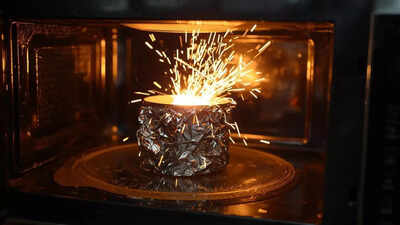
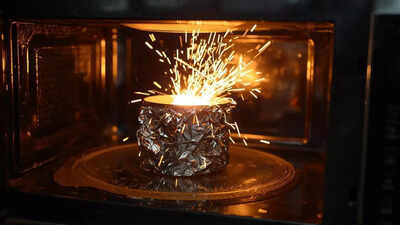
Domestic kitchens contain heating technologies that operate on distinct physical principles, yet they often appear interchangeable in everyday use. Aluminium foil is a routine accessory in conventional cooking, used to shield food surfaces or retain moisture, and it is generally unremarkable when placed in a standard oven. The same material behaves very differently inside a microwave oven, where its presence can provoke sudden flashes, crackling sounds, and visible electrical discharge. These effects are widely recognised in household safety guidance and have been examined in laboratory settings concerned with electromagnetic exposure and material response. The contrast arises from differences in energy delivery, field geometry, and the interaction between metals and electromagnetic radiation within confined spaces.
What happens when microwave energy hits aluminium foil
Microwave ovens are able to produce heating energy from microwave radiation at around 2.45 GHz. Many reflections of microwaves travelling through the cavity generate a standing-wave configuration within the metallic surface (the “Oven”). The introduction of an object made from metal (aluminium foil, for example) generates oscillations through the motion of the electric field. When the field exceeds the breakdown threshold of air, electrons are stripped from gas molecules, producing ionisation and a visible spark. This process has been described in experimental studies of metal objects exposed to microwave fields, published in Materials, where arcing was observed to originate preferentially from sharp features rather than smooth surfaces. Measurements reported in the literature show that even thin household foil can support sufficient current density to initiate discharge under typical microwave power levels.
Why foil edges and folds trigger sparks
The likelihood of sparking is governed less by the mass of metal than by its shape and placement. Flat, smooth metal plates can sometimes reflect microwave energy without immediate discharge, while crumpled foil presents multiple points of curvature with small radii. At these points, electric charge accumulates unevenly as the alternating field reverses direction billions of times per second. The rapid oscillation prevents charge dissipation through grounding, since the foil is usually electrically isolated from the oven walls. As a result, voltage differences arise across very short distances. Laboratory observations have shown that sparks often leap from foil edges to nearby air or to the oven cavity, following the shortest available path. Plasma-like electric discharges can occur and last for only microseconds duration. Repeated discharge events can destroy the inner components of the microwave oven and can create holes in the foil. The basic electromagnetic boundary conditions that create the discharge are the basic cause of the problem, i.e., there is little or no thermal heating caused by direct exposure to the heating elements.
How do conventional ovens heat aluminium foil safely?
The method used for producing cooking energy in a conventional oven is thermal energy released via hot air, thermal energy generated by the elements (in the oven), and via the rack/trays or other surfaces of the conventional oven. The energy involved is carried by moving molecules and infrared radiation, not by a coherent electromagnetic field oscillating at microwave frequencies. Aluminium foil placed in such an environment absorbs heat gradually from its surroundings. Its high thermal conductivity allows it to distribute that heat across its surface, but there is no mechanism for inducing large electrical currents. Without rapidly alternating electric fields, charge does not accumulate at edges in the same way, and the surrounding air remains electrically neutral. Temperatures in ovens can be high enough to soften or oxidise aluminium, yet these processes occur over minutes rather than microseconds and do not involve electrical breakdown. Observations from materials science show that aluminium remains chemically and electrically stable under typical oven conditions, provided it is not in contact with exposed heating elements that could cause localised overheating.
How does energy behave differently in microwaves and ovens?
The two appliances also differ in how and where the energy is contained or released. In terms of design, microwave ovens are constructed as resonators, keeping electromagnetic energy until such time as the energy is absorbed by food products, or the electromagnetic (radio) energy dissipates into the surrounding air (heat). This effect occurs primarily due to the efficiency of reflection caused by the metallic walls of the cavity, along with their compact size and high intensity of electromagnetic fields contained in the cavity. In most instances, the placement of non-intended (unplanned) conductors causes local increases in electromagnetic fields in the vicinity of the conductor, as opposed to allowing a more uniform absorption of energy. Conventional ovens do not act as resonators for electromagnetic energy; the heat energy produced by such an oven spreads outwards through convection- and radiation-based processes ranging from the reflections of walls or other surfaces to the heat energy of a convection/ radiative oven. The aluminium foil, therefore, experiences a diffuse thermal environment rather than a structured field pattern. Reports comparing these appliances note that the absence of sparks in ovens is not due to any special property of foil, but to the lack of conditions required for electrical discharge. The material responds predictably to heat, while remaining largely inert to the modes of energy transfer present in conventional cooking.Also Read | Why you should never kill a centipede in your home