Who is Delcy Rodríguez, the law grad chosen as Venezuela’s interim president after Maduro’s capture?
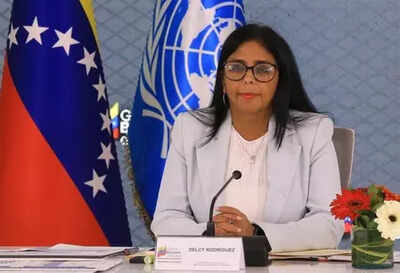
Venezuelan President Nicolas Maduro was captured on Saturday during a United States military operation and the country’s executive authority passed immediately to Vice President Delcy Rodríguez. The transfer followed constitutional provisions under Articles 233 and 234, which state that in the event of a president’s temporary or absolute absence, executive power rests with the vice president.Within hours of the operation, Rodríguez chaired a meeting of Venezuela’s National Defense Council. Speaking on state television channel VTV, she condemned the US action, demanded the “immediate release” of Maduro and his wife Cilia Flores, and described the operation as a violation of Venezuela’s sovereignty. She urged Latin American governments to reject what she called the use of force against an elected government, according to the broadcast.Rodríguez’s rapid assumption of authority was not unexpected within Venezuela’s political system. For more than two decades, she has occupied senior positions across communications, foreign policy, legislative power and economic management, making her one of the most established figures within the ruling structure.
Education and early political formation
Delcy Rodríguez was born in Caracas in 1969. She studied law at the Central University of Venezuela, graduating in 1993. During her time at the university, she was active as a student leader. She later pursued specialisation in labour law in Paris, although she did not complete the programme.Her academic career included teaching law at the same University. She also served as president of the union within the Venezuelan Association of Labour Lawyers. These roles placed her early professional life within legal and institutional frameworks rather than electoral politics.
Rise within chavismo
Rodríguez’s political ascent is closely tied to chavismo, the political movement founded by Hugo Chávez and later led by Maduro. Alongside her brother Jorge Rodríguez, now president of the National Assembly, she emerged as a central figure during the later Chávez years and after his death in 2013.Her first cabinet-level role came when she was appointed minister of communication and information in 2013. She held the post until 2014, overseeing state messaging during a period of domestic unrest and international scrutiny.In 2014, she became Venezuela’s foreign minister, a position she held until 2017. During this period, she represented Venezuela at international forums including the United Nations. She frequently accused foreign governments of interfering in Venezuela’s internal affairs and defended the Maduro administration against allegations of democratic erosion and human rights violations.
Legislative power and executive authority
In 2017, Rodríguez was appointed president of the Constituent National Assembly, a body created after the opposition won control of the National Assembly in the 2015 elections. The Constituent Assembly assumed sweeping legislative powers and played a key role in consolidating executive authority.In 2018, Maduro appointed Rodríguez as executive vice president for his second term. She retained the post during his third presidential term, which began on January 10, 2025, following the disputed July 28, 2024 elections. Venezuela’s opposition maintains that those elections were fraudulent and argues that opposition candidate Edmundo González Urrutia was the rightful winner, a claim supported by some governments in the region.Alongside the vice presidency, Rodríguez also served as minister of economy and finance and minister of petroleum, placing her at the centre of Venezuela’s fiscal and energy policy during a period of sanctions and economic contraction.
A figure of trust within the system
José Manuel Romano, a constitutional lawyer and political analyst, told CNN that Rodríguez’s long tenure across senior roles reflects her standing within the government. He described her as a figure with the president’s “full trust” and noted her influence across ministries, including defence, according to CNN.“She is very results-oriented and has significant influence over the entire government apparatus, including the Ministry of Defense,” Romano told CNN.
Signals and limits of engagement with the US
After Maduro’s capture, US President Donald Trump said that Secretary of State Marco Rubio had spoken with Rodríguez. Trump told reporters that she appeared open to cooperation with Washington.The remarks were met with scepticism by analysts. Imdat Oner, a policy analyst and a former Turkish diplomat, told CNN that Rodríguez should not be viewed as a moderate figure. He described her as one of the most powerful actors within the existing system and suggested that any transitional role would be tightly managed, according to CNN.Rodríguez’s own public statements following Maduro’s capture offered little indication of compromise. In a phone interview with VTV, she said the whereabouts of Maduro and Flores were unknown and demanded proof they were alive. Later, during the National Defense Council session, she insisted that Maduro remained Venezuela’s president despite his detention.“There is only one president in this country, and his name is Nicolás Maduro Moros,” she said during the televised address on VTV.
An interim role shaped by continuity
By constitutional design, Rodríguez’s position is interim. By political reality, her authority is rooted in continuity. Her education in law, long presence in executive and legislative roles, and control over key economic portfolios have made her one of the most durable figures in Venezuela’s governing structure.As events unfold, her leadership reflects not a break from the past but the consolidation of a system she has helped shape for more than twenty years.