
This ‘useless’ body part explains why humans get goosebumps and its surprising role in skin and hair health |

[ad_1]
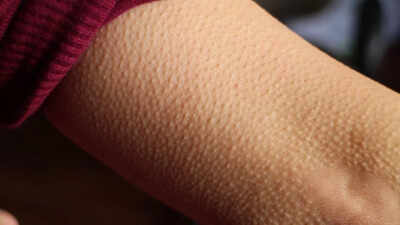
Goosebumps are one such odd body function, which we have all experienced but have rarely been compelled to probe into. They erupt suddenly on a chilly morning or during the emotional notes of music or in an instance of utter awe. Usually ascribed to the redundant remains of our evolution, the function of goosebumps can be conveniently marshaled into the same camp as other redundancy in the human body. But the truth in this regard is much more fascinating. The human skin is the largest body part in the human body. It is an intricately complex body function by itself. The function is solely devoted to the regulation of temperature as well as the protection it provides to our body. A harsh look at the function of the goosebumps will make us understand the critical importance it held in our ancestors’ lives.
What causes goosebumps on your skin
Scientifically known as cutis anserina, goosebumps result from the contraction of tiny muscles known as arrector pili muscles. These muscles are found attached to the base of hair follicles across much of the body, with the exception of the face, armpits, eyelashes, and eyebrows. By contracting, they pull the hair follicle upright in a process called piloerection, leading to the striking bumpy texture experienced on the skin.This is a completely involuntary response. The arrector pili muscles are responsive to the sympathetic nervous system, which is the same system that限定 the fight-or-flight response. This is why goosebumps often come with no warning from the cold or simply at a sudden shift in emotion as per Elsvier study.
How goosebumps helped early humans survive
At some point in our distant past, people were much hairier than humans today. If the arrector pili muscles contracted, raised body hair trapped a layer of warm air close to the skin, providing some insulation to keep early humans warm in cold environments. Contraction of muscle itself creates warmth, too, adding another subtle layer of protection against the elements.Raised hair likely had another function as well. Similar to how animals flare their fur to make themselves appear larger and more intimidating, humans could have used goosebumps in the past as a means of making themselves look bigger when confronting a predator or rival. Such an explanation is reinforced by the fight-or-flight system’s relationship with goosebumps, as it ties the response into perceptions of danger.
Why do emotions give us goosebumps
One of the more curious aspects of goosebumps is that they tend to link with emotion. Many people experience them during powerful music, meaningful speeches, or moments of deep awe. This is because the sympathetic nervous system is sensitive not just to temperature but also is closely linked to emotional centres in the brain. States of increased arousal, motivation, or emotional intensity share much of the same pathway activation that physical threats or cold do. Thus, goosebumps are an emotional response as much as it is physical-a reflection of the body’s ancient wiring but not related to modern practical needs.
An unexpected role in skin and hair health
Goosebumps may also have effects on skin function in less obvious ways. The arrector pili muscles are situated near sebaceous glands, which produce sebum, an oily substance to help keep the skin moisturised. By contracting these muscles, they will ever so softly squeeze the glands and hence encourage sebum release. Undeniably unglamorous, such a process is in support of maintaining healthy skin and preventing too much dryness of it.More interestingly, however, there is evidence for a more fundamental biological function. A 2020 paper in Cell reported that arrector pili muscle contraction offers the triggering signal for quiescent hair follicle stem cells to proliferate in mice. That would mean the same system responsible for goosebumps is also part of the system that regulates hair growth, pointing toward an active function rather than evolutionary vestiges.
[ad_2]
Source link