

SC highlights Sengar’s dominant position, Pocso offence; upholds stringent provisions | India News
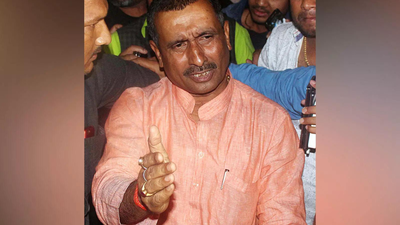
NEW DELHI: The Supreme Court on Monday stayed a week-old Delhi high court order granting bail to former BJP MLA Kuldeep Singh Sengar, convicted of raping a minor in Uttar Pradesh’s Unnao, during pendency of his appeal against conviction and ensured that he is not released from prison.Departing from the general practice of the apex court not interfering with HC orders granting bail, a bench of CJI Surya Kant, and Justices J K Maheshwari and A G Masih said the case against Sengar and the way the HC granted him bail raises several questions of law requiring deeper consideration.“Keeping in mind these peculiar circumstances, we deem it appropriate to stay the operation of the impugned order dated Dec 23 passed by HC. Consequently, the respondent (Sengar) shall not be released from custody…” the bench said.One of the issues raised by CBI through solicitor general Tushar Mehta was that the HC failed to appreciate that Sengar, a public servant being an MLA, was in a dominant position and hence his offence of raping a minor girl must be construed as an aggravated form of sexual assault under IPC and Pocso Act.
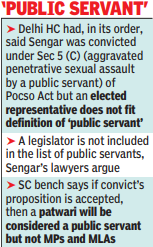
‘Public servant’
Such an act under Pocso warrants stringent punishment, which under IPC shall not be less than 10 years imprisonment and could extend up to the entire natural life of the convict.When Sengar’s counsels, senior advocates N Hariharan and Sidharth Dave, questioned the CBI contention about Sengar being a public servant, CJI Kant-led bench said, “We are worried that if the proposition advanced by the convict is accepted then a patwari will be considered a public servant but not MPs and MLAs.” The bench sought Sengar’s response to CBI’s appeal and posted the matter for further consideration on Jan 20.Mehta said, “A person may not be a ‘public servant’ for the purpose of the Prevention of Corruption Act, 1988, but may still be a ‘public servant’ within the meaning of the Pocso Act if he is in such a dominant position as contemplated in other categories of Section 5.”“Considering the intent, object and purpose of the POCSO Act, an elected representative who wields enormous power and is in a position of dominance over children will have to be treated as a ‘public servant’ for the purposes of the Act, particularly when the Respondent Accused (Sengar) was an MLA of the same constituency where the victim/survivor resided,” he said.“We are conscious of the fact that ordinarily when a convict/under-trial has been released on bail pursuant to an order passed by the trial court or the high court, such order shall not be stayed by this Court without hearing such person,” the SC bench said. “However, the instant matter revolves around certain unique facts and circumstances, wherein the respondent-convict is also separately convicted and sentenced in a case under Section 304 Part II of the IPC and is consequently still in custody. We are informed that in such proceedings also, the respondent-convict has applied for bail, and after hearing the arguments, the order is said to have been reserved by the concerned court.”The bench said the rape survivor had a statutory right to file a separate appeal against the HC order and required no SC permission. “In case she needs any free legal aid, the Supreme Court Legal Services Committee is directed to provide such services to her. However, she may, if so advised, file her appeal through counsel of her own choice,” it said.Hariharan pointed out innuendoes being hurled at the judges of HC bench which granted bail to Sengar and said some allegations going viral on social media were contemptuous. Mehta said the judges in HC division bench were among the finest in the country with unimpeachable integrity and condemned the personal attack unleashed against them.“There are always some elements who attempt to browbeat honest judges. Such devious forces must not be encouraged. The opinion of party (CBI) which lost before the bench of these two honest and brilliant judges must put an end to this controversy generated by some unscrupulous vested interests,” he said.The bench agreed and said it is not uncommon that even the most brilliant and honest judges commit an error. “These two HC judges are among the finest. But we (judges) are all prone to committing errors,” CJI Kant said.