
India’s 2025 Economic Reset: A Big Bang of Reforms | India Business News
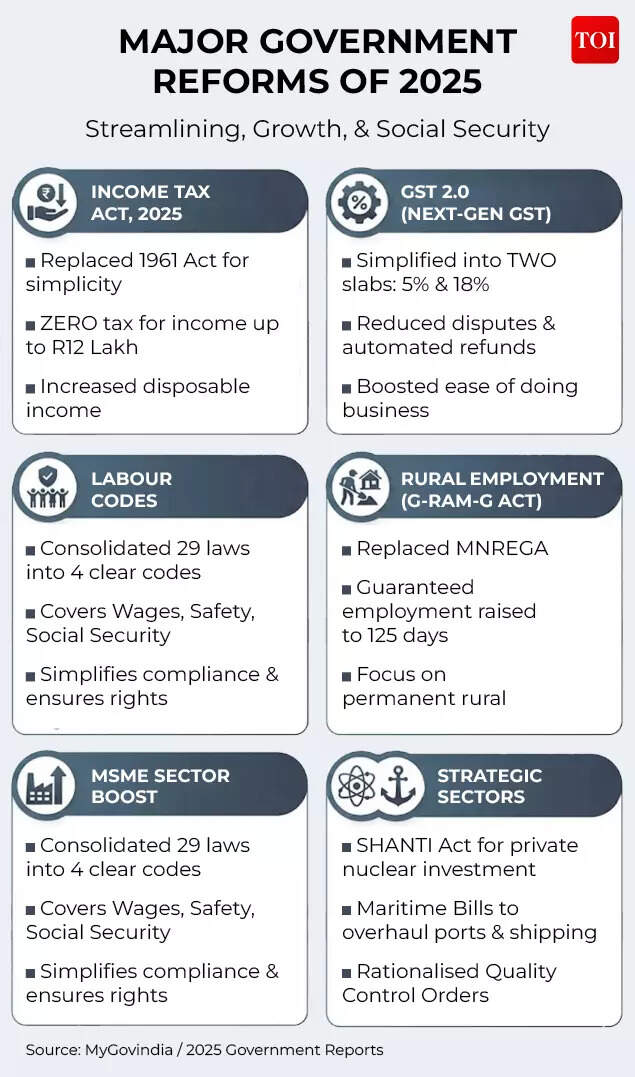
Driving the newsIt began with a tax relief for the middle class. It ended with a slew of reforms that had been put on hold for many years. By December-end, the 2025 turned out to be one of the most consequential years for Indian economy.In one of its busiest legislative sessions in years, parliament cleared a string of measures that had languished for decades or stalled amid political resistance: 100% foreign direct investment in insurance and pensions and private participation in nuclear power, and a new law, VB-G RAM G replacing MGNREGA.
Add to these, a simplified goods and services tax (GST) regime, the long-delayed rollout of four labour codes, and a brand-new Income Tax Act replacing a statute dating back to 1961. The scale and sequencing have led economists and investors alike to describe the push as a “big bang” – not incremental tinkering, but a coordinated attempt to reset India’s growth model under mounting global pressure.The government has framed the moment as a decisive turn toward “ease of living” and “ease of doing business.” In a message amplified by MyGovIndia, PM Modi said, “Ours is a Government committed to boosting ‘Ease of Living’… Our reform trajectory will continue with even more vigour in the coming times.”Why it mattersThe reform surge comes at a precarious moment for the world’s fastest-growing major economy.India is expanding at more than 8% year-on-year, but that pace is under threat from a sharply deteriorating external environment. US tariffs of up to 50% on Indian exports – imposed by President Donald Trump – have hit key labour-intensive sectors such as textiles and electronics, complicating New Delhi’s ambition to turn India into a manufacturing rival to China.
Major government reforms of 2025
At the same time, net foreign direct investment has fallen to multi-year lows even as headline growth remains strong. Manufacturing is stuck at about 17% of GDP, far below the government’s 25% target, wage growth has been uneven, and private investment has yet to become a self-sustaining engine.Against that backdrop, the 2025 reform burst is about urgency as much as ambition. Policymakers believe cutting red tape, simplifying taxes, easing labour rules and opening capital markets can offset global headwinds, revive investor confidence and keep India on track for its 2047 goal of becoming a developed economy.As Bloomberg put it, the reforms are designed to “set the stage for a surge of foreign capital” at a time when external shocks risk derailing growth.The big pictureWhat makes 2025 different is not a single reform, but how multiple changes are being stacked to reinforce one another.Tax reset: Big relief for middle classPresenting her one of the most important budgets in February, finance minister Nirmala Sitharaman delivered the much-awaited relief for the middle class. The Union Budget gave relief to households by exempting incomes up to Rs 12 lakh from income tax. It also simplified the ITR filing.
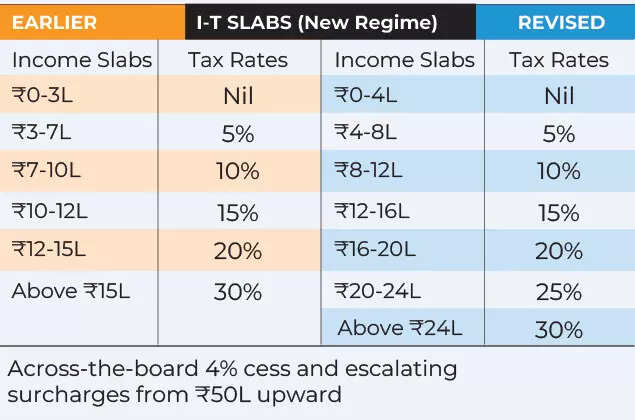
New Income Tax Slabs FY 2025-26
GST: Festive bonanzaLong criticised for its complexity, the GST has been rationalised from four main slabs to two. Automated filings, faster refunds and easier registration are intended to lower compliance costs for businesses and stimulate consumption. The government points to record festive-season sales – including Rs 6.05 trillion during Diwali – as early evidence of impact.
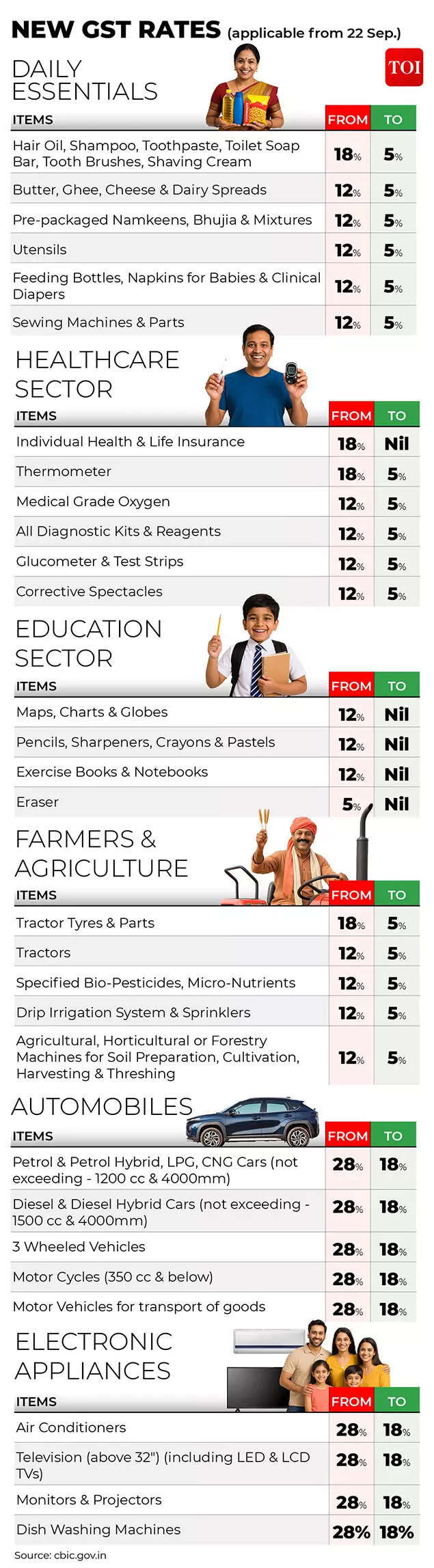
New GST rates
Labour overhaulPerhaps the most politically sensitive step has been the activation of four labour codes consolidating 29 laws. Unveiled in 2020 but delayed by opposition from trade unions and state governments, the codes aim to formalise employment, reduce compliance burdens for small firms and expand social security coverage, particularly for women and gig workers.
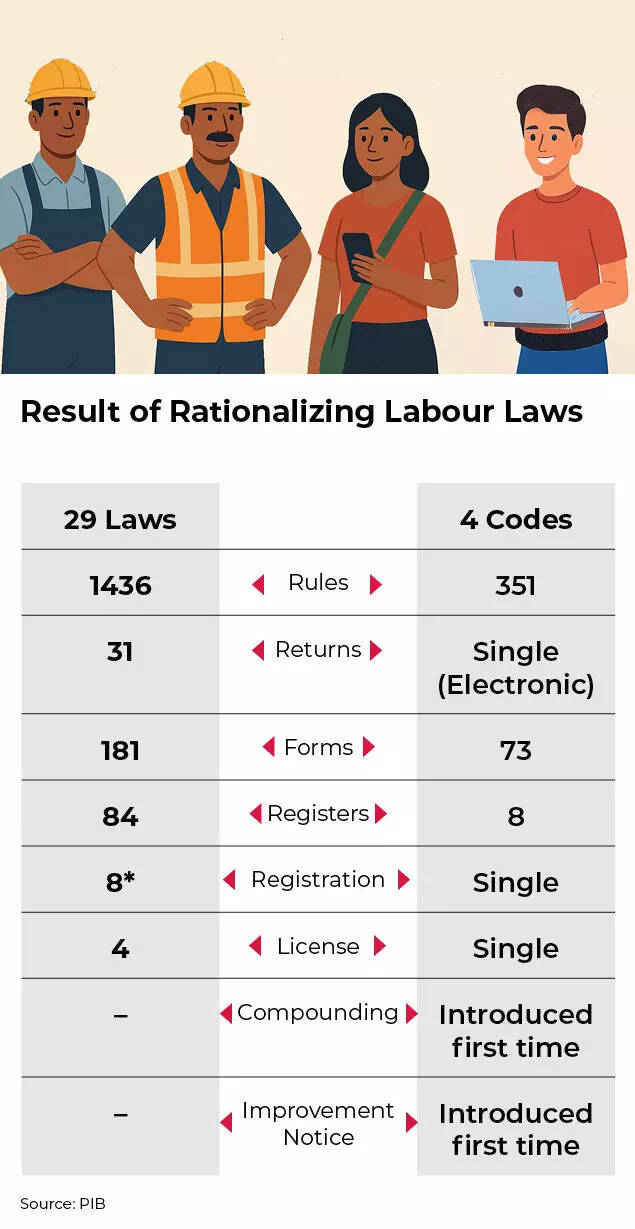
Result of Rationalizing Labour Laws
Economists say the reform could be transformative if states implement it consistently, making it easier for firms to scale up without fear of crossing rigid regulatory thresholds.Capital liberalisationOn the financial front, Parliament’s decision to allow 100% foreign ownership in insurance and pensions ends years of internal debate. Overseas investors had been capped at 74%, limiting their appetite for long-term commitments. Bloomberg reported that policymakers want to redirect household savings from gold and property into equities, bonds and long-term financial products to fund infrastructure and industrialisation.The opening of nuclear power to private firms – potentially unlocking more than $200 billion in investment – marks a break with decades of state dominance in strategic sectors.Together, these moves reflect what analysts describe as a shift from ad hoc reform to systemic redesign.What they’re saying
- BJP leaders argue the timing reflects political realism. “Modi does a big thrust of reforms periodically, like a ‘big bang’, when the conditions are ripe,” Baijayant Panda, the party’s vice-president, told the Financial Times. “This is one of those moments.”
- Political scientists see a clear convergence of factors. “Multiple things have created conditions for the government to push for certain economic reforms which were on the back burner,” Rahul Verma of the Centre for Policy Research told the FT, citing recent state election victories that restored momentum after Modi lost his outright parliamentary majority last year.
- Political analyst Pratap Bhanu Mehta told FT that India was facing “probably the most significant crisis” of the last quarter-century, sandwiched between “a hostile China and a hostile United States.” The renewed impetus for reforms “is actually a response” to that, Mehta added.
- From the investor side, optimism is tempered by caution. Barclays India chief executive Pramod Kumar told Bloomberg that “the latest spate of reforms will help revive global investor sentiment amid tariff worries,” adding that increased foreign flows would create new opportunities for banks and capital markets.
- Others stress that results will not be immediate. “Reform is always good, but it takes time and impacts happen with a lag,” Joshua Crabb of asset manager Robeco said in comments reported by Bloomberg.
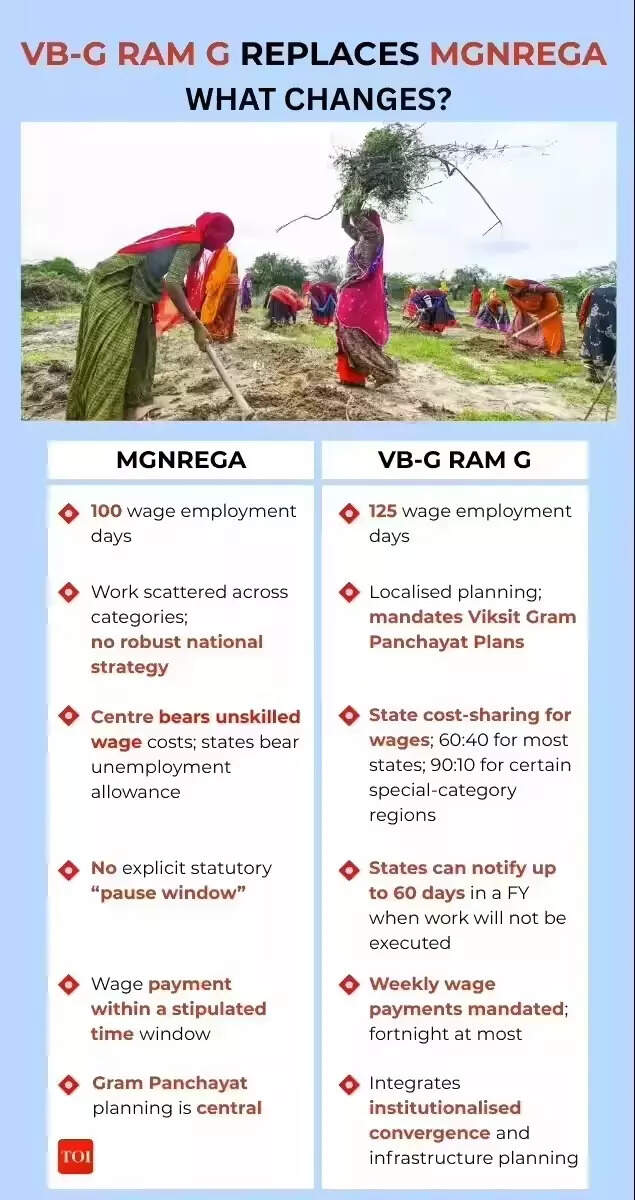
VB-G RAM G Replaces MGNREGA: What changes?
Between the lines: Speed as strategyParliament’s winter session became one of its most productive in years. Eight major bills passed in just over 60 hours. But the speed seemed intentional. Delay, officials believed, carried greater risk than backlash. Years of half-finished reform had produced fatigue among investors and bureaucrats alike. This time, the aim was to overwhelm inertia.Politics explains not just why reforms are happening, but why they are happening now.PM Modi entered his third term weakened by the loss of a single-party majority, but a series of state-level wins in Maharashtra, Haryana, Delhi and Bihar rejuvenated the ruling coalition. That political breathing space allowed the government to revive contentious legislation, including labour codes and foreign ownership rules, with less fear of parliamentary paralysis.External pressure has also played a catalytic role. Analysts quoted by Bloomberg argue that the tariff shock from Washington injected urgency into improving India’s business climate, turning reform from a long-term aspiration into a near-term necessity.
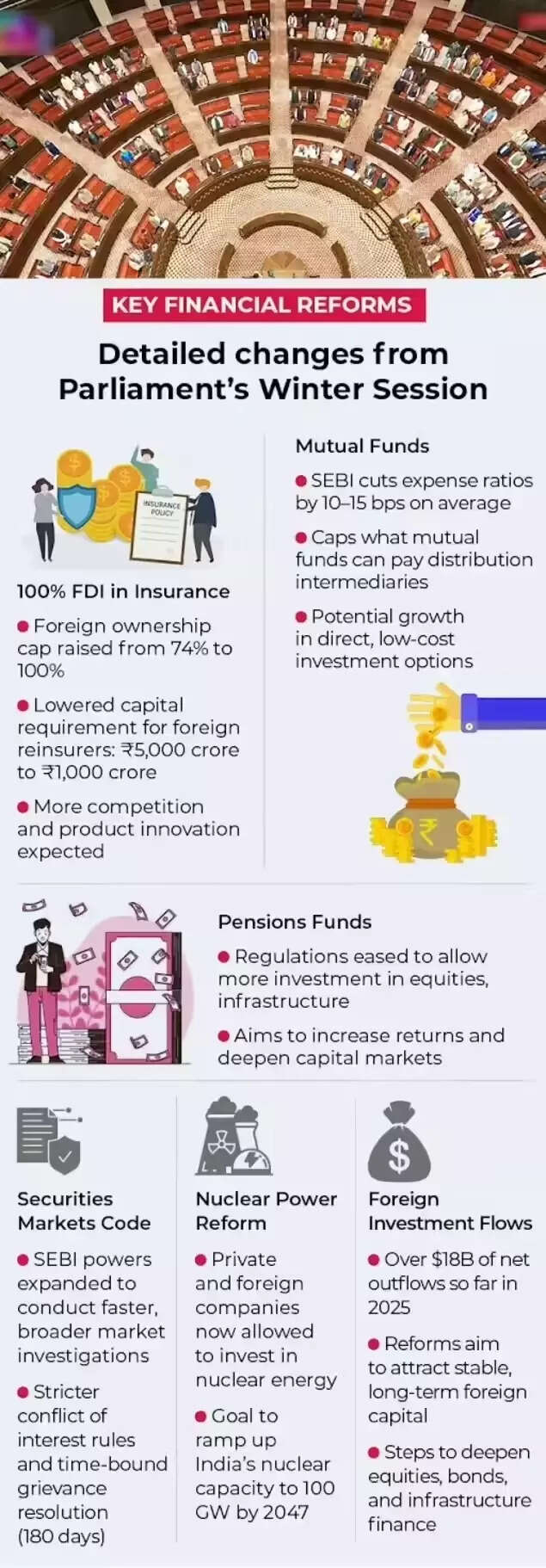
Key Financial Reforms
There is also a quieter strategic recalibration underway. Modi’s second term was dominated by cultural and ideological priorities, culminating in high-profile events such as the inauguration of the Ram Mandir in Ayodhya. Even former advisers now acknowledge that economic reform took a back seat. Arvind Subramanian, a former chief economic adviser, told the Financial Times that during 2019–24 “the religious agenda was an obsession… and the policy reforms were neglected.”The pivot in 2025 suggests an attempt to rebalance ideology with delivery – and to secure Modi’s legacy as an economic reformer rather than just a political one.Zoom in: The financial reformsThe financial sector may be where the “big bang” is most visible.Bloomberg reported a surge of high-profile deals following regulatory changes, including multi-billion-dollar investments by Japanese financial institutions in Indian banks and non-bank lenders. Lawmakers have also eased rules for mergers and acquisitions, while the central bank has allowed state-run banks to play a more active role in financing takeovers.The aim is consolidation and scale. Indian firms, policymakers believe, need deeper capital markets and larger balance sheets to compete globally. Capital markets are already responding: Indian companies have raised a record $22 billion through IPOs in 2025, while benchmark indices have delivered strong long-term returns despite near-term volatility.Still, foreign portfolio investors remain cautious, having withdrawn billions from equities this year amid valuation concerns and currency weakness. That tension underscores the gap between policy intent and market confidence.Zoom in: Labour and manufacturingLabour reform is central to India’s manufacturing ambitions, but also its biggest execution risk.By simplifying rules and raising thresholds for small companies, the government hopes to encourage firms to grow without fear of losing tax breaks or regulatory exemptions. Rural employment schemes have also been refocused toward building durable assets such as roads and infrastructure, rather than just distributing wages.
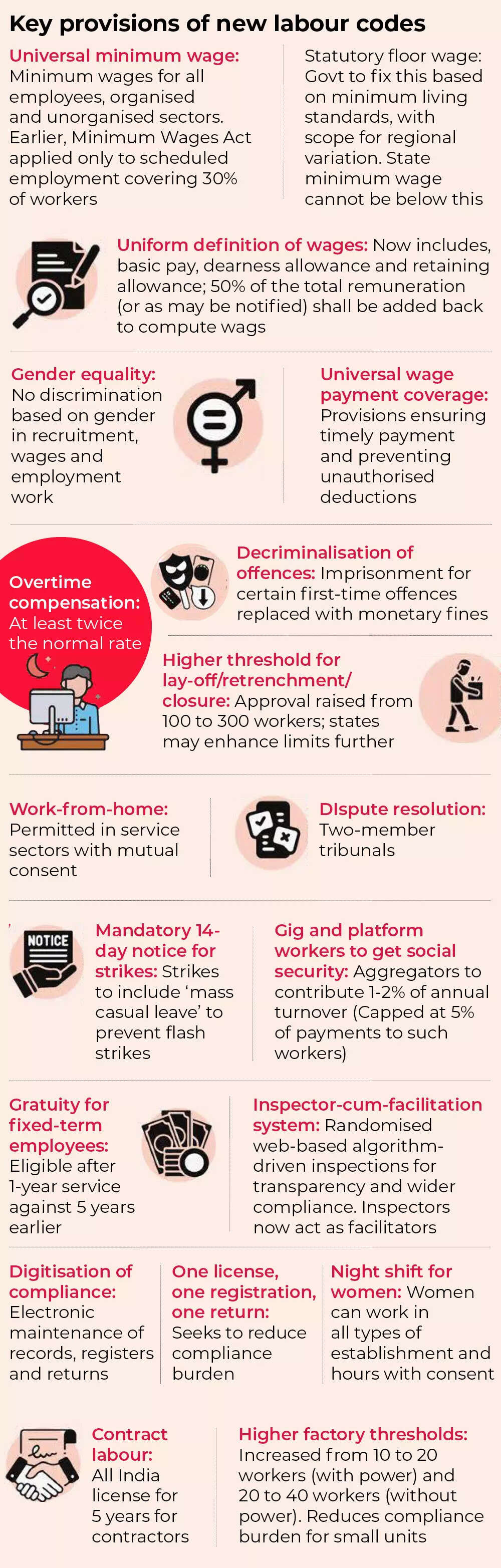
Key provisions of new labour codes
If successful, economists argue, these changes could help absorb millions of young workers entering the labour force each year. If poorly implemented, they risk remaining on paper – a familiar fate for past reforms.What nextThe true test of India’s 2025 big bang will be whether private investment responds.Manufacturing’s share of GDP remains stubbornly low, trade negotiations with the US have yet to deliver tariff relief, and the rupee’s weakness has emerged as a near-term risk. Opposition parties have also criticised the government for rushing legislation through Parliament with limited debate, raising questions about consensus and durability.Yet the direction of travel is clear. As Bloomberg wrote, the latest measures “signal a policy shift toward diversification, structural reforms, and attracting long-term capital.”For PM Modi, the stakes are personal as well as economic. Success would place him alongside India’s most consequential reformers since the 1991 liberalisation. The ambition is clear: sustain near-8 percent growth for twenty years, deepen capital markets, formalize labour, and make India investable at scale. The risk is equally clear: geopolitical shocks, unfinished trade deals, and domestic pushback.For now, India has chosen speed over caution. In a year defined by tariffs, elections, and recalibration, New Delhi decided that the greater danger lay in standing still.