

How Manoj Sinha quietly built a housing revolution in J&K without spending a rupee of government money
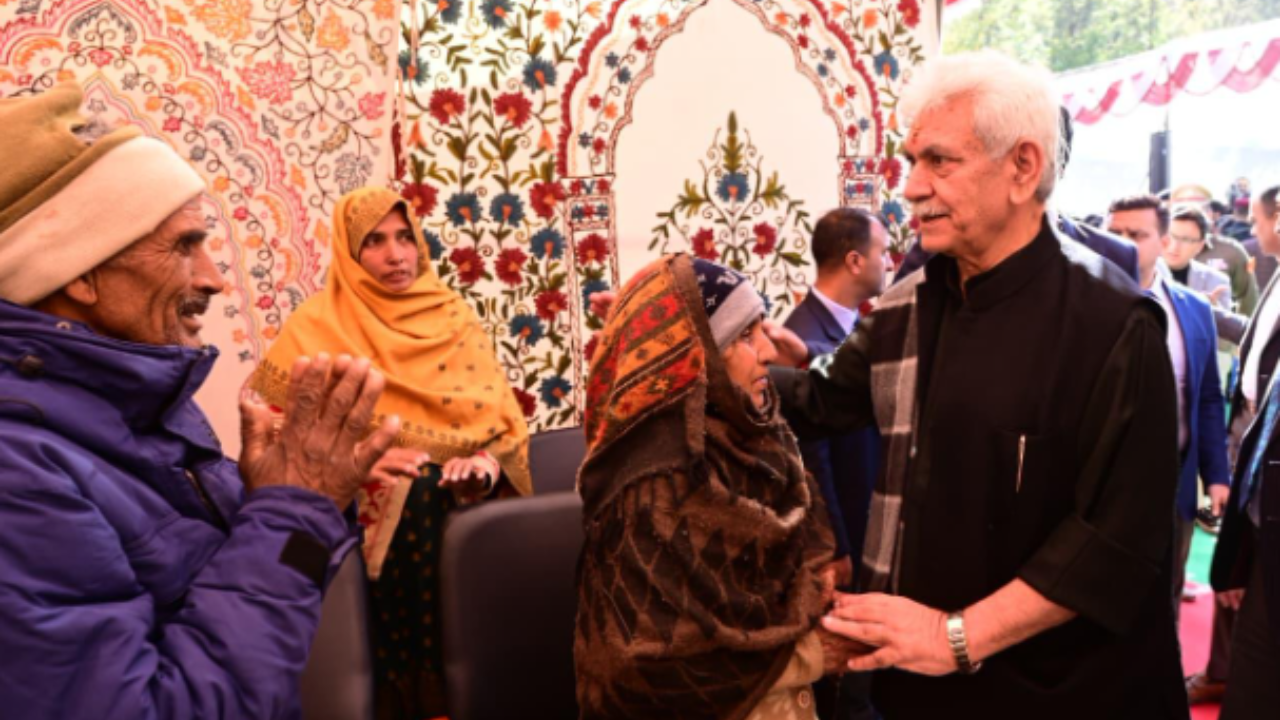
As the winter air in a small hamlet near Rajouri is sharp enough to sting one’s breath, yet there is an unmistakable warmth spreading through the village. An elderly man with decades of hardship etched across his face stands near the patch of land where his new home is soon to rise. His trembling hands rest on the soil, not out of cold, but out of relief. Tears gather in his eyes as he whispers, “Yeh sirf zameen nahi… hamare kal ka waada hai.” (This is not just land… it is a promise for our tomorrow.)
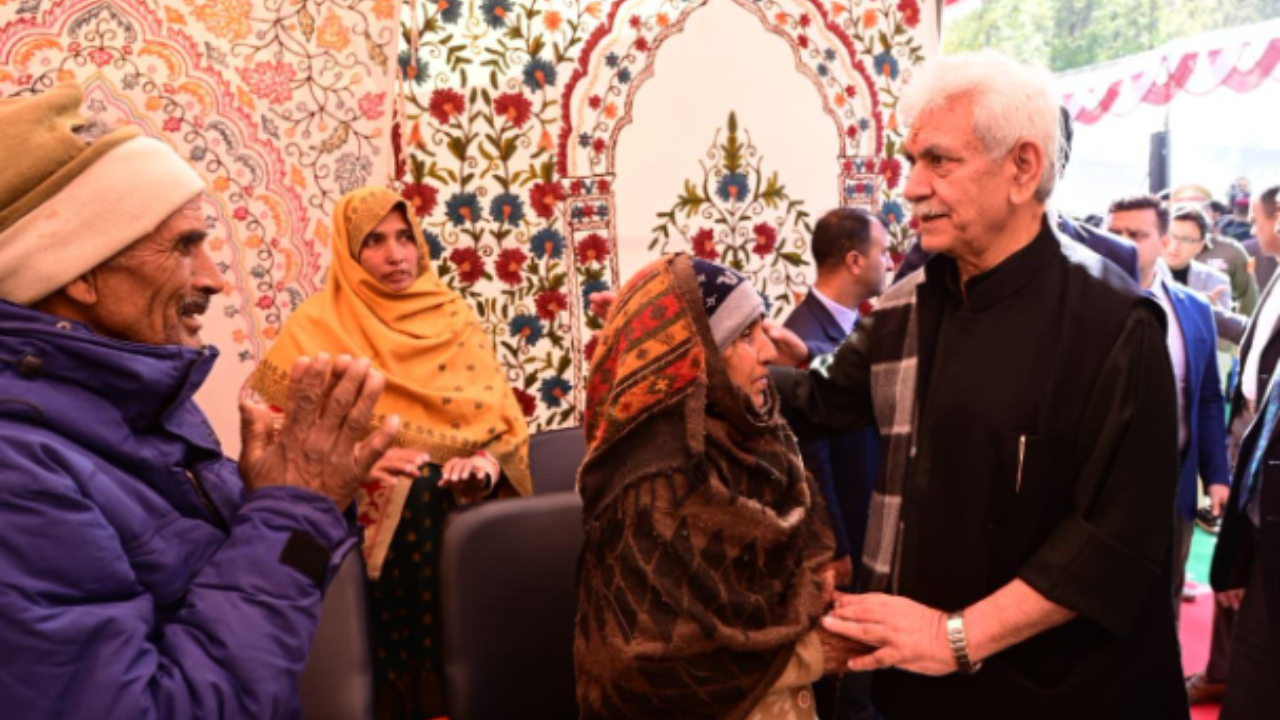

This home, for thousands of families, who suffered due to natural disasters, cross-border shelling, and decades of terrorism, are at the heart of this quiet transformation sweeping across Jammu & Kashmir Union Territory (UT). For these families, Lieutenant governor, Manoj Sinha has brought together a new model of rehabilitation. This model is helping to transform the lives of thousands such families, and it is doing so by rebuilding homes and helping people to create a better future for themselves and their families. And this has now become one of the most remarkable reconstruction missions undertaken in Jammu & Kashmir’s recent history.
What makes this exercise extraordinary is not just the scale. It is the method.
“Not a single rupee from the government coffers is being spent on constructing these homes” And the mission of Lieutenant Governor Sinha was simple: Ensure that no family in J&K remains homeless.
The psychological assurance provided to people living on the volatile Line of Control (LOC) is as important as the physical structure of their dwelling. Fatima Bano of Poonch remembers spending many nights with her children in a damp bunker while the walls of their homes vibrated with the distant explosions. “The children have screamed at all the loud noises. The old walls of our home had cracks in them from the shells,” she says. Today, as she stands on the ground where her future home is soon to be constructed, she says: “The walls are important, but the promise matters more. This is not just rehabilitation, this is the return of dignity, made possible by Lieutenant Governor Manoj Sinha. The house will be strong, I am told it can take the impact of shocks. .”
The State Disaster Response Fund (SDRF) could provide Rs 50,000 to Rs1 lakh depending on the scale of damage, barely enough to repaint a wall, let alone rebuild a house in mountainous terrain.That is when Manoj Sinha turned to an old Indian solution for a new Kashmiri crisis.
While having the service of free internet appears to be a minor consideration, Lieutenant Governor’s initiative is set to prove to be a vital tool for young people who have disappeared from their communities due to being displaced and destroyed by disasters, cross-border shelling, and decades of terrorism. Suhail Ahmad, a student from Poonch, stated, “After your whole world crumbles, it feels as if you no longer have access to education. You are completely disconnected from everything and everyone. This access I believe will connect me to the global community; I can now participate in online classes, gather information, do research, and communicate with others. This service shows me that I am still important and have a future, not just an immediate place to stay and live. It gives me a chance to rebuild the life that was taken away from me.”
In a system where rehabilitation often meant monetary relief, amounts insufficient even for rebuilding a wall, observers suggest that the Lieutenant Governor’s approach replaced cash with complete transformation. “Beneficiaries do not receive compensation; they receive a house, a roof, a promise for the next 15 years, and a connection to the digital world. This represents a new governance innovation rather than abandonment,” said Mehar Bano of Ramban, adding that the ultimate goal of the partnership is to create a transparent, outcome-based structure with the credibility of the government riding on its ability to deliver results.
“This project gives us hope that we can start afresh without fear of the past returning. No compensation was provided earlier, so this initiative will help us rebuild our lives with dignity,” she added.
Officials close to the administration say this new approach was seared into the Lieutenant Governor’s mind during his visits to the border hamlets in the aftermath of “Operation Sindoor,” after speaking to one elderly women living under tarpaulin sheets in one such belt, the Lieutenant Governor made his resolve clear: “Jis ghar ka chhath toot gaya, uska jeevan tootne nahi doonga.” (I will not let the breaking of a roof break a family’s life.)
“On a visit to these affected villages, the Lieutenant Governor encountered families sheltering under crumbling walls. The limited financial support provided by the State Disaster Response Fund (SDRF) was grossly inadequate. A couple of thousands could fix a wall but would do nothing to rebuild family in the harsh, high cost of living environment. He saw mother cooking outside, and children shaking from the cold. The payments provided were insignificant. The LG openly stated, ‘I will not allow a family to fall apart because their roof had fallen in,’” said a senior official who travelled along with the Lieutenant Governor.
“Rather than wait for the revenue that would never be sufficient for this type of massive project; the government started working with an entity that could help facilitate the project, and provide the backup necessary to guarantee its success. The partnership was formed with the High-Range Rural Development Society (HRDS India), a non-profit organisation with extensive experience in the production and installation of prefabricated houses,” the official said, adding that through this partnership, the government would provide the authority to provide legitimate oversight of the project, while HRDS India would have the necessary resources to make the project a success.
The first phase of the Initiative involves construction of more than 1,800 state-of-the-art, three-bedroom pre-fabricated “Smart Houses.” Designed for modern living and efficiency, these technologically advanced homes offer superior resilience against future climate challenges and include facilities such as boundary walls and cowsheds. The construction of these houses is slated for completion within six months from the commencement of foundation work.
HRDS India will provide free life insurance coverage for the next 15 years and free annual health check-ups for all family members. The NGO will also cover the maintenance of the houses for the next five years.
The fast construction pace that characterizes the reconstruction effort in Jammu & Kashmir UT, represents an intentional shift away from the typical sluggishness that has characterized many post-disaster reconstruction initiatives to this point. Reconstruction efforts in Poonch and Rajouri have resulted in the establishment of foundations for 521 new homes, a Rs 52 crore plan which will provide 530 new homes for people living in Ramban & Udhampur districts. Reconstruction efforts in Jammu will result in the start of construction on 350 Smart Houses as part of the ongoing Smart Housing Project. In addition, work will start in coming days in both Kathua & Samba districts to construct 449 further homes under the same plan, thus creating thousands of new homes for residents of these areas on an unprecedented scale within UT.
On Tuesday, addressing the gathering in Samba district of Jammu, LG Sinha commended HRDS India for its noble endeavour and its support to the UT administration in ensuring dignified and secure housing for the affected families in Jammu and Kashmir. “Unity is strength. Collective action can surmount challenges which appear unconquerable and we have witnessed this spirit during the crisis in August this year. Welfare of people of J&K is our top priority. We are committed to serve them and fulfil all their aspirations,” the Lieutenant Governor said, adding that the project for construction of new homes for affected families being completed with the help of HRDS-India, manifests our commitment to people and inclusive development of J&K.
Those provided with these smart houses believe that there has been a visible change in Jammu and Kashmir during the last many years, crediting Lieutenant Governor Manoj Sinha of taking historical steps for overall development of the Union Territory. “It was a tough time for people like me as huge damage took place to infrastructure due to floods and in border shelling during Operation Sindoor. I pay my heartfelt thanks to Lieutenant Governor Manoj Sinha for an effort that has been started to heal wounds of sufferers like me,” said Bishno Devi, whose house was damaged due to floods in August.
Muskaan Shafi , a political commentator lauded the LG administration for its proactive relief measures, while drawing a sharp contrast with J&K Chief Minister, Omar Abdullah’s current conduct. “LG Manoj Sinha Ji’s effort to develop new homes for the families who have been affected by natural disasters, calamities, cross border shelling, and trauma from decades of terrorism, is commendable and an important part of the healing and rebuilding process for such families,” Muskan stated.
Lieutenant Governor Manoj Sinha’s housing revolution is a bold gamble on the power of certainty, a strong roof, and connection to the digital world, in a land where uncertainty, before 2019, was the only constant. As well as being a strong bet on dignity’s restorative power. The tears flowing from thousands of new homeowners show that this investment is producing incredible dividends, seen through their eyes, smiles, and grips.
(Mudasir Dar is a social and peace activist based in South Kashmir. Views expressed above are the author’s own.)
Disclaimer
Views expressed above are the author’s own.
END OF ARTICLE