
DRDO conducts Pinaka test: Maiden long-range guided rocket tested in Odisha; meets textbook precision | India News
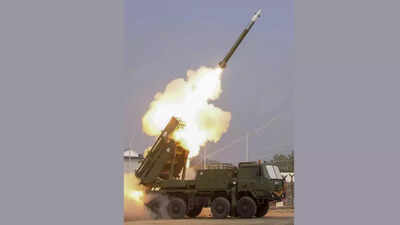

NEW DELHI: Defence Research and Development Organisation (DRDO) on Monday successfully conducted the maiden flight test of the Pinaka Long Range Guided Rocket (LRGR 120). It was conducted at the Integrated Test Range in Odisha’s Chandipur.“The rocket was tested for its maximum range of 120 km, demonstrating all in-flight manoeuvres as planned. The LRGR impacted the target with textbook precision,” reported news agency PTI.
Earlier, the day the Centre also cleared a fresh set of defence procurements worth around Rs 79,000 crore, giving the armed forces a significant boost in combat capability. The approvals were taken at a meeting of the Defence Acquisition Council (DAC), chaired by defence minister Rajnath Singh.According to the defence ministry, the council granted Acceptance of Necessity (AoN) for a range of equipment to be inducted by the Army, Navy and Air Force. The cleared proposals include loitering munitions for artillery units, low-level lightweight radars, long-range guided rocket ammunition for the Pinaka multiple launch rocket system, and the Integrated Drone Detection and Interdiction System Mark-II, among other systems.Importance of Pinaka The Pinaka Long Range Guided Rocket (LRGR 120) is an extended-range, precision-guided rocket developed for the Indian Army’s Pinaka Multiple Launch Rocket System (MLRS). The “120” denotes its maximum strike range of around 120 kilometres. Unlike earlier unguided Pinaka rockets, the LRGR is equipped with a guidance system that significantly improves accuracy, enabling it to engage targets such as enemy artillery positions, command nodes and logistics installations at long distances. The rocket is fired from the existing Pinaka launcher, allowing the Army to enhance capability without inducting a new launch platform.The LRGR 120 is part of India’s effort to increase indigenous, long-range precision firepower. Guidance is achieved through a combination of inertial navigation, with mid-course updates and terminal correction, reducing circular error probable (CEP) compared to earlier variants. The system provides the Army with a stand-off strike option, allowing targets to be hit from well behind forward areas, improving survivability of launch units. The rocket is intended for deployment across artillery regiments operating the Pinaka system, strengthening deep-strike and counter-force capabilities.