
In MP, a highway learns to slow down for tigers | India News
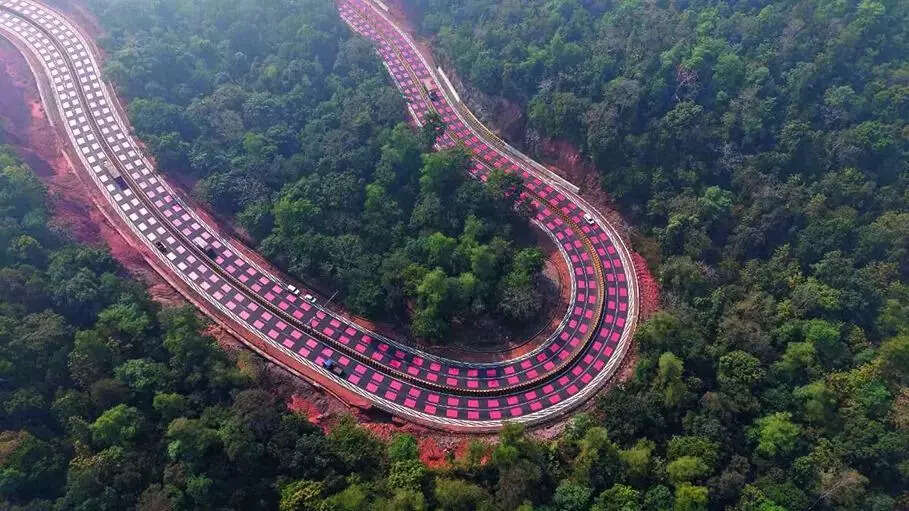
“To mitigate this risk, NHAI applied a 5mm thick red surface layer – the ‘table-top’ – over the road in the designated danger zone within the tiger reserve. The bright red texture signals to drivers that they are entering a wildlife-sensitive stretch and its slightly raised surface automatically reduces vehicle speed,” said S K Singh, regional officer, NHAI. “As per my knowledge, it is the first such concept implemented in the country,” he added.Officials involved in the project say the markings serve two purposes. Visually, they announce that the driver is entering a forest stretch where the rules of the road subtly change. Physically, they produce a mild vibration under the tyres, enough to encourage drivers to ease off the accelerator without the abrupt jolt of a speed breaker, which is considered unsafe on high-speed highways. The technique is widely used in other countries but has rarely been seen on Indian national highways, particularly in wildlife zones.Speed, conservation scientists have long argued, is the variable that determines whether an animal crossing a road is seen in time, and whether a driver has the distance needed to stop or swerve. Underpasses and fencing decide where animals cross; speed decides what happens when something goes wrong. On NH-45, the red-marked stretch is meant to slow vehicles gradually, well before they reach the points where animals are most likely to emerge.Below the road, the more conventional work has been done. Along the forest section, 25 wildlife underpasses have been built, their locations chosen on the basis of observed animal movement rather than engineering convenience. Continuous iron fencing runs on both sides of the highway, guiding animals towards these openings and preventing them from wandering onto the carriageway at random. Similar structures elsewhere in the country, including near Pench, have shown that when crossings align with natural routes, animals do use them, from ungulates to large carnivores.Former IFS officer and wildlife expert Jagdish Chandra said the red-road concept could make a significant difference. “There will be positive results. This is the first such project implemented in the country,” he said.