

Does cracking your knuckles make them bigger? Scientists finally settle long-standing myth |

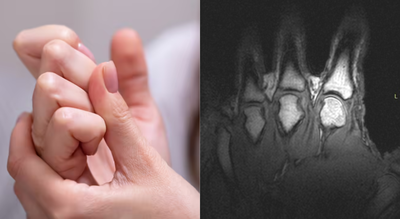
Nearly everyone who cracks their knuckles has heard the same warning at some point: keep doing that and your hands will grow, your joints will suffer, and arthritis will follow. The habit has long carried a reputation for causing damage, passed down more as certainty than question. Yet when scientists have actually examined what happens inside the joint, the story turns out to be far more specific, and far less alarming, than the myths suggest.
What causes the cracking sound
Researchers now agree that the sound produced when knuckles, toes or other joints crack is caused by gas, not bones grinding or cartilage snapping. A widely cited2015 studyused real-time MRI imaging to observe joints as they cracked, capturing the process as it happened rather than relying on theory alone.
The scans showed that when a joint is pulled or stretched, the pressure inside the joint space drops suddenly. Synovial fluid, the slippery liquid that lubricates joints, cannot fill the increasing space quickly enough. As a result, a gas-filled cavity forms inside the fluid. This process is known as tribonucleation, and the rapid formation of that cavity is what produces the distinctive popping sound.
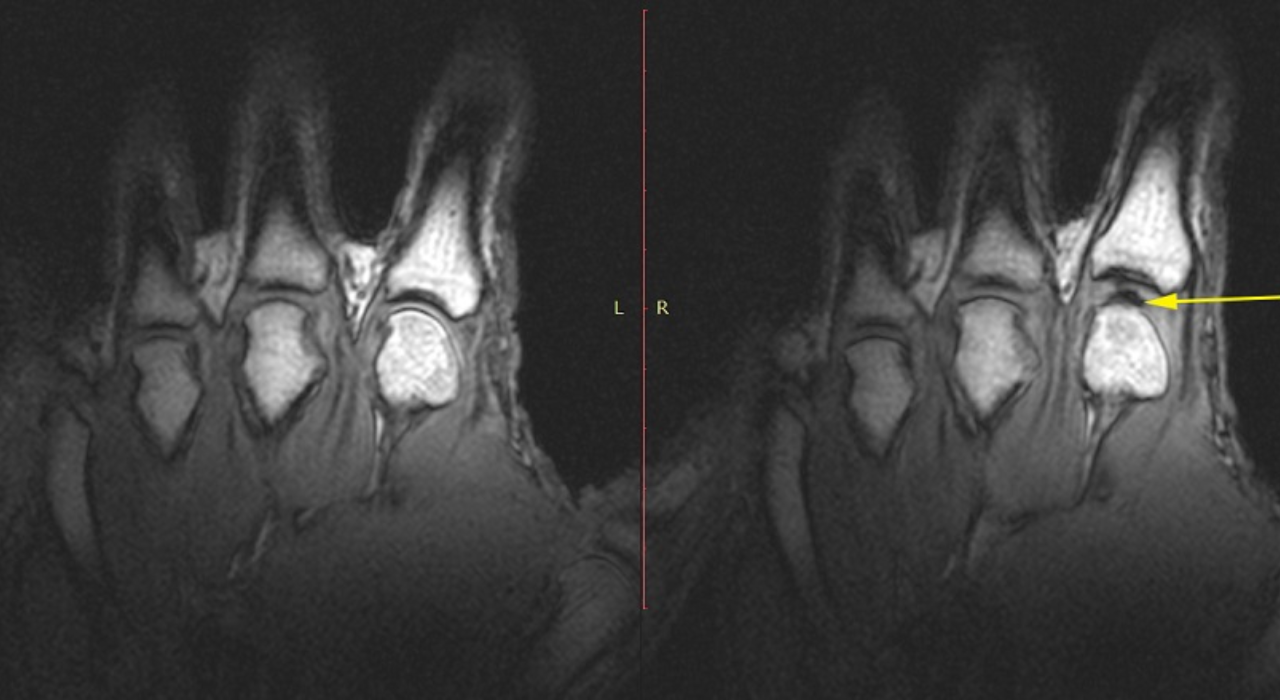
Side by side MRIs revealing a gas bubble forming as joints in the fingers are cracked (University of Alberta)
Greg Kawchuk, a professor in the Faculty of Rehabilitation Medicine at the University of Alberta, described the process in simple terms while speaking to Science Alert.“When you do that, you can actually see very clearly what is happening inside the joints,” he said.“It’s a little bit like forming a vacuum. As the joint surfaces suddenly separate, there is no more fluid available to fill the increasing joint volume, so a cavity is created and that event is what’s associated with the sound.”This finding overturned earlier theories from the 1970s that suggested the noise came from gas bubbles collapsing rather than forming.
Does cracking your knuckles cause damage?
Once the mechanism was understood, researchers turned to the more persistent fear: long-term harm. The idea that habitual knuckle cracking leads to arthritis or enlarged hands has been repeated for decades, but controlled evidence has not supported it.One of the most frequently cited examples comes from Dr Donald Unger, who decided to test the claim on himself. For 50 years, he cracked the knuckles of his left hand at least twice a day while deliberately leaving his right hand untouched. In 2004, he published his findings, reporting no difference between the two hands in terms of arthritis or joint health. The experiment later earned him an Ig Nobel Prize in Medicine in 2009 for its unusual but informative approach.Additional researchcomparing habitual knuckle crackers with non-crackers has produced similar conclusions. Studies measuring grip strength and cartilage thickness using ultrasound found no reduction in strength or structural damage among people who cracked their knuckles regularly, defined in some studies as five or more cracks per day.While the force involved in cracking a joint is substantial, scientists have calculated that it carries enough energy to damage hard surfaces under certain conditions, repeated cracking itself has not been shown to cause lasting joint injury.
Why the myths persist
Scientists have debated the source of joint cracking since at least 1947, when British researchers first proposed that vapour bubbles were involved. Conflicting explanations over the decades allowed myths to settle in more firmly than the evidence.What research does show is that joints need time to reset after cracking, which explains why the same knuckle cannot be cracked again immediately. The gas cavity must dissolve back into the synovial fluid before the process can repeat.Current evidence suggests that habitual knuckle cracking does not enlarge hands, thin cartilage, or cause arthritis. That does not mean joint pain should be ignored, but the sound itself, unpleasant to some, satisfying to others, is not a warning sign of damage.As with many everyday habits, the science turns out to be more precise and less dramatic than the folklore.