
Can AI help detect breast cancer early in India? | India News
India has the highest global mortality rate for breast cancer.This isn’t an outlandish claim, but reality backed by multiple studies across the globe. The studies spanned over decades, but India has remained the premier.With several campaigns running across the country, every camp set up for cancer screenings and everything that prompts people to take constant screenings seriously, the medical sciences are making progress towards tackling cancer early.
However, the numbers do not paint a positive picture. As per ICMR data cited by the government in a 2025 press release, “the estimated number of incidences of cancer cases was more than 14 lakhs in 2023 in India.”Every year, India records over 1.57 million new cancer cases, and this number is expected to rise. Over 70% of these cases are detected at late stages, as cited by CK Birla Hospital. Dr Monika Pansari, a surgical oncologist with 18 years of experience, states that most cancer cases in her career used to seek help only at a much later stage.“We used to see quite a few of advanced malignancies (cancerous growth), advanced cancers, cancers coming in stage III, stage IV. That used to be huge as far as breast cancer is concerned,” says the doctor.This makes treatment more challenging and lowers the survival rates. However, early detection can improve survival rates by up to 80% for some cancers.
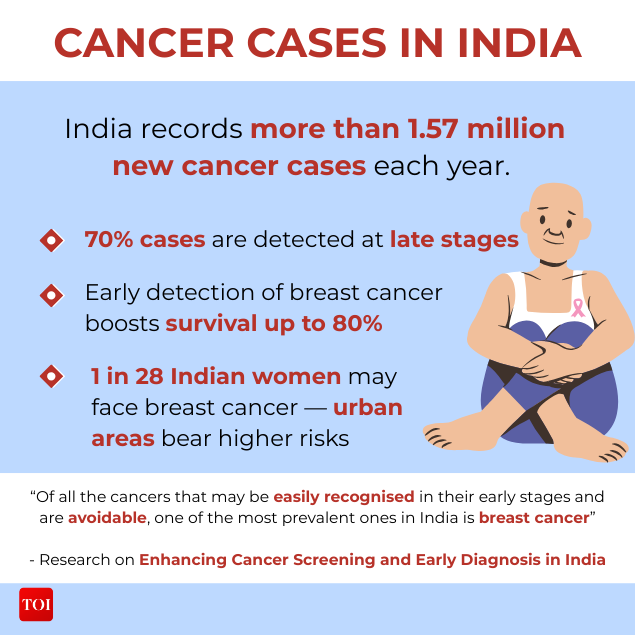
Cancer poses a serious threat to life, but it is not always irreversible. Several types are highly curable and even preventable when detected early.“Of all the cancers that may be easily recognised in their early stages and are avoidable, one of the most prevalent ones in India is breast cancer”, a research on cancer screening and early diagnosis in India said.Omega Hospitals, in its statistical analysis of breast cancer cases in Indian women, says that 1 in 28 Indian women may encounter breast cancer during their lifetime, with urban areas bearing a higher burden compared to rural regions.
Breast cancer detection advancements
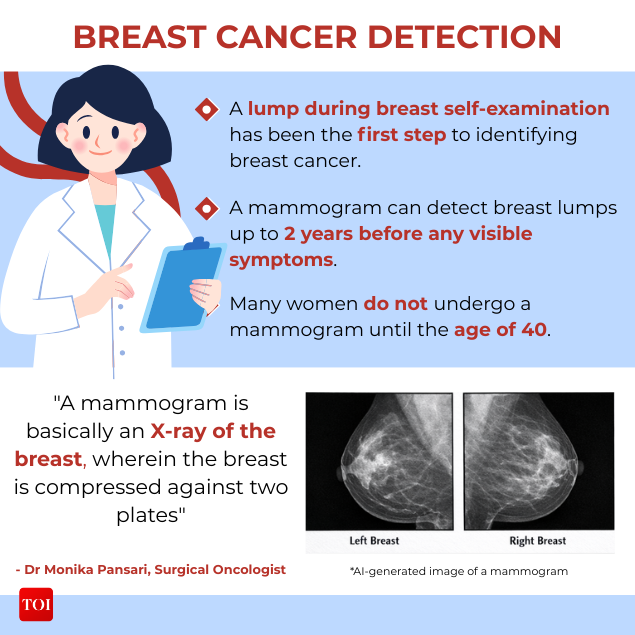
It is always better to look out for the symptoms. Through regular examinations and check-ups, the unfortunate instances of cancer developing in the later stages can very easily be avoided. Research shows that feeling a lump during breast self-examination has been the first step to identifying breast cancer. However, some procedures can detect breast cancer as early as 1-3 years before the lump is even felt, like a mammogram.CK Birla Hospital says that through a mammogram, breast lumps can be detected up to 2 years before the presence of any visible symptom. However, it says, many women do not undergo a mammogram until the age of 40.“A mammogram is basically an X-ray of the breast, wherein the breast is compressed against two plates,” explains Dr Monika Pansari.
Reflecting on the experience over the time of technological advancement in cancer detection technology, she says the improved quality of screening results has helped in the appropriate diagnosis of malignancy.“The quality of mammograms has changed, which used to be a film. Earlier, in the older days, what we used to get was just a film mammogram,” the doctor said, “Now, it has become digitalised, wherein obviously we can detect the cancer even if it’s very tiny, which was very difficult in earlier old mammogram machines.”She further goes on to explain other processes used for breast cancer detection, complementary to mammography.“For digital mammograms, there is something called tomosynthesis, wherein we do imaging of the breast, just like a CT scan, multiple slices of images are taken, wherein even if it’s a small, tiny tumour, which is maybe missed in the standard mammogram, can be picked up in tomosynthesis.”This goes on to show the massive progress medical sciences have made in tackling and screening cancer.
Importance of early detection
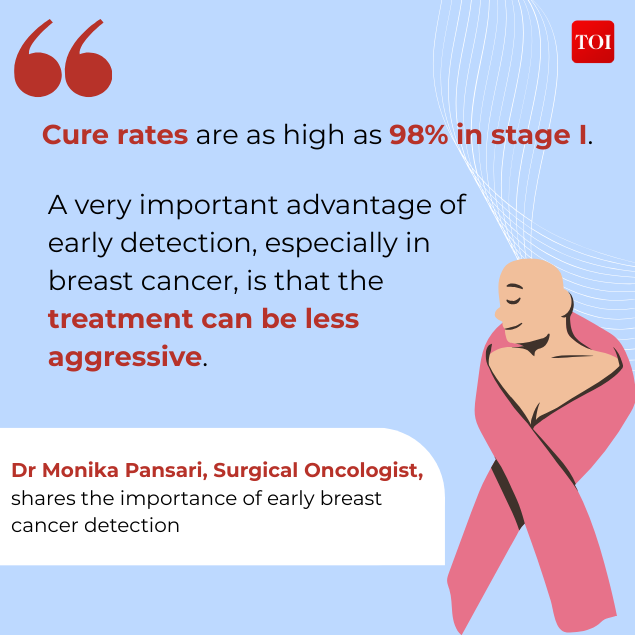
Dr Monika goes on to list out the importance of having check-ups as a vital part of one’s routine, as early detection increases the chances of getting rid of the cancerous cells with the least procedures to undergo.“Cure rates are as high as 98% in stage I. So later the stage, lower the cure rates,” she says, “If you talk about stage II, cure rates are a bit lower than stage I. Stage III again, cure rates will be a little less than stage II.”She further elaborates how Stage IV breast cancer, while it can be kept under control for years, takes a much longer time and harsher procedures. “For stage IV in breast cancer, we can keep the treatment going and keep the cancer under control for many years if it is a good or favourable type of cancer,” she says, underscoring the possibilities of elongated treatment durations.“A very important advantage of early detection, especially in breast cancer, is that the treatment can be less aggressive,” the surgical oncologist says, “For cancer treatment, we always offer surgery, chemotherapy and radiation.”However, she highlights, early detection could save the need for such procedures. “If we detect the cancer early, if the cancer is some favourable type of cancer, which in medical terms we say hormone receptor positive, there is a small possibility that they may not need chemotherapy.”Ignoring breast cancer until late not only elongates the trauma of the treatment on the body, but it can also lead to losing a crucial part of one’s identity. Dr Pansari, while talking about the benefits of early detection, pointed out how it can also help in “saving the breast.”“For females undergoing mastectomy, that is removal of the breast, is a very emotionally and functionally traumatising experience. Their body image perspective can change entirely should there be an instance,” she explains. “Patients who come to us with advanced malignancy. Obviously, we have to offer them a mastectomy in case it is difficult to preserve the breast.”
She further adds, “If the same patient undergoes screening regularly and if we pick up the cancer in early stages, then definitely breast conservation surgery can be offered, and that helps with their long-term mental well-being as well.”
Human-AI partnership for breast cancer detection
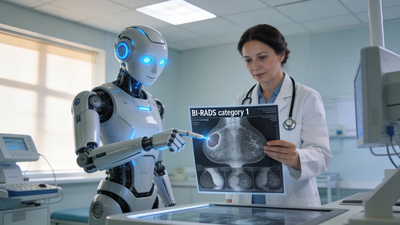
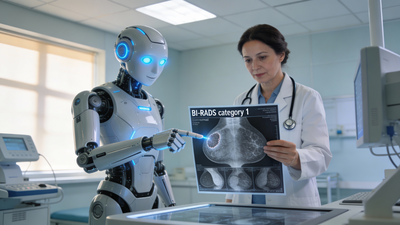
With the intervention of artificial intelligence, progress in methods of detecting cancerous cells is being made faster and more efficiently.As Cancer Research Institute puts it, “AI creates immeasurable efficiency when it comes to aggregating, recalling, and contextualising complicated datasets without the element of human error. In other words, with a few short prompts, advanced models can process irrationally large amounts of data, identify patterns, make predictions, and perform analyses that researchers would otherwise need to sleuth manually.”Despite the clarity and digitisation, about 20% of breast cancers are missed in the mammogram readings, studies by the US National Cancer Institute say. However, incorporating AI in the systems has improved the efficiency of detection.
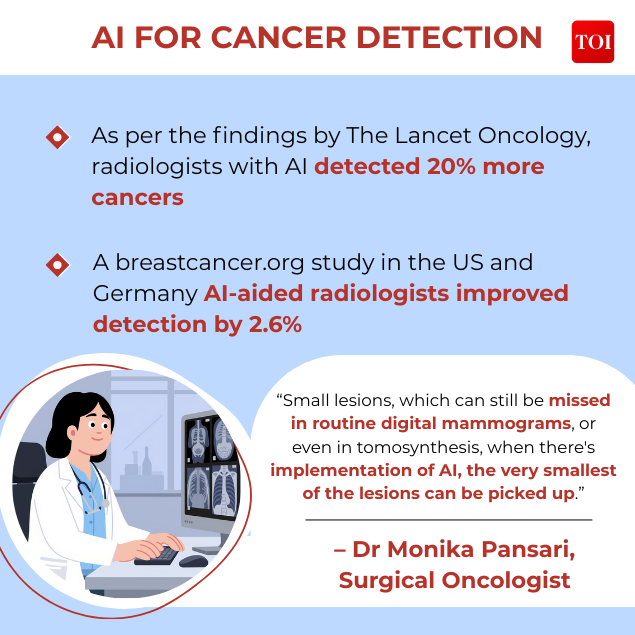
In Sweden, a study was conducted by The Lancet Oncology, where more than 80,000 women were screened through mammography. Half of the population had their reports read by a pair of radiologists, while for the other half, AI and one radiologist were paired together. As per the findings, the other half with an AI partner detected 20% more cancers than the first group.As per breastcancer.org, a separate study in the US and Germany showed that radiologists, when paired with artificial intelligence, detected cancer 2.6% better as compared to the radiologist working alone.Dr Monika, when asked about the impacts of AI being implemented in the Indian healthcare system for detecting breast cancer, goes on to support the chances of betterment in cancer detection.“It’s basically a software, there is a lot of data, which is there. So, small lesions, which can still be missed in routine digital mammograms, or even in tomosynthesis, when there’s implementation of AI, the very smallest of the lesions can be picked up. So that is how AI is going to help us in early detection,” says the oncologist.
AI for breast cancer detection in India
The intervention of AI is still in the testing phase, as Dr Pansari highlights, “It is still under evaluation. We have not yet started practising it in our day-to-day routine, regular life, but definitely, AI can help us.”The oncologist also expresses her optimism about getting the technology implemented in India soon, as she says, “research is on. Hopefully, we’ll have it all in a few days, a few months. Not days, maybe a few months or years.”“For anything to come into the medical practice,” the doctor says, “there’s a lot of validation, which happens because it is for public use. We cannot use it in our clinical practice until the trial and validation are done.”She further goes on to add, “It has got its own pros and cons. Until the time we complete the research and collect data, we cannot use it for the public. So that validation has to happen. And once it is all done, then we may start using it.”While AI hasn’t made its way into everyday medical practice, NIRAMAI (Non-Invasive Risk Assessment with Machine Intelligence), a startup based in Bengaluru, has developed a machine that uses heat to analyse and screen the presence of cancerous tissues in the breast.With the dawn of AI in cancer detection in India possibly breaking soon, the country stands at a crucial intersection of technology and public health. While traditional screening methods like mammography have significantly improved early diagnosis, their limitations underscore the need for smarter, more accessible solutions.