
National Mathematics Day: Why is it celebrated on Srinivasa Ramanujan’s birthday?
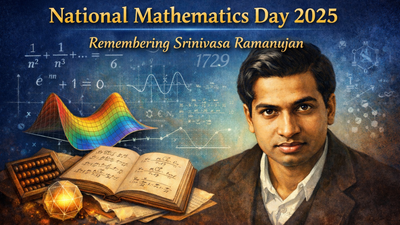
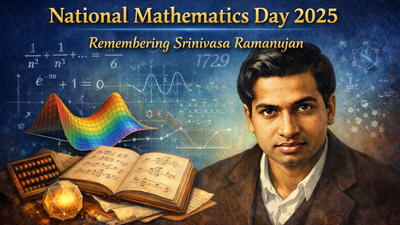
Every December 22, India celebrates National Mathematics Day as a comfortable tribute to Srinivasa Ramanujan: A genius remembered, a nation proud, a few school competitions, a poster or two. But Srinivasa Ramanujan is not a comfortable story. He is the rare kind of life that forces a blunt question on any education system: What do you do with a mind that does not behave like a “good student”, yet changes the subject itself?National Mathematics Day was formally announced in 2011 during celebrations marking Ramanujan’s 125th birth anniversary, when the then Prime Minister Manmohan Singh declared December 22 as National Mathematics Day and 2012 as National Mathematics Year.“We have gathered here today to celebrate the life and work of a great son of India and of Tamil Nadu, and one of the greatest mathematicians the world has seen. It is a pleasure to participate in this function in the memory of Srinivas Ramanujan, whose extraordinary genius so very brightly lit up the world of mathematics in the second decade of the last century. Men and women of such dazzling brilliance and deep intellect are born but rarely. Indeed, Srinivas Ramanujan’s genius was ranked by the English mathematician G. H. Hardy in the same class as giants like Euler, Gauss, Archimedes and Isaac Newton. While we rightly claim Ramanujan as one of our own, he equally belonged to all humanity like the other great men and women in any sphere of human thought,” said Singh during the 125th birth anniversary celebrations of Srinivasa Ramanujan, held in Chennai on December 26, 2011.
The education that made Srinivasa Ramanujan and almost broke him
Ramanujan was born on December 22, 1887, and his early schooling took place in Tamil Nadu with the family moving between places like Erode, Kumbakonam, and Madras/Chennai as circumstances changed.The version we often repeat — no formal training — is true in spirit but lazy in detail. Ramanujan did go through the ordinary school route. What he didn’t have was the kind of structured, higher-level mathematical training Cambridge students took for granted.The pivot point came when he was a teenager: He got hold of G.S. Carr’s Synopsis of Elementary Results in Pure and Applied Mathematics — a compendium of thousands of theorems, often presented with minimal proof. For most students, it would have been a reference book. For Ramanujan, it became a private laboratory. He verified results, extended them, and began writing mathematics the way other people write diary entries: daily, urgently, and with a feeling that the page might not keep up. In 1904, after finishing school with distinction in maths, he entered Government Arts College, Kumbakonam on scholarship and then the classic Ramanujan pattern asserted itself. He was brilliant at what he loved, indifferent to what he didn’t. He neglected other subjects, failed to meet the system’s all-round expectations, and lost the scholarship.He later studied at Pachaiyappa’s College in Madras (now Chennai). Again: Strong in mathematics, poor elsewhere; he attempted only questions that interested him, and he failed the “Fellow of Arts” examinations (a key qualification then), effectively leaving him without a formal degree.Ramanujan’s “lack of university education” was not romantic minimalism. It was a structural mismatch. The curriculum demanded breadth but his mind demanded depth.
Srinivasa Ramanujan: A clerk by job title, a mathematician by compulsion
By his early twenties, Ramanujan was producing serious mathematics in near-poverty. He sought patrons and recognition in Madras’ mathematical circles, published early work in the Journal of the Indian Mathematical Society, and began attracting attention locally. In 1912, he obtained clerical work at the Madras Port Trust which is where his life begins to read like a plot twist. The man doing accounts in the day was doing number theory at night, as if sleep was an unnecessary luxury.
Ramanujan’s letter to Hardy
On January 16, 1913, Ramanujan wrote to G.H. Hardy at Cambridge, introducing himself not as a prodigy, not as a scholar, but as a clerk: A man with “no University education” who had been working at mathematics in his spare time.What followed in the package wasn’t an essay, or a careful explanation. It was pages of results — identities, series, claims about prime numbers and special functions — often without proof. To Hardy, who had seen plenty of crank correspondence, it initially looked suspicious. Britannica notes Hardy’s first reaction as incredulity at Ramanujan’s unorthodox methods and missing proofs.But here’s the hinge: Even without proofs, mathematics had a certain fingerprint. Hardy later wrote about a cluster of formulas he received. They “defeated” him, he mentioned, adding he had “never seen anything in the least like them before.” That is not praise. That is a professional recognising a peer.Hardy didn’t just reply with compliments. He asked for proofs, pushed for conventional presentation, and began a correspondence that became both mentorship and translation: Hardy demanding structure, Ramanujan delivering brilliance in raw form.Hardy then helped arrange support that would allow Ramanujan to leave India and work in England including institutional backing that enabled him to join Trinity College, Cambridge.And recognition followed: Ramanujan was elected a Fellow of the Royal Society in 1918. He was the first Indian Fellow of Trinity College, Cambridge. The letter worked because it wasn’t a plea. It was evidence. Ramanujan didn’t argue that he was gifted. He sent mathematics that made it hard to dismiss him.
National Mathematics Day: What exactly did Ramanujan contribute?
Ramanujan’s legacy often gets flattened into a listicle: “number theory, infinite series, partitions.” True, but the real story is how those words became modern research highways.According to Britannica, he made groundbreaking contributions to number theory, mathematical analysis, infinite series, and especially the partition function (how numbers can be expressed as sums of positive integers).
- Partition function and asymptotics: Ramanujan’s work (notably with Hardy) reshaped how mathematicians estimate the growth of partitions, a result that became foundational in analytic number theory and beyond.
- Infinite series, continued fractions, and special functions: He produced identities and evaluations that were not merely “clever”; they became tools other mathematicians could build on, especially in areas linked to modular forms and q-series.
- Methods that arrived before their justifications: He often discovered first and proved later (or left proofs implicit). This is precisely why Hardy’s insistence on proof mattered: It turned private insight into public mathematics.
- The “mock theta” turn: This was Ramanujan’s late-life discovery of mock theta functions, a new class of mathematical objects he described in his final letters and notebook pages. At the time, they looked incomplete and mysterious because they behaved like classical theta functions but did not fully fit existing definitions. Decades later, mathematicians realised these ideas were foundational to modern number theory, with applications extending into mathematical physics and string theory.
National Mathematics Day: Significance of celebrating this day
National Mathematics Day matters because it asks India to stop treating maths like a fear test and start treating it like a life skill. For many students, mathematics becomes a source of stress — a subject to “clear”, not to understand. This day tries to reset that relationship. It reminds schools, parents and policymakers that mathematics is not just for engineers or toppers, it sits quietly behind how the modern world works — from budgeting at home to building apps, from medical research to economic policy.It also flags a bigger national concern: when fewer students pursue maths deeply, the country ends up short of strong mathematicians, good teachers and serious research. That shortage doesn’t stay inside universities; it shows up in innovation gaps. National Mathematics Day, at its best, is an annual nudge: nurture curiosity, reward reasoning, and make mathematical thinking aspirational again.