
The original ‘Little Master’: Hanif Mohammad, Pakistan’s first great Test batter | Cricket News
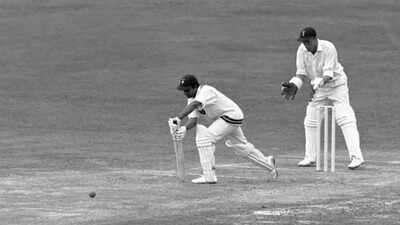
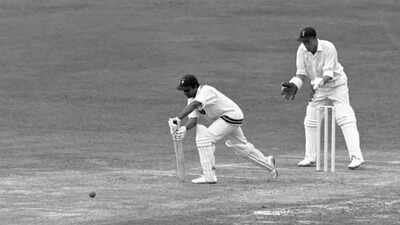
Even before Pakistan had Imran Khan, Wasim Akram, Javed Miandad, or Shoaib Akhtar, it had Hanif Mohammad. Pakistan’s first great cricketer did not announce himself with power or speed, but with time. Lots of it. He built a team around the idea that you could refuse to lose.Hanif was Pakistan cricket’s first true star. At a time when the country was new and still finding its voice, he gave it one through the bat. His feats, heard across Pakistan on radio, took the game out of drawing rooms and college grounds and into streets, maidans, and homes. Cricket stopped being a pursuit of a small, educated elite and became a sport for everyone.
Hanif Mohammad was born in 1934 in Gujarat, in undivided India. After Partition, his family moved to Pakistan, and so did his cricketing future. Hanif played 55 Tests, including Pakistan’s first against India in 1952. He played for Pakistan across a career that lasted 17 years, scoring 3,915 runs at an average of 43.98. Those numbers matter, but they only tell part of the story. Hanif’s true value lay in what he represented and how he played.He was called the “Little Master”. He stood 5 feet 3 inches tall. When he first appeared in top-level cricket, he looked younger than his age and smaller than most around him. When he walked out to bat at Lahore in November 1951, during the first unofficial Test between Pakistan and MCC, he was only 16. It was his first-class debut.“He looked about 12, Brian Statham said, as cited by Wisden in its obituary of Hanif. By the end of the day, the joke had worn thin. Hanif made 26 in 165 minutes. In the very next match, he batted for over four hours to score 64 as Pakistan chased 288. That innings, quiet as it was, changed things. Eight months later, Pakistan were granted Test status.With Abdul Hafeez Kardar as captain and Fazal Mahmood leading the attack, Hanif was the one who held the innings together. Time and again, he stood between Pakistan and defeat, building long innings based on defence, judgment, and discipline.Nothing defines him better than the innings that still stands alone in cricket history. Bridgetown, 1957–58. Pakistan were touring the West Indies. West Indies made 579. Pakistan collapsed for 106 on the third day of what was a six-day match, and were asked to follow on, trailing by 473. Defeat was not a question of “if”, only “when”.Hanif reached 61 on stumps on Day 3, having endured Roy Gilchrist’s short-pitched assault, he chose not to hook. Over the next three days, Hanif batted. And batted. He added exactly 100 on the fourth day as Pakistan lost just one wicket. On the fifth day, he defied pain from thighs bruised by Gilchrist, and sunburn that caused the skin under his eyes to peel away. During intervals he would sit in a corner of the dressing room and eat a piece of chicken. By stumps he had 270, and Pakistan a small lead. He scored 337, batted for 970 minutes, and shared century partnerships with four players, including his brother Wazir. Pakistan declared on 657 for 8. The match was drawn. Hanif’s innings remain the longest individual innings (by minutes) in Tests.A year later, Hanif showed that this was no one-off. Playing for Karachi against Bahawalpur in 1959, he scored 499 in a first-class match. It was the highest first-class score at the time. He was run out in the final over while trying for his 500th run. The record stood for 35 years, until Brian Lara made 501 for Warwickshire.That reputation sometimes reduced him to a caricature, but Hanif was more than a blocker. He could attack when required and is often credited as the originator of the reverse sweep. His skill set was wide. He captained Pakistan, kept wicket, and even bowled right- and left-handed in Test cricket. Yet, above all, he was a master of one thing: staying in.Hanif’s career was not without lean phases. His 1962 tour of England brought his first sustained run of low scores. He managed 177 runs in the series at an average of 17.70, with a highest score of 47. Five years later, nearing his mid-30s, he returned to England with a point to prove. English fast bowlers thought the short ball would trouble him. John Snow tested him repeatedly. Hanif answered with 187 not out in the first Test at Lord’s. It took 556 balls and the match was drawn. By the late 1960s, consistency became harder to maintain and Hanif decided to step away. He finished with 12 Test centuries and 15 fifties. His average, once above 47, settled at 43.98. He scored Test centuries against all opponents away from home, dismissing any idea that he was dependent on home conditions. His away average of 42.62 was close to his overall average in Tests.Hanif was also part of one of cricket’s most remarkable families. Three of his brothers — Wazir, Mushtaq and Sadiq — played Test cricket. Another brother, Raees, was once Pakistan’s twelfth man. In 1969–70, Hanif, Mushtaq and Sadiq played together against New Zealand at Karachi, Hanif’s final Test, echoing the Grace brothers’ feat for England in 1880. At least one brother featured in Pakistan’s first 89 Tests. His son Shoaib later played 45 Tests.Hanif Mohammad passed away on August 11, 2016, in Karachi, aged 81 years and 234 days. By then, Pakistan cricket had seen fast bowlers who terrified batters, captains who won world titles. But before Pakistan learned how to win, it learned how not to lose. That lesson came from Hanif Mohammad, who was born on this day (December 21) in 1934.