

AI boom or bubble? Is the AI bet driving US growth into risky territory; Ruchir Sharma explains
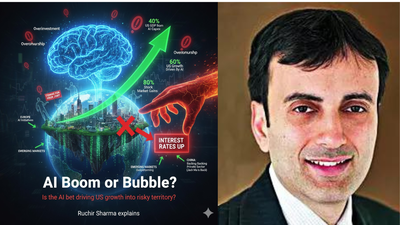
The global economy has entered a phase where artificial intelligence has become the dominant force shaping growth, markets and policy, with the US now the most exposed to both its promise and its risks, according to economist and investor Ruchir Sharma.“This big factor has out-Trumped Trump – AI,” Sharma said in a conversation with Nicolai Tangen, earlier on December first week, arguing that artificial intelligence has now become “the singular focus of the global economy and particularly the US economy”.
Ruchir Sharma, chairman of Rockefeller International and founder and chief investment officer of Breakout Capital, is a veteran global investor and economic commentator.“The US economy has now become one big bet on AI,” he said. “Outside of AI, there’s a lot of weakness in the US economy. But AI has continued to drive everything.”Sharma warned that the scale of this concentration leaves little margin for error. “This big bet on AI better works out for America,” he said. “Because if it doesn’t work out, then I think that there’s a lot of trouble for this country ahead.”
AI now dominates US economic growth
Veteran analyst pointed to the growing contribution of AI-linked capital expenditure to US growth. “The measures currently show that about 40% of economic growth in America this year has come from capex spending towards AI,” he said.Beyond investment, he stressed the importance of the wealth effect. “The stock market doing well, the financial assets doing well — that is clearly powering the spending of the top 10% in this country,” Sharma said. “And the top 10% is what’s driving the entire consumer spending.”He added that market gains themselves are heavily concentrated. “About 80% of the gains in the stock market this year have been powered by AI plays,” he said.“By some measures, you can argue that about 60% of economic growth in America today is being driven by AI.”
Productivity gains remain uncertain
Despite the scale of investment, Sharma said it is still too early to see decisive productivity gains from AI. “AI adoption is still in its nascent stage,” he said. “So far, it’s too early.”Asked how much of recent productivity improvement can be attributed to AI, Sharma replied, “Very little as yet.”Drawing a comparison with the internet boom, he said, “If you look back at the internet revolution in the late 1990s, the big bump in productivity really happened later. It takes a while for these benefits to come through.”He also said there is still uncertainty about how AI will ultimately be used. “We don’t even know as yet what exactly AI is going to end up doing,” Sharma said.
‘The most hated tech revolution’
The author of What Went Wrong with Capitalism, Ruchir Sharma argued that AI differs from past technological revolutions because of widespread fear rather than optimism.“This is the most hated tech revolution,” he said. “If you look back at the other big revolutions, people were very optimistic about what it would bring.”By contrast, Sharma said surveys show deep anxiety. “Only about 35% of people are feeling good about AI,” he said. “Most people want this to be regulated because they’re fearful about the impact.”“One, all the techno-optimists are telling them, ‘We’re coming for your job.’ And second is just fear — people don’t know how to use these tools,” he added.
Bubble signals are flashing
While calling AI a “good bubble”, Sharma said the market displays multiple warning signs.“I look at the four O’s,” he said — “overinvestment, overvaluation, overownership and overleverage.” On investment, he said, “Tech investment as a share of GDP is about 5% today. That’s roughly what we saw back in 2000.”On valuations, Sharma said, “By any stretch, the US stock market — and of course the AI plays — are overvalued.” While price-to-earnings ratios may not match dotcom levels, he said, “If you look at price to free cash flow or very long-term earnings, by those measures we are getting there.”Overownership is also visible. “Americans have about 52% of their financial wealth in equities today,” Sharma said. “That is higher than what it was even in 2000.”On leverage, he said conditions are changing fast. “The biggest issuers of debt in the last few months have been companies like Meta, Amazon and even Microsoft,” Sharma said, as firms rush to stay ahead in the AI arms race.
Interest rates are the real trigger
Sharma said bubbles rarely burst because of technology disappointment alone.“Every single bubble or mania in history has been pricked by just one factor — when interest rates finally go up,” he said.He expressed concern about the Federal Reserve’s policy stance. “Inflation is already quite sticky,” Sharma said. “The Fed’s 2% target is nowhere in sight. The Fed has missed its 2% target for five years in a row.”“The fact that the Fed is cutting interest rates in this environment is completely bewildering to me,” he added.If inflation accelerates or rates rise, Sharma warned, “That’s when this entire overinvestment AI bubble will burst.”
Global markets rotate away from the US
Sharma said one of the biggest surprises this year has been the underperformance of US markets relative to Europe, emerging markets and China.“At the beginning of the year, everyone was onto the American exceptionalism trade,” he said. “Instead, Europe, emerging markets and China have outperformed America.”He said extreme positioning played a role. “America’s weight in global equity indices was hitting nearly 70%,” Sharma said.But reforms also mattered. “In Europe, expectations were very low, but at least countries like Germany began to wake up and say, ‘We need to do something here’,” he said.
China’s private sector pivot
Sharma said China’s market rebound reflects necessity rather than ideology.“The economy in China is in big trouble outside of AI,” he said. “The property market is bust.”He said Beijing realised that competing with the US on AI required a shift. “There was a very important pivot,” Sharma said. “China realised that if we have to compete with America on AI, we need to back the private sector again.”“Jack Ma is back at Alibaba,” he noted, adding that the stock has doubled this year.
Government power and tariffs
Sharma said the expanding role of the state continues to distort capitalism.“The asymmetry remains,” he said. “On the upside, you capitalise the gains. On the downside, the risks are socialised.”On tariffs, he said, “There’s no objectivity or science behind it. It’s very arbitrary.”While tariffs have helped revenues — cutting the US deficit by about 1% of GDP — Sharma said, “Tariffs have had a negative effect on economic growth. It’s just been offset by the optimism around AI.”
Quality stocks offer a contrarian opportunity
Looking ahead, Sharma highlighted quality stocks as a neglected opportunity.“The last 12 months have been one of the worst runs that quality stocks have had in recorded history,” he said.“There has never been a better time to buy quality stocks,” Sharma added, referring to companies with high returns on equity, low leverage and strong cash flows.He also expects global markets to continue outperforming the US. “These tend to be multi-year trends once they begin,” he said.While he declined to predict exact timing, Sharma offered a clear signal to watch: “At the slightest sign that interest rates are going to go up — that’s when you know this is done.”