From Lalbagh mornings to gallery walls: Bengaluru’s long love affair with art | Bengaluru News
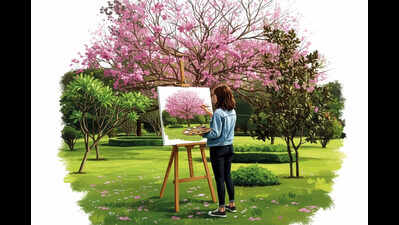
For generations of fine artistes, Bengaluru has never been just a city to live in — it has been a city where they became who they are. Long before galleries and curated spaces emerged, the city offered something rare: the time and freedom to observe, absorb and create. In a walk down memory lane with M S Murthy, Gurudas Shenoy and S G Vasudev, Bengaluru emerges as a place that shaped artists and allowed them the space to simply be.‘At dawn, the city became a classroom for artists’ Veteran artiste M S Murthy, born and raised in Bengaluru, remembers a city that moved at a gentler pace and quietly nurtured creativity. As a fine arts student, his days often began at Lalbagh. “By six or seven in the morning, professors from other institutions would already be there. It was such a peaceful space to observe, sketch and learn,” he recalls. That atmosphere, Murthy believes, shaped not just his technique but his artistic temperament.
Bengaluru never rushed artists; it gave them time and allowed them to grow at their own pace
M S Murthy
‘Impossible not to fall for a city that is an artist’s paradise’ For painter Gurudas Shenoy, it was love at first sight when he first came to Bengaluru from Udupi. Arriving for an exhibition at the Venkatappa Art Gallery, he recalls stepping out onto Kasturba Road at around 6.30 am. “It was October, birds were calling, and that beautiful Victorian building stood quietly in front of us,” he says. “That moment stayed with me. I felt this was not just a garden city — it was an artist’s city.”
I have never stopped being inspired by Bengaluru; it has consistently served as my muse
Gurudas Shenoy
‘The city was our canvas’ For Murthy, neighbourhoods like Malleswaram and Basavanagudi represented the cultural heart of the city. “Drama, music and art flowed through these areas,” he says, pointing to Ravindra Kalakshetra as a landmark that captured the city’s artistic spirit. “For a long time, it was the only place where serious performing arts came together under one roof,” he adds. Gurudas remembers Bengaluru as a city that never belonged to a single centre, but to many neighbourhoods — from KR Market to MG Road. “Every place had its own character,” he says, adding, “The city felt like a living canvas.”‘Bengaluru’s potential inspired us to work on an art ecosystem’As decades passed, Bengaluru’s art scene began to take shape, and S G Vasudev was central to this shift. From Chitrakala Parishath and Kalamandir to the early galleries on MG Road, dedicated spaces emerged. “We felt Bengaluru had the potential of a city like New York,” he says, adding “Everything seemed possible — with some effort.” In the late 1980s, Vasudev focused on strengthening the city’s cultural foundations. He played a key role in starting the Fine Arts Department at Bangalore University, and later helped initiate platforms such as Ananya Drishya and Art Park, bringing artistes and the public closer together.
This city allowed me to move freely between art, literature, cinema and education
S G Vasudev
The power of the audienceWhat continues to work in Bengaluru’s favour, Vasudev believes, is its audience. “Musicians, dancers, artists — they all say Bengaluru is more receptive,” he notes. Murthy echoes the sentiment. “The city always gave space to different art forms, languages and ideas. People showed up for curiosity,” he says. Shenoy adds, “This city has always been rich — culturally, creatively and emotionally. As long as that spirit survives, Bengaluru will remain a paradise for artists.”Institutions that shaped the art scene in Bengaluru
- Venkatappa Art Gallery (est. 1975) was one of the earliest state-backed spaces to foreground modern Indian art in Karnataka.
Karnataka Chitrakala Parishath , founded in 1960, became a rare public-facing art complex with studios, galleries, and affordable exhibitions — unusual for Indian cities at the time.- Ravindra Kalakshetra, inaugurated in 1967, became Bengaluru’s first major integrated cultural space for theatre, music and dance.
From modest beginnings to collector demandBengaluru’s art market is known for depth rather than spectacle, with collectors often investing in long-term practice rather than rapid turnover. Works by well-known Bengaluru artists today span a wide price spectrum, typically costing collectors anywhere between Rs 4 lakh and Rs 1 crore or more, depending on the artist, medium, scale and period of the work. What were once modestly priced paintings in the 1980s and ’90s have steadily appreciated over time, as sustained practice, institutional recognition and growing collector confidence reshaped valuations. At the same time, the city has remained accessible to new buyers — emerging artists at platforms such as Chitra Santhe sell works from as little as Rs 2,000 to Rs 50,000, while prints and drawings by senior artists are often available in the Rs 50,000 to Rs 2 lakh range. Mid-career Bengaluru artists typically fall between Rs 3 lakh and Rs 10 lakh, reinforcing a market that grows organically, rewarding patience, continuity and artistic legacy. Lalbagh and Cubbon Park functioned as informal open-air studios for decades. Art students from institutions like Karnataka Chitrakala Parishath, Ken School of Art, and National College regularly sketched here well before formal studio hours. Early-morning park culture played a major role in nurturing observational drawing among Bengaluru artistes.Note: The prices mentioned are indicative and approximate, based on inputs from art curators and collectors